The listing is built, the catalogue synced, the stock uploaded. The video is missing, and everything stops there. A Spanish seller arrives at TikTok Shop with Amazon reflexes, prepares a white-background photo and a bullet list of features, and finds out that nobody on that listing is looking at either.
What a video does on a TikTok Shop listing
In a classic catalogue, the image documents the product. Here the video does something else: it stands in for the person who, in a physical shop, would put the thing in your hands.
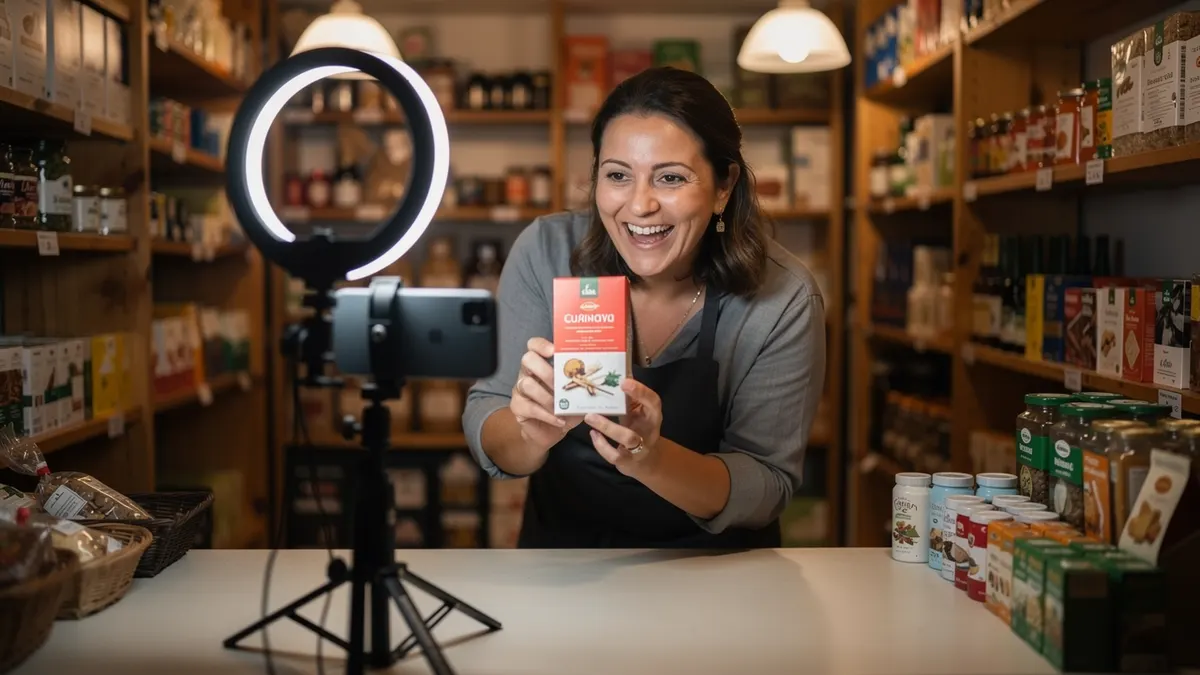
That changes what has to be filmed. It is not about showing the object from six angles, it is about showing someone using it, somewhere real, with their hands inside the frame.
The practical consequence
A video with no person in it underperforms on this surface, however cleanly it is lit. This is not a matter of taste: the listing is opened from a video in the feed, and the visitor arrives looking for the continuation of what they just watched.
Hence the rule that governs everything else: the listing video is produced with the same creator, in the same session, as the video that drives the traffic. Splitting them doubles the cost and breaks the continuity.
The three videos a listing asks for
| Video | Useful length | What it has to show |
|---|---|---|
| Opening | 15 to 25 seconds | The person unboxing and reacting, product recognisable in the first three seconds |
| Real use | 25 to 40 seconds | The complete gesture, with no cut hiding the difficult part |
| Answer to the doubt | 20 to 30 seconds | The specific objection that blocks the purchase, said out loud and answered |
The third is the one almost nobody commissions and the one that works hardest. A listing gets visits from people who are already interested but hold one concrete reservation: the size, the battery life, whether it stains, whether it fits. A video that names that reservation converts better than one repeating the good points.
The first two resemble what is already produced for the feed, whereas this one only exists if somebody has bothered to read the questions arriving at customer service.
What does not need filming
Product shots rotating on a neutral background, captions listing the specifications, epic music. All of that is already on the listing as text and image, and repeating it on video spends the seconds that count.
Who publishes: the brand, the creator or the affiliate
All three routes exist, none is contracted the same way, and this is the most expensive confusion a new seller runs into.
From the brand account. The video is an owned asset. It requires a written assignment of rights from the creator who appears in it, with media, territory and term. Without that document the brand owns a file it cannot use.
From the creator account. The video lives on their profile and the brand does not control it. It is the most credible format and the most fragile: if the creator deletes the post, the link dies.
Through affiliation. The creator publishes and earns a commission on attributed sales. There is no assignment of rights by default, because there is no commission in the editorial sense: there is a commercial relationship. If the brand wants to reuse that video on its own listing or in advertising, that is negotiated separately and signed separately.
The practical difference between the three is not the price, it is what is left at the end. The first leaves a file usable for years; the second leaves a post that depends on a third party; the third leaves sales and nothing else. A brand building a video catalogue needs the first, even if it starts with the third.
The mistake that repeats
Assuming the affiliate commission pays for usage rights. It does not. An affiliate creator has agreed to sell, not agreed to have their face in the brand's advertising for a year.
What the platform rejects
A video can be uploaded and then quietly disappear from the listing. The most frequent causes are predictable and avoidable:
- Watermarks from another network, which give away a recycled video.
- Result claims the listing cannot support, above all in cosmetics and supplements.
- Prices or promotions said out loud, which go stale and contradict the listing.
- Music taken from the general library instead of the commercial one.
The fourth is the one that most often takes down a whole campaign, because it hits every video of the session at once and is discovered late.
The first three are fixed in the edit. The fourth is not: if the session was shot against a general-library track, every piece has to be re-cut, and sometimes the one cut to the beat has to be reshot.
What to write in the brief
Everything above fits on one page, and that page is what prevents the second shoot.
The product and its doubt. What gets filmed and, above all, which concrete objection has to end up answered. Without that line the creator improvises praise.
The three pieces and their lengths. With the note that they come out of one session, not three commissions.
Where the audio comes from. Commercial library or a track supplied by the brand. Never "whatever fits".
The assignment of rights. Media, territory and term, written before the shoot and not after seeing the result.
The advertising disclosure. With its exact Spanish wording, so it does not depend on the creator's judgement on a Sunday night.
Why it is written before, not after
A brief written after the shoot only documents what can no longer be changed. The five points above take ten minutes to write and save the awkward conversation where the brand asks for something it never asked for.
Advertising disclosure in Spain
A commissioned, paid video is advertising, and advertising has to be identifiable as such. In Spain that is not a platform recommendation: Law 34/2002 requires commercial communication to be clearly identifiable, and the sector code of conduct held by Autocontrol sets out how that works in creator content.
In practice, three things: the disclosure goes in the video itself or in the visible text without expanding it, it goes in Spanish, and it goes at the start rather than the end.
What does not count as disclosure
A hashtag lost among fifteen others. A label only in English. A mention appearing at second forty of a forty-five second video. None of the three meets the requirement of clear identification.
Sources
- TikTok Shop, seller centre in Spain
- Law 34/2002 on information society services and electronic commerce
- Autocontrol, advertising industry codes of conduct
- Organic Law 1/1982 on the protection of the right to one's own image
Checked on 8 September 2026. This guide is not legal advice. Where this guide and the official source disagree, the source prevails.