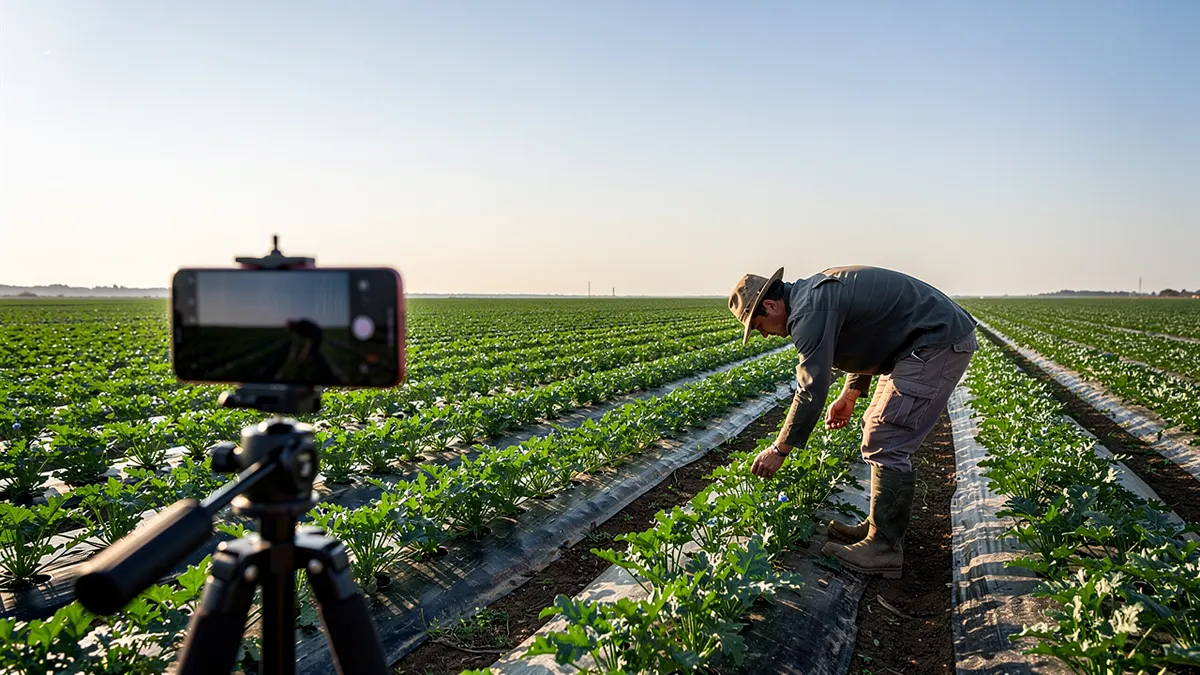
An immense sector almost nobody films. Here is what producers, suppliers and exporters really need video for.
What producers need
Four uses, all immediate.
The demonstration of a machine before purchase: what it really does, at what speed, with what maintenance.
Team training: setting a machine, dosage, safety, repetitive gestures.
Direct selling: more and more farms sell part of their production with no intermediary, and video replaces the visit.
And seasonal recruitment: showing the real working conditions attracts better than an advert.
One note from the field: those videos are not aimed at the general public. They are watched on a phone, often on a weak connection, by somebody looking for a precise piece of information.
Input suppliers are the most regular clients
Three economic reasons.
Their sales cycle follows the season, which produces a recurring and predictable content need.
Their argument is technical, and a video shot in the field is worth more than a brochure.
And their distribution network needs the same material, adapted by region and by crop.
Three formats that sell well: the field demonstration, the testimony of a producer using the product for two campaigns, and the correct-application video, which reduces dosage errors and therefore complaints.
One mandatory precaution: claims about yields, effects and safety are regulated, and are checked with a lawyer before the shoot.
The season is the calendar
Three consequences for organising production.
The shoot does not move: a field operation is filmed on the day it happens, or not at all.
Orders are placed months ahead, which is unusual for a creator coming from general-public content.
And a single missed season costs a year, because the next crop does not arrive before then.
One arrangement that works: draw up a shooting calendar by crop and by region, and have it approved at the start of the campaign. That document becomes the strongest commercial argument with a supplier.
Filming in the field is another trade
Five concrete constraints.
The light is harsh for much of the day, which means shooting early or late.
Wind makes the sound unusable without a lapel microphone and a windshield.
Dust damages equipment, and means changing lenses as little as possible.
Distances are long: a shooting day covers two farms, rarely more.
And the connection is weak: files are transferred in the evening, from town.
One pricing consequence: this work is invoiced by the day, travel included, never by the video.
What is filmed on an equipped farm
| Subject | What it proves | Constraint |
|---|---|---|
| The sensor in place | The real installation | Access to the field |
| The monitoring screen | Data observed on a given day | No customer data visible |
| The operator's gesture | The daily use | Safety around machinery |
What is prepared with the farmer
The hour of real work, access to the fields, the mandatory equipment, an escort and the consent of those filmed.
What is never claimed without a document
A yield gain, an input saving or a battery life. Those figures are proven by a documented trial, to be confirmed with the manufacturer and the farmer.
Who should speak
Three choices, in order of credibility.
The person driving the machine or applying the product: they describe what they do, in their own words.
The farm's technical manager, who talks figures, dates and conditions.
And the supplier's engineer, last, to clarify a technical point, never to carry the testimony.
One detail changing everything in this sector: giving the full context in the first seconds, crop, area, region, date. Without those four pieces of information, a professional considers the video is not about them, and they are right.
One last marker for export: foreign buyers now ask for evidence of traceability and working conditions. A video shot on site, dated and archived, becomes a commercial document, not only a communication asset.
Sources
Checked on 4 September 2026. Thresholds and rates change: where this guide and the official source disagree, the official source is right.