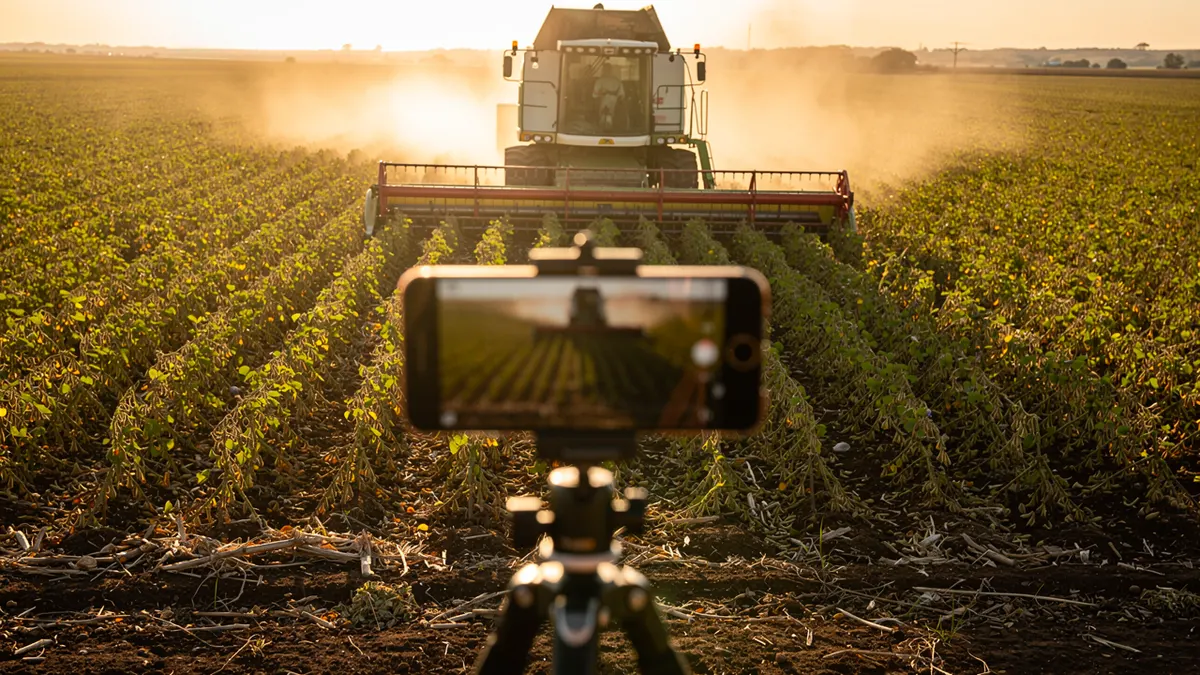
It is the country's leading industry, it commits considerable sums to technical decisions, and it still sells with documents nobody opens.
What the video replaces
It replaces three things, and that is what justifies its price.
The catalogue, which the buyer does not open, because it does not answer their questions.
The demonstration visit, which costs everybody a day and cannot be repeated for every prospect.
And the phone call describing a machine, an exercise in which half the information is lost.
A well-made video does not replace selling: it eliminates the pointless meetings and prepares the ones that remain.
Who should appear
Two people, and not the ones you would think.
The farmer who uses the machine, filmed on their own land, saying what they did before and what has changed.
And the technician who sets it up and maintains it, because they are the one answering the real questions.
The salesperson does not appear. Their presence immediately turns the video into a pitch, and the audience files it as such.
The figures are the content
That is the particularity of this category: what elsewhere would be a technical detail is here the main argument.
Five values count: the real throughput, the consumption, the working width, the setting-up time, and the availability of parts.
Two rules. Always give the conditions of the measurement: soil type, moisture, crop, speed, year. With no conditions, a figure is not information but an unverifiable claim.
And take the manufacturer's values word for word, with their source. Performance claims bind the brand as much as the person speaking, and are checked before publication.
The calendar governs everything
It is stricter here than in almost every other category.
The content must exist before the decision window, which itself precedes the field campaign. Publishing during the work means talking to people who are watching nothing.
Two practical consequences. Shoot during the previous campaign and keep the images, properly dated. And publish between seasons, when investment decisions are taken.
What else to film
Three sequences almost nobody produces and that close sales.
Routine maintenance: what has to be done every week, in how long, with which tools.
The breakdown and its resolution: who to call, within how many hours, with which parts available in local stock.
And operation in difficult conditions: mud, slope, moisture, residue. That is where a machine is judged, and it is exactly what catalogues never show.
What the machinery imposes on the shoot
| Constraint | What it changes | The workaround |
|---|---|---|
| Engine noise | The voice becomes inaudible | Record the commentary separately |
| Dust | The lens dirties in minutes | A cloth, a short shot |
| Safety | No approach while it works | Film stationary, then running from a distance |
What is prepared with the farmer
The work schedule, access to the fields, the mandatory equipment, an escort and the consent of the operator appearing on screen.
What is verified before claiming a performance
Output, consumption or working width are proven by the manufacturer's documentation. An approximate figure turns against the brand, to be confirmed with the manufacturer.
The format
Three rules, on top of the viewing constraints described above.
Horizontal remains the main format, because the video will also be sent by message, shown at a trade fair and projected during a visit.
The length can be long when the subject is technical: in this category, a four-minute explanation is watched in full if it is useful.
And the short version exists in addition, not instead: thirty seconds to attract, four minutes to convince.
Finally plan the second language when the brand exports, and keep the rushes sorted by crop, by region and by season. They will serve again for the next model, out in two years.
Sources
Checked on 4 September 2026. Thresholds and rates change: where this guide and the official source disagree, the official source is right.