It is the most sceptical audience in commerce. Here is what a parent has to see, and the promises that bring trouble.
Safety is the only real subject
Three checks, made by every parent before buying.
Detachable parts: what unscrews, what gets lost, what fits in a mouth.
Stability: what tips, what slips, what holds when pulled.
And cleaning: what washes, at what temperature, what stays damp.
Those three points are filmed without asserting anything, and they decide the purchase more surely than any promise.
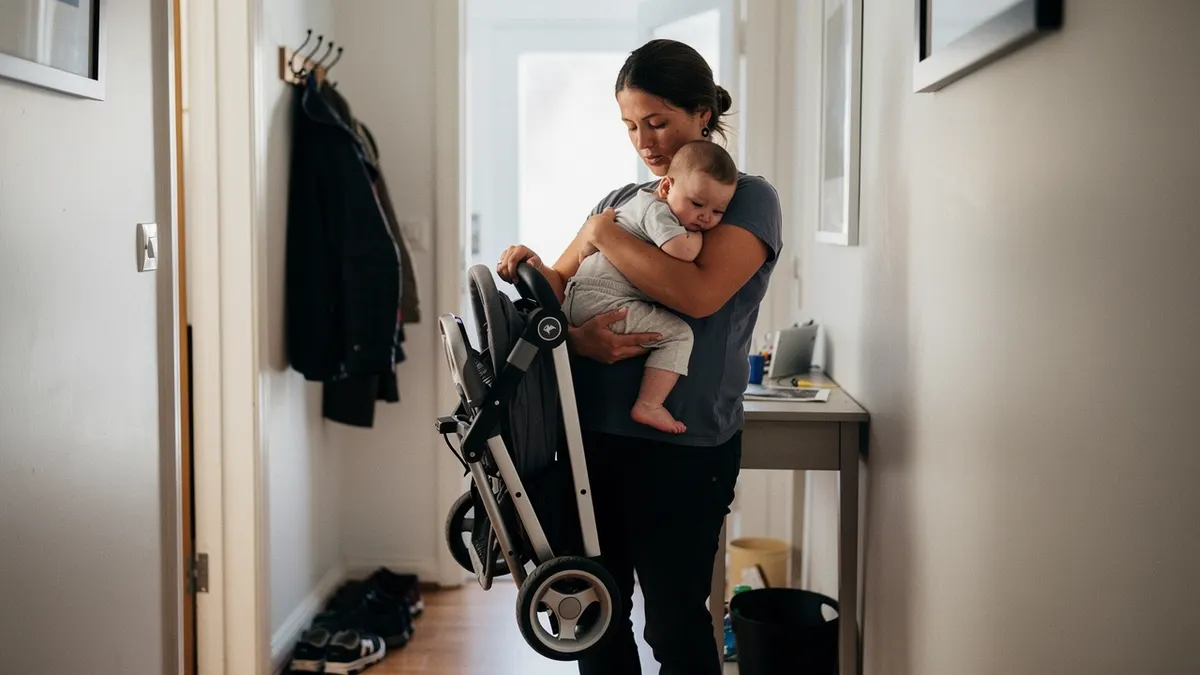
Film one-handed use
That is the real constraint of this category, and it shows immediately.
A parent is holding a child, a pushchair, a bag: anything needing two hands is a design fault.
So film every manipulation one-handed: opening, closing, adjusting, folding, storing.
Add the shopping-bag test: the product handled while the other arm is loaded.
Real parents, real homes
Three reasons, economic as much as credible.
A setting that is too clean disqualifies the video: this audience knows what a room looks like at that stage of life.
An actor is spotted by the way they hold the child, before they even speak.
And vocabulary counts: the words used between parents are not those of the catalogue.
One casting consequence: look for people in the middle of that period, not people who lived it five years ago.
Claims are most tightly regulated here
Five families of sentences never to be spoken.
Any health claim: relieving, preventing, correcting, promoting a development.
Any promise about sleep or behaviour.
Any comparison with a medical device or a professional recommendation.
Any invented age indication: the age on the packaging is safety information, it is read as it stands.
And any suggested use not provided for in the instructions, even presented as a tip.
The working rule: the brand supplies the authorised wordings in writing, the creator repeats them word for word, and the rest is described as a personal observation. The rules applicable to childcare articles and their advertising are checked with the competent authorities before publication.
The purchase happens before the birth
That is the calendar particularity changing the whole production.
A large share of decisions is taken during pregnancy, often as a family, with a list and a budget.
Two consequences. Useful content explains how to choose, not why to buy now. And it must stay online a long time: these videos are consulted for months, then again by the next person.
What is shown, and how
| Subject | The shot | The limit |
|---|---|---|
| A care product | The gesture on an adult's hand | No claimed effect |
| A garment | The fabric, the seam, the fastening | No face without consent |
| An item of equipment | The full assembly, in one piece | No safety shortcut |
What requires a written form before any release
Both parents' consent for any recognisable child, and the consent of every adult in frame. With nothing in writing, the video does not go out.
What is never said
A sleep promise, a health claim, medical advice or a misuse of equipment. Those subjects are referred to the professional, to be confirmed with a lawyer.
The shot that reassures most
One single one, and almost nobody films it.
The product stored, folded, cleaned, put back in its box or in a corner of the room.
That shot answers the question every parent asks before adding one more object to a flat: how much space does it take when not in use. It is also the one that gets the video shared between parents, because it deals with a problem the manufacturer never mentions.