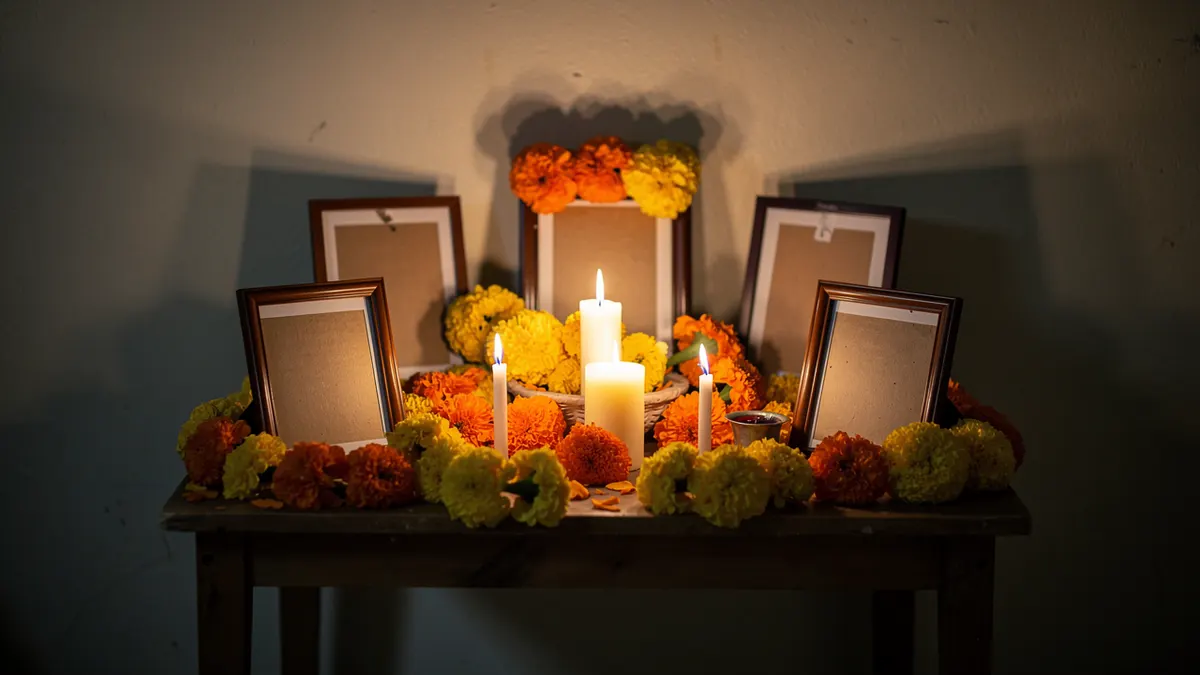
It is a cultural moment, not a commercial event. A brand can be present, but the tone is decided before the shoot, and it cannot be corrected afterwards.
Taking part, or appropriating
That is the line not to cross, and it is easy to spot.
Taking part means accompanying an existing practice: providing what is used, helping to prepare, showing a family doing what it does every year.
Appropriating means using the visual signs of the tradition as decoration to sell something else: the make-up, the flowers and the skulls stuck onto a product with no connection to it.
The test holds in one question: if the product is removed, does the scene remain true? If so, the brand is accompanying. If the scene exists only for the product, it is appropriating.
Film with somebody who lives it
That is the casting criterion that decides everything.
Somebody who sets up an offering at home every year needs no script: they know what they put out, in what order, and why.
Somebody discovering the tradition for the campaign produces a reconstruction, and it shows immediately.
So ask, at casting, whether the person already does it. It is the only question that counts, and it saves all the others.
Avoid the imported version
That is the most visible mistake for the local audience.
The late-October decorations from elsewhere, the costumes, the horror aesthetic, the pumpkins: those are the codes of a different holiday, and mixing them immediately signals a campaign designed from a distance.
The difference is not only aesthetic: one celebrates fear, the other honours people who have died. A brand confusing the two loses both audiences.
Publish before, not on the day
That is the practical consequence of the calendar.
Purchases concentrate in the preceding week: flowers, candles, ingredients, cut paper, frames, cleaning.
Publishing on the day itself comes after the purchase decision, and also comes at a moment when people are with their family rather than on a screen.
Useful content is therefore published between seven and two days before, and then stops.
The right tone
Four rules are enough.
No discount announced in content showing an offering.
No commercial urgency vocabulary.
No staging of real people who have died without the explicit agreement of their family.
And a discreet place for the brand: a product in use, not a logo in the centre of the frame.
Add the identification of the commercial nature, still due even in cultural content, and check before publication the rules applicable to the product concerned.
What is filmed with accuracy
| Element | What respects it | What jars |
|---|---|---|
| A family altar | The objects, in a wide, calm shot | A fast, musical edit |
| A cemetery | The consent of the families present | A stolen shot |
| A product | Its real place in the tradition | A set added for the occasion |
What is asked before filming
The consent of the people involved, permission for the place, and the view of someone who actually practises the tradition on what the video shows.
What separates homage from decoration
A product with a place in the celebration can appear; a product with no connection dressed in the season's colours is spotted immediately, and turns against the brand.
What really works
Three kinds of content, all simple.
The preparation of a family dish, filmed in full, with the person explaining who they are preparing it for.
The buying of flowers, at the market, with real prices and quantities.
And the making of something by hand: cutting, frame, candle, decoration.
Those are the three most watched formats of the season, and they need no production budget.