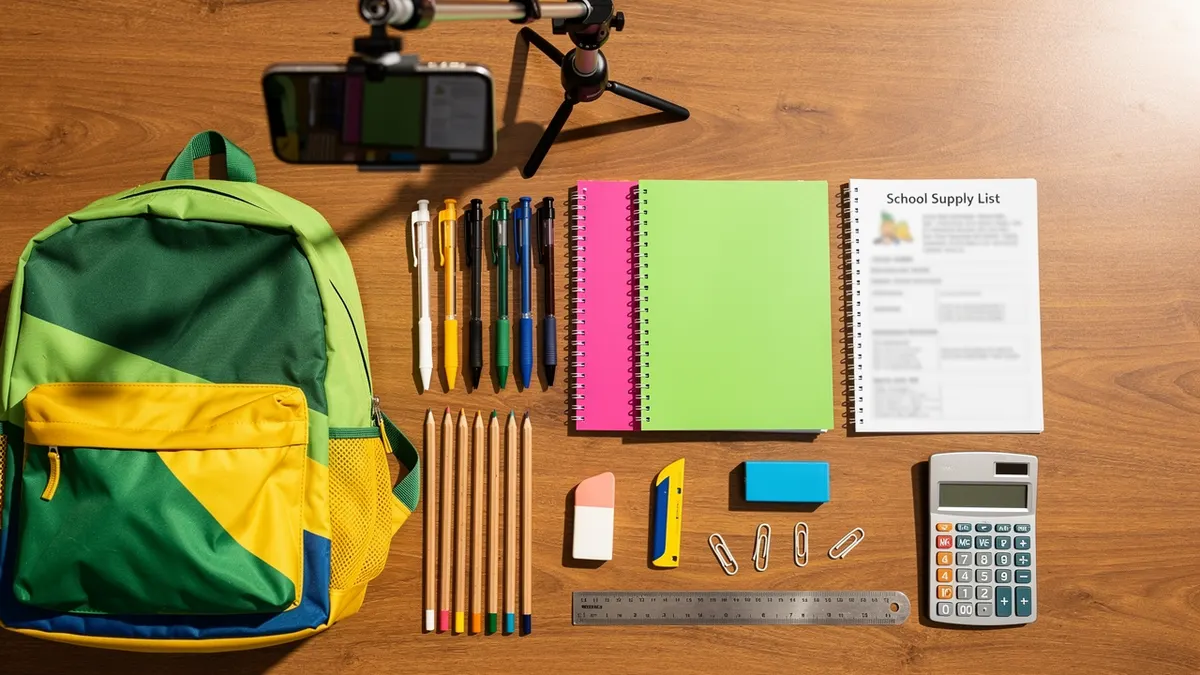
Here the school year starts in February. The category's biggest commercial week therefore falls in high summer, and that changes the whole plan.
The real calendar
It has four phases, and the peak is not the longest.
December: the lists circulate, parents start comparing, and nobody is advertising yet.
January: the main buying wave, concentrated into a few weeks, at maximum intensity in the last days before the return.
February and March: the catch-up, what was missing, what was forgotten, what broke in the first week.
Then mid-year, quieter, when replacements and specific supplies sell.
The consequence is brutal: the content has to be shot in November at the latest. A brand ordering in January arrives after the purchase decision.
The formats that sell
Five, from the most useful to the most visible.
The list resolved
Described in the box. It is the central format of the category.
The price comparison
The same basket in two configurations, with the total displayed. That format calls for caution: a filmed price goes out of date, and a named comparison with a retailer commits the brand.
Durability
The schoolbag, the pencil case or the bottle after a term of use. That is what parents who have already rebought the same thing twice are looking for.
Organisation
Storing, labelling, preparing the night before. Useful content all year, shot once.
What is left from last year
The most honest and most watched format: sorting before buying. It sells less volume and much more trust, and it puts the brand on the side of the family budget.
Precautions with children on screen
They are not optional.
The written authorisation of the legal representatives is signed before the take, for any visible or recognisable minor, including in the background.
Advertising aimed at children is regulated: direct incitement to buy addressed to a minor, pressure on parents and promises of social status are risk areas. The applicable rules, the way of identifying the advertising nature and the shooting conditions depend on your situation and are checked with a lawyer, before the shoot.
In practice, many campaigns in this category are shot very well without showing a single child's face: the hands, the desk, the schoolbag and the parent's voice are enough.
A calendar that decides everything
| Moment | What gets filmed | Why so early |
|---|---|---|
| Two months before | The lists and the price comparison | Parents compare first |
| One month before | Organising the school bag | The purchase is decided |
| The first week | Real use in class | The proof after purchase |
What to show when the product is ordinary
The detail that holds: a binding that does not give, a nib that does not bleed onto the next page, a size that fits the bag.
What is filmed without a child
Hands, the desk, the object in close-up. The video works with no face, and avoids every permission that comes with one.
Practical notes for the brand
Four points that change the result.
Send the products in December, not January. A creator receiving their parcel during the buying wave films too late.
Provide the list of references by school-list wording, as described above.
Give prices only if you accept them being filmed, otherwise explicitly ask for them not to be shown.
And buy the rights until April at least. A back-to-school campaign cut at the end of January leaves the whole catch-up wave with no content.