Why beauty is a major UGC niche in Brazil, the formats that work and how creators and brands collaborate.
Why beauty dominates UGC in Brazil
Seven reasons specific to this market.
The category is bought frequently, which creates a continuous need for content.
The audience is very informed, compares formulas and reads lists.
Sales channels are multiple: pharmacy, marketplace, direct selling, shops.
Direct selling between individuals remains massive, and content travels with the products.
Results are visible, and therefore filmable, unlike many other categories.
The climate raises questions of wear and sweat absent elsewhere.
And the diversity of skin tones and hair makes a single demonstration structurally insufficient.
What makes Brazilian beauty UGC different
Seven particularities foreign brands underestimate.
The shade range has to be shown on several undertones, dealt with above.
Hair vocabulary is very precise here, and a wrong term discredits the video.
Heat and humidity are the first criterion for judging make-up.
Price per use counts more than the displayed price.
Direct selling creates an audience looking for arguments to resell, not only to buy.
Local cultural and musical references are expected, and their absence is audible.
And the demand for honesty is stronger than average, the category having promised a lot.
The beauty UGC formats that perform
Seven formats, from the most useful to the most decorative.
The complete application in one take, with no cut between steps.
The shade swatched on the jawline, then outdoors, since indoor light misleads about undertone.
Wear over a whole day, with the time stated in each shot.
Removing the product at the end of the day, a rare and much watched format.
Comparison with an equivalent product already owned.
The hair format, with the curl type stated explicitly.
And the unboxing, which is only worth anything if it shows the real volume in a hand.
The heat test
Six checks the Brazilian audience expects.
Behaviour after several hours outdoors, filmed in the same place as at the start.
Wear after effort or a journey, with no retouching between the two shots.
Transfer onto clothing or a mask, a question asked systematically.
The look under late afternoon light, different from the morning's.
Compatibility with sun protection, a daily subject here.
And ease of removal in the evening, which decides the repeat purchase more often than people think.
Filming colours without betraying them
Seven technical settings.
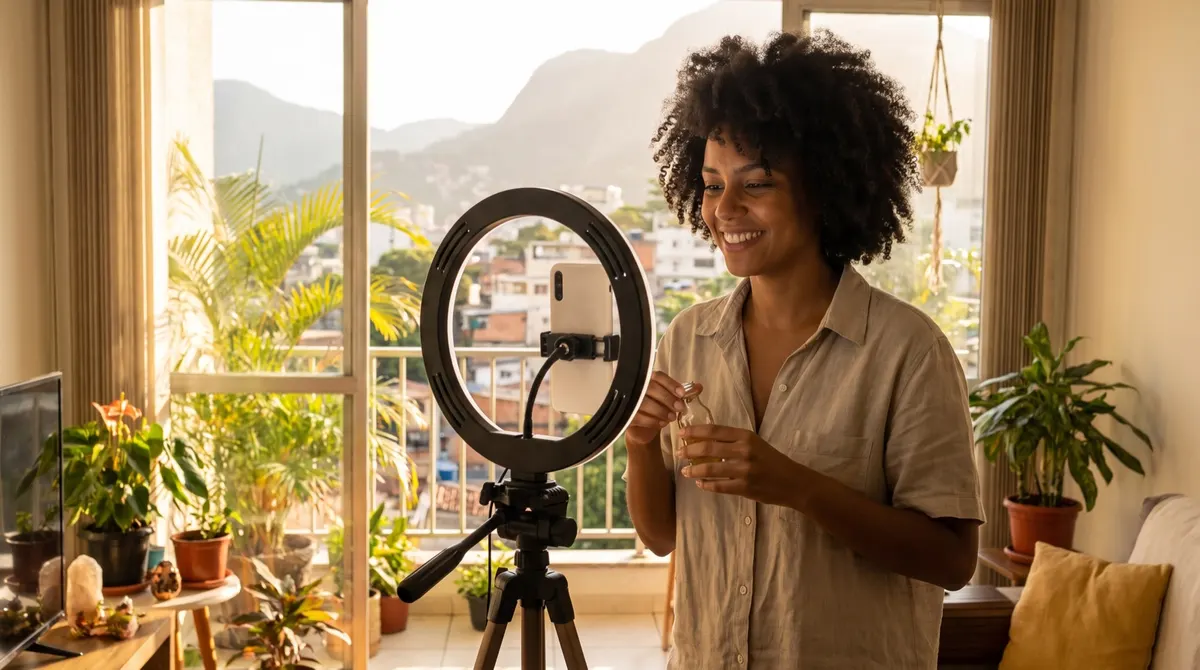
Locking the white balance before the first take, otherwise the shade changes mid video.
Filming near a window, then repeating the same shot outdoors.
Turning off any automatic enhancement on the device, which alters skin colour.
Cleaning the lens, since one mark is enough to veil a swatch.
Filming bare skin next to made-up skin, in the same shot.
Stating the shade and reference out loud, since names look very similar.
And avoiding coloured lights, which make any swatch unusable.
How brands and creators collaborate
Seven working points specific to the category.
The brief supplies the closed list of authorised wordings.
The shade sent is chosen with the creator, never assigned at random.
The timeline allows for the wear test, which takes several days.
The brand approves the script before shooting, normal practice here.
Advertising rights are negotiated separately, with a written duration.
Regulatory review is added to the schedule.
And renewal is planned from the first order, since loyalty counts a lot in this category.
What you cannot claim
Five precautions, to be validated with a lawyer and with the competent health authority before release.
A cosmetic is not a medicine, and medical vocabulary is to be set aside.
Claims depend on the product's category and registration, which is checked.
A personal result is told in the first person, without generalising.
Sun protection mentions have their own framework, to be repeated word for word.
And any skin reaction has to be reported to the brand, never minimised.
What is filmed on a beauty product
| Shot | What it shows | Lighting condition |
|---|---|---|
| The texture taken on a finger | The real consistency | Side window, no filter |
| The application | The gesture and the amount | Same light from start to finish |
| The result | What it does on this skin | No digital smoothing |
What is said out loud
The skin shown is that of the person on camera, the light is not retouched, and the result applies only to that skin. Three sentences that protect everyone.
What is never promised
An effect on a skin condition, a deep action, marks disappearing or a timeframe. Those fall under cosmetics regulation and are confirmed with the manufacturer and a lawyer.
Getting started, brand side or creator side
Seven concrete steps.
On the creator side, film three videos with products you already own.
Choose a speciality, complexion, hair or skincare, rather than covering everything.
Systematically state your undertone and hair type, rare and sought-after information.
On the brand side, order a series across three skin tones before anything else.
Provide the exact reference and shade, to be shown on screen.
Plan to buy the rushes, reused at every packaging change.
And measure over sixty days, since beauty has a longer buying cycle than it seems.
One last marker: in Brazil the winning beauty brand is not the one producing the prettiest videos, it is the one showing its range on enough faces for each person to recognise herself. That is an ordering decision, taken before the shoot, and it costs the same.
Sources
- Portal do Empreendedor (MEI), Brazilian government
- Receita Federal, Brazilian tax authority
- Simples Nacional, official portal
Checked on 4 September 2026. Thresholds and rates change: where this guide and the official source disagree, the official source is right.