Pets as a UGC niche in Brazil, the formats that work and how creators and brands collaborate.
Why pet brands bet on UGC in Brazil
Six reasons specific to the market.
Pet ownership is very widespread and cuts across all income levels.
The animal is treated as a family member, which makes the spend little sensitive to price.
The purchase is repeated: food, litter, care and accessories come back every month.
The doubt is about the animal's acceptance, a question no product page can settle.
Pet content travels very well in sharing, which extends each video's life.
And the pool of creators is huge, since anybody with an animal can produce.
What makes pet content different
Six particularities to know before accepting an order.
The shooting time is unpredictable, dealt with above.
The brief cannot describe a precise behaviour, only a situation to prepare.
Sound counts more than elsewhere: the animal's noises carry the emotion better than the voice.
Safety comes before the shot: no gesture, setting or accessory should put the animal in difficulty.
The brand cannot guarantee the reaction, and a good quote says so explicitly.
And imperfection is an advantage: a failed take where the animal runs off sometimes converts better than a perfect one.
The UGC formats that work for pet brands
Seven formats, ranked by effect on sales.
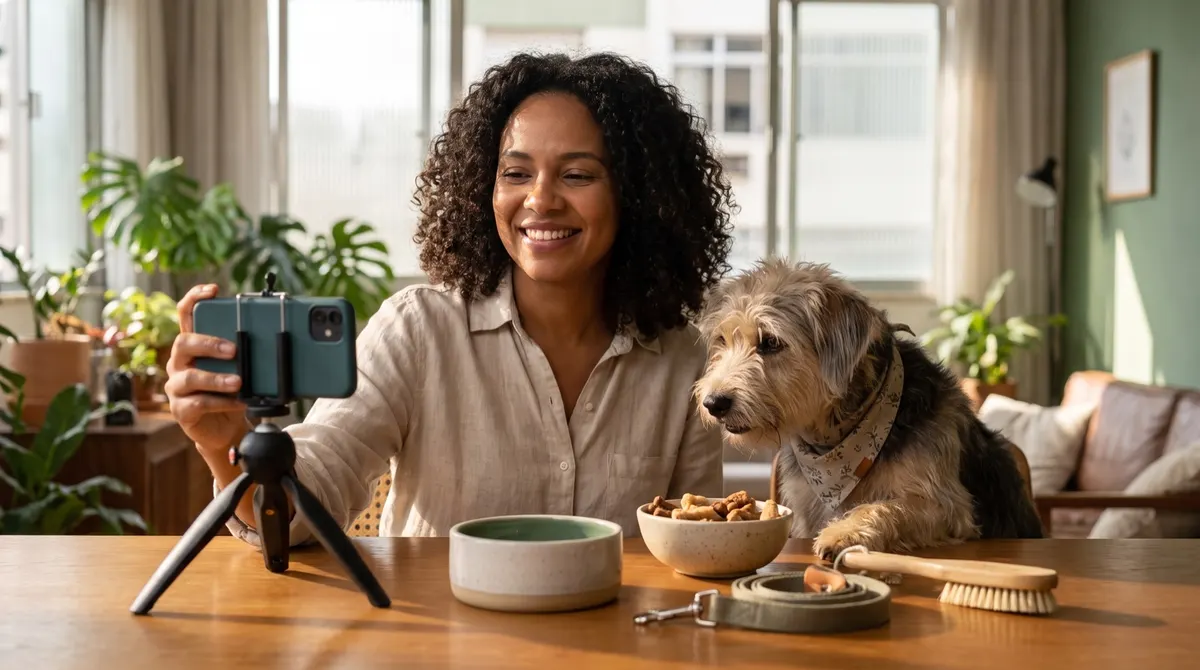
The first reaction to the product, filmed continuously, with no staging.
The food transition, a long format answering owners' real question.
Scale: the product next to the animal, indispensable for accessories and beds.
Storage and bulk, a central question in a flat.
Cleaning: what the product becomes after a week of real use.
The comparison with what the animal used before, when the household has had both.
And the answer to comment questions, often very technical in this category.
How a collaboration unfolds
Six points to frame in the quote.
The real shooting time, longer than elsewhere, and invoiced as such.
The impossibility of guaranteeing a behaviour, written in black and white.
The gestures and situations forbidden, defined with the brand before the shoot.
Regulated claims: anything touching animal health, feeding or behaviour is checked with the competent authorities and, as the case may be, with a vet or a lawyer.
Systematic referral to a vet for any health question.
And the duration of rights, often shorter because an animal's appearance changes fast.
Advice for creators wanting to start
Six decisions to take before the first order.
Choose a segment, food, accessory or care, rather than the whole category.
Film your own purchases first, which builds a portfolio with no spending.
Systematically plan twice the time expected, and announce it to the client.
Refuse any brief asking for a precise reaction, or renegotiate it into a situation to prepare.
Never improvise a sentence about the animal's health, even one that seems harmless.
And keep the rushes, because a good sequence is reworked for months.
What is filmed with an animal
| Sequence | What it proves | Real time needed |
|---|---|---|
| The product presented | Spontaneous interest | Two minutes of waiting |
| Use in situation | Comfort or palatability | Five minutes |
| The calm afterwards | No discomfort | One minute |
What makes a shoot bearable for the animal
Short sessions, a familiar room, no physical restraint, and stopping the moment it turns away. A missed shot beats a stressed animal, and stress shows on screen.
What is never said
An effect on a condition, a dosage, a guaranteed coat improvement or a timeframe. Any animal-health claim is confirmed with a vet and the manufacturer before the shoot.
A niche with plenty of room left
Five reasons to settle in.
Demand far exceeds the supply of creators able to deliver on time in this category.
Food brands pay well, because the buying cycle is monthly and loyalty is strong.
Rare profiles are missing: cats rather than dogs, older animals, shelter animals, less photogenic breeds.
Local shops, clinics and groomers also buy, with fast decisions.
And the relationship lasts: a brand that finds a reliable creator in this niche keeps them a long time.
One last marker: in pet UGC, the brand is not buying a beautiful image, it is buying proof that the animal accepts the product. That is why the unplanned take is worth more than the prepared one, and why the time spent letting the camera run is the real production cost.