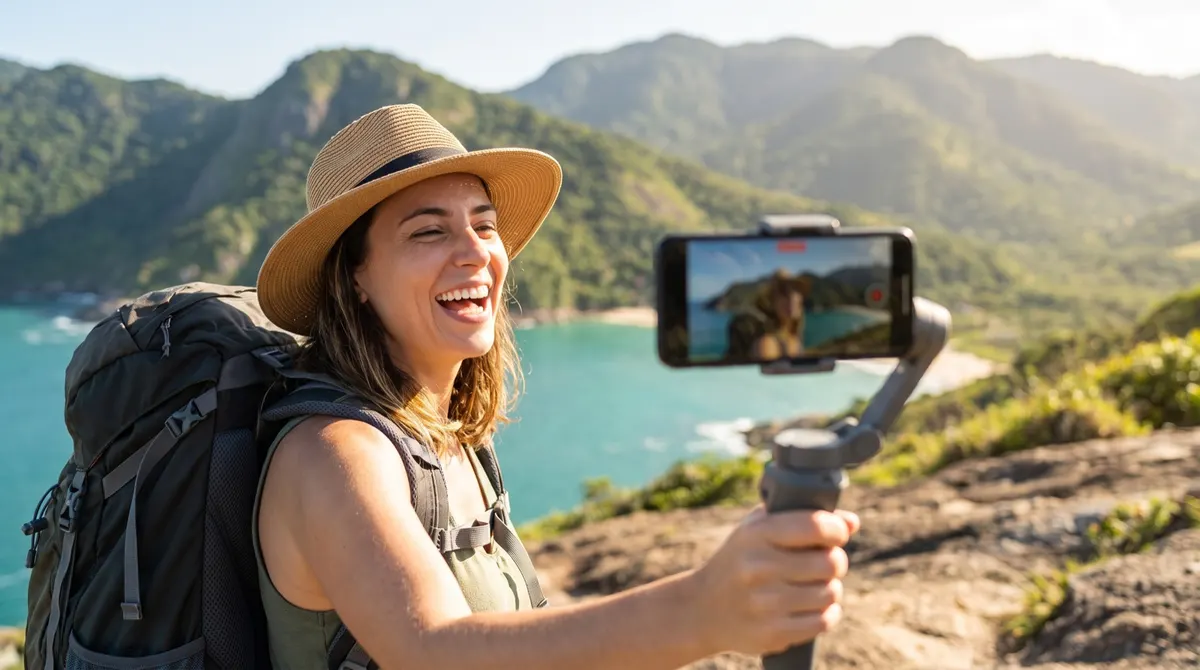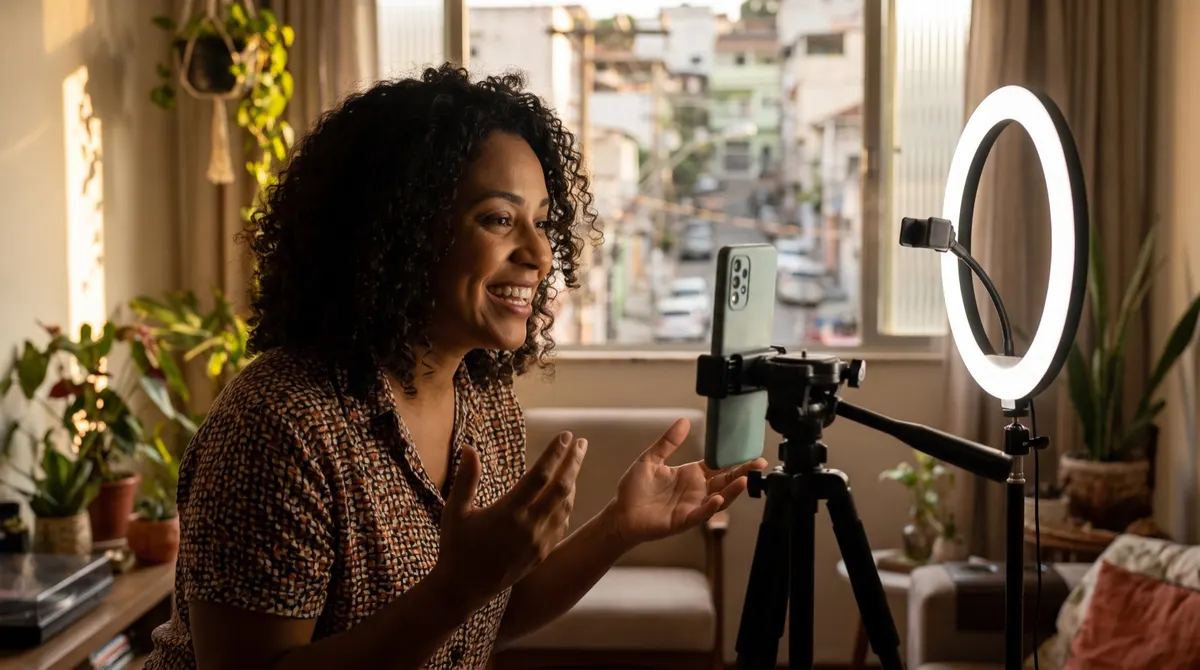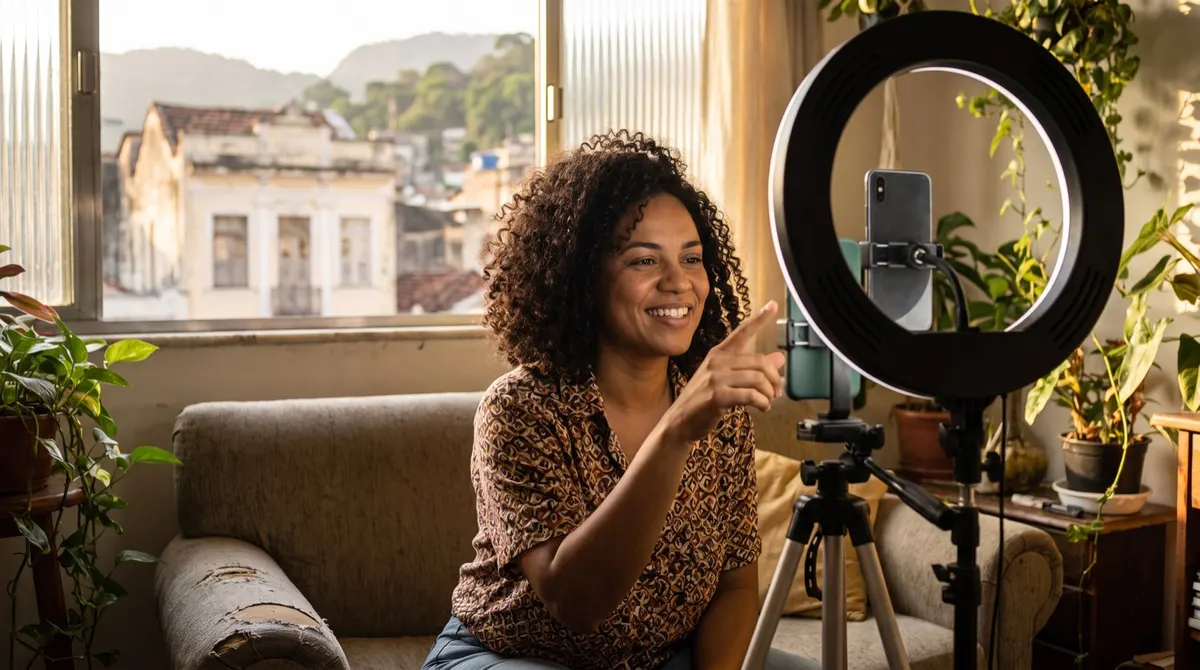
Concrete methods for Brazilian creators to be comfortable and natural on camera, from warm-up to delivery.
Warm up before pressing record
Seven moves that take five minutes and change the first take.
Speaking out loud for two minutes, about anything, to settle the voice.
Reading a difficult sentence three times, until it comes out cleanly.
Yawning deliberately, which relaxes the jaw better than any exercise.
Drinking water at room temperature, never iced.
Moving before sitting down, since prolonged stillness stiffens the posture.
Doing one deliberately bad take, to remove the stakes from the first.
And checking the frame and the sound before thinking about the text, otherwise technical worry is heard in the voice.
Speak to one person, not to a crowd
Seven ways of making the address concrete.
Mentally choosing one specific person, a friend, a neighbour, a real customer.
Placing a photo of that person next to the lens, a simple and effective method.
Starting with hello as if they had just arrived, then cutting that opening in the edit.
Using the informal address, the norm in this format in Brazil.
Asking a real question, even without expecting an answer.
Using the vocabulary you would use with them, not the brand's.
And remembering that the viewer watches alone, on their phone: there is never a crowd.
Script or improvisation, find your balance
Seven markers for not choosing an extreme.
Writing the first sentence word for word, because that is where everybody stumbles.
Writing the last sentence too, so as not to end apologetically.
Keeping only three points in the middle, never a full text.
Noting those three points on a sheet stuck behind the phone.
Accepting that you will say the same idea in different words at each take.
Keeping the short hesitations, which make the video credible.
And declining scripts the brand supplies word for word, offering instead to rephrase in your own way, which most accept.
What the body does when you are uncomfortable
Six signals visible on screen, and their correction.
The shoulders rise: rest your forearms on a table.
The hands disappear: keep them in frame, with the product.
The gaze wanders: fix the lens, not your own image on the screen.
The pace accelerates: slow down by marking a silence after each sentence.
The torso pulls back: bring the camera closer rather than leaning in.
And the smile freezes: speak while walking for the first seconds, then sit down.
Takes, energy and pacing
Seven rules for not exhausting yourself.
Limiting to three takes per sentence, beyond which fatigue is audible.
Filming the difficult passages first, while energy is high.
Keeping the second take more often than the fifth, truer and less manufactured.
Raising your energy one notch above your natural level, since the camera always absorbs some.
Filming in ten-minute blocks, with a real break between each.
Not shooting after a full working day, since the voice is already tired.
And stopping as soon as you hear yourself reciting, which is never fixed in the edit.
Watch yourself back and set a routine
Seven steps for really improving.
Watching each video once only, with sound, noting a single point to improve.
Never judging your appearance, only the pacing and the clarity of the message.
Comparing a video with last month's rather than with an established creator's.
Keeping a folder of the takes you find successful, to understand what sets them apart.
Filming one video a week even without an order, since regularity counts more than intensity.
Redoing the same subject three months later, to measure the distance travelled.
And asking for precise feedback from somebody you trust, never a general opinion.
What you work on, in order
| What you improve | How | How long |
|---|---|---|
| The delivery | Reading aloud, every day | Two weeks |
| The gaze | Look at the lens, not the screen | Immediate |
| The hands | Give them something to hold | Immediate |
What makes a take more natural
Speaking to one specific person. Imagining a real person behind the camera changes the intonation within a single take, faster than any diction exercise.
What is never fixed in the edit
A shifting gaze and a voice rising at the end of sentences. Both show in every shot, so redoing the take beats cutting around it.
What gear fixes rather than mindset
Six problems wrongly blamed on lack of confidence.
A voice that sounds bad often comes from the microphone, not from you.
A dark picture makes you look hesitant, when it is the light.
Framing that is too wide gives an impression of distance.
A phone held in the hand makes a take look nervous when it is not.
A cluttered setting draws the eye and makes you look secondary.
And a long shot with no cut tires the viewer, which has nothing to do with your comfort.
One last marker: in Brazil what separates a comfortable video from a tense one is not talent, it is repetition and two technical settings. Nobody is natural on the first take; everybody becomes so by the thirtieth video, provided you film one a week rather than ten in a day.