This is the date that saves the quarter for toys, tech and clothing. It falls in mid-winter, and it is not handled like an end-of-year festival.
Winter, indoors and school holidays
That is the first difference from end-of-year festivals.
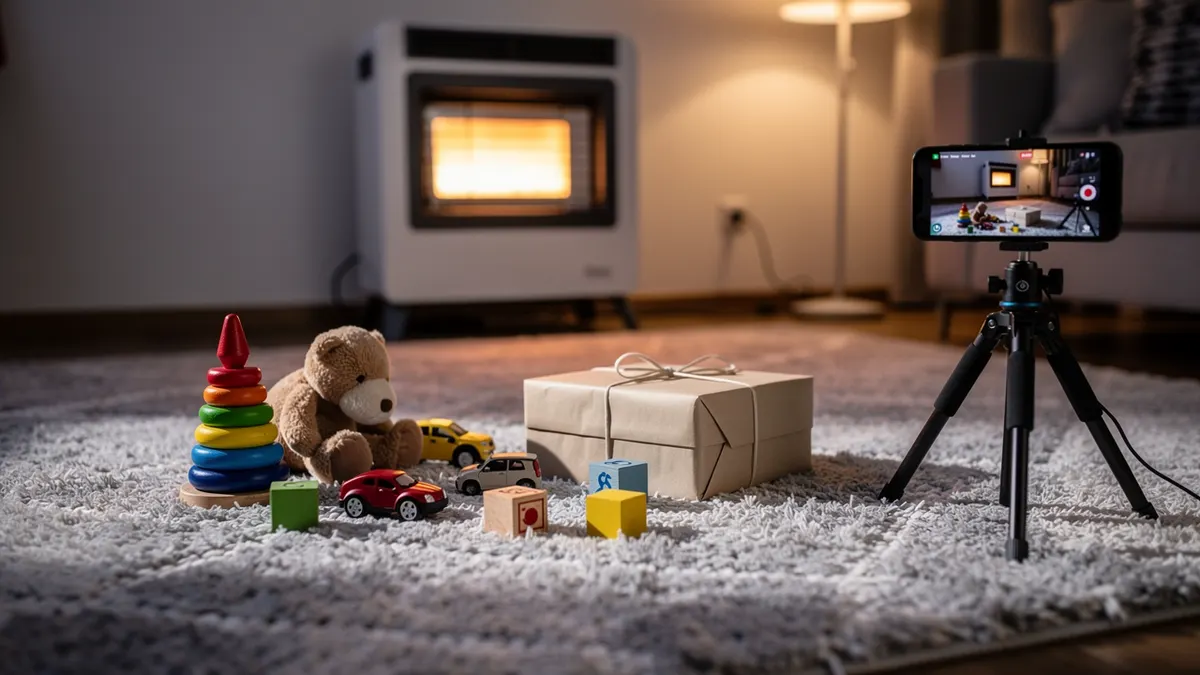
The date falls in the cold season and close to the school holidays, which moves all the content indoors: living room, bedroom, table, floor. Outdoor, beach or garden scenes correspond to nothing.
Two practical consequences. Daylight is short, so shoots are planned within a reduced window. And the product has to work in an enclosed space: an outdoor toy films badly at that time of year.
Add the presence of children at home during the holidays, which is both a shooting constraint and the real context of use.
The child chooses, the adult pays
That asymmetry commands the edit.
The child sees the product, recognises it, asks for it. The adult is looking for something else: the price, the durability, the size, the noise, the real age of use.
The answer is not a video speaking to both, it is two separate pieces cut from the same shoot. One shows the object in action, with no talk. The other answers the questions of the person paying.
A single video trying to do both convinces neither.
The gift has a ceiling
That is the economic particularity of this date, and it changes the brief.
The budget per child is often set in advance, and it is more modest than at the end of the year. The viewer's question is therefore not "is this the best product", but "what do I get for that amount".
Two formats follow. The selection by price bracket, with what is included. And the comparison between two options at the same price, which helps people decide.
Careful though: a filmed price goes out of date, and an announced discount binds the brand. The price goes in as an overlay, it is not burnt in.
Shoot in June
The production calendar is two months ahead.
The content is shot in early winter, then approved, and broadcast from the first half of the month of the festival. A brand ordering three weeks ahead gets what is left.
Plan the end too: demand collapses the day after. The rights must cover the whole period, and dated content stops dead.
What the calendar imposes
| Moment | What people search for | What you deliver |
|---|---|---|
| One month before | Ideas by age bracket | A filmed selection |
| Two weeks before | The price comparison | A short demonstration |
| The last week | In-store availability | The message about stock |
What is filmed without a child appearing
An adult's hands, the toy in action on a table, the unboxing seen from above. A shot with no face avoids every permission, and loses nothing.
What frames advertising aimed at families
The ban on directly urging a child to buy, the duty to disclose the partnership and caution about any educational benefit, to be confirmed with a lawyer.
Caution about what is said to a child
That is the regulatory constraint of the category.
Advertising aimed at minors is regulated: direct incitement to buy addressed to the child, pressure on parents, promise of social status, showing a use contrary to the manual or the age range.
Add the written authorisation of the legal representatives for any visible or recognisable minor, obtained before the take.
The applicable rules, the disclosures and the shooting conditions depend on your situation and are checked with a lawyer, before the shoot. In practice, a large share of campaigns in this category are shot very well without showing a single child's face: the hands, the play, the table and an adult's voice are enough.