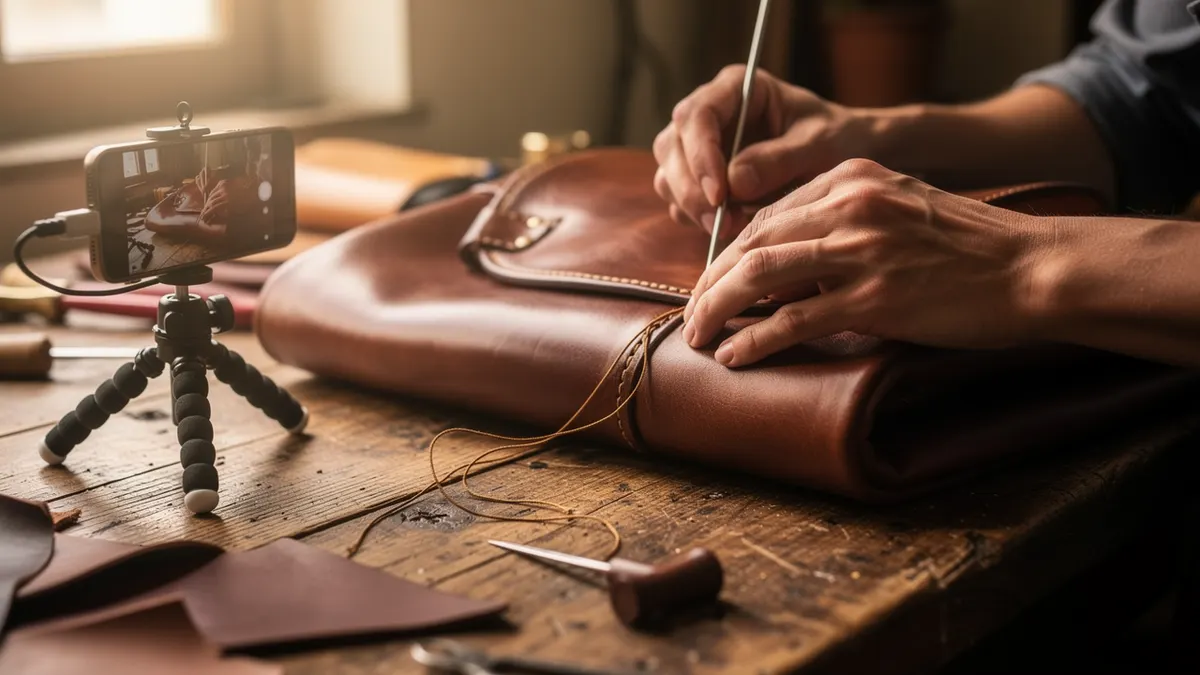
Leather, craft, luxury and tourism: a market that buys content showing the material and the gesture, not only the finished object.
Who buys video here
Six client categories.
Leather goods and tanning workshops.
Craftspeople and art restorers.
Fashion and accessory brands.
Shops and galleries.
Accommodation and restaurants.
And art and trade schools.
What they order
Six frequent formats.
A making-of or gesture video.
A filmed product sheet.
Content for an online shop.
A workshop presentation.
A video for a trade fair.
And a series of short formats.
Filming material, the local skill
Seven technical points.
Raking light that reveals the grain.
A colour faithful to the real material.
A tripod for every macro shot.
Focus set before the take.
A gesture repeated several times.
A neutral background that does not tint.
And a wide shot that places the workshop.
What a workshop expects from a provider
Six requirements.
Not disturbing the work in progress.
Not touching tools without permission.
Respecting the confidentiality of the models.
Getting written consent to film people.
Delivering images usable in the shop.
And having it approved before release.
The multilingual advantage
Six uses that can be invoiced.
A subtitled version for export.
A version filmed for a precise market.
Proofreading by a native speaker.
Content adapted to an international fair.
Communication toward a foreign buyer.
And a product sheet in two languages.
How to build a price here
Six lines to show.
Preparation and location scouting.
The half-day or day of shooting.
The number of macro shots delivered.
The number of revisions included.
The rights line, with duration and territory.
And the option of a second language.
Tourism, as a complement
Six seasonal clients.
Accommodation and rentals.
Restaurants and cafés.
Guides and private tours.
Town-centre shops.
Cultural events.
And travel agencies.
What a city of art and craft orders
| The buyer | Their typical order | What they require |
|---|---|---|
| A leather or paper workshop | The gesture and the material | A close shot, no music |
| A boutique hotel | The room and breakfast | Natural light |
| A fashion brand | The fit and the cut | Faithful colour rendering |
What heritage forbids or regulates
Filming for commercial purposes in a museum or near a monument may require a paid permit. The rule depends on the site, and is asked of its manager before blocking a shooting date.
What makes a craft shot sellable
Silence and duration. A gesture filmed continuously for fifteen seconds, with the real sound of the tool, beats a fast edit that stops you seeing what is being done.
What the platform brings
On UGC MATCH, joining is free and there is no subscription: you declare your languages, you are visible by category and country, and the order keeps a record of the brief and the delivery. The brand pays at ordering, the funds are not released straight away, and payment goes out on approval. The platform retains 10% of the price on the creator side, who therefore keeps 90%, and charges the brand a 6% service fee, with a minimum of 1.50 EUR.
One last marker: here, your value is measured in millimetres of sharpness. It is a technical skill, and it is invoiced as one.