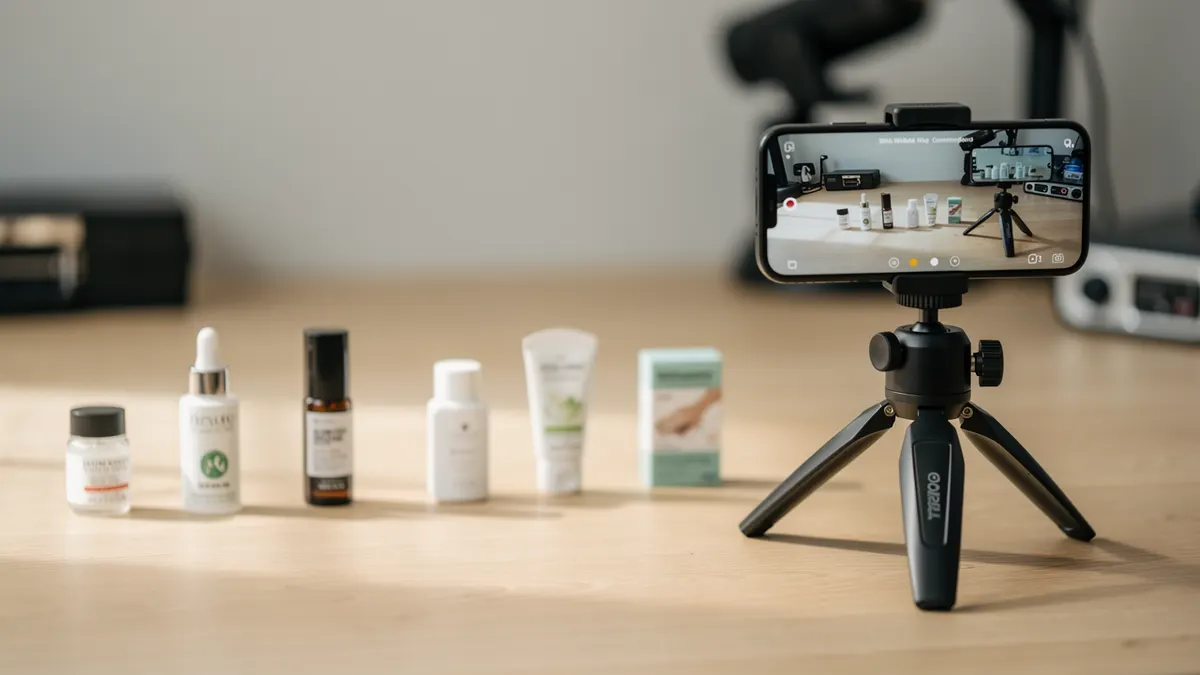
What to film before having clients, how many pieces are enough, and how to present them to get hired.
From three to six videos, no more
Four reasons to stop there.
Nobody watches beyond the third, and the sixth only serves if the first five convinced.
A long portfolio forces the buyer to sort, which is your job and not theirs.
Each extra piece dilutes how clearly your speciality reads.
And a short set really does get updated, whereas a long one never does.
One rule of composition: three different formats are worth more than six videos of the same type with six different products.
What to shoot without clients
Five pieces to produce with what you already own.
The silent demonstration, filmed in close-ups, with the real sound of the object.
The piece to camera, thirty seconds, a problem and a solution.
The three reasons format, the structure brands ask for most.
The comparison between two products you really use.
And the video with a mandated sentence you set yourself, to prove you can work within a constraint.
One precaution: an uncommissioned example is always presented as such, a mention to write under the video. It is a matter of honesty and it takes nothing away from its demonstration value.
The rule that changes everything: the niche
Four reasons a specialised portfolio gets hired faster.
A brand is looking for somebody who knows its category, not somebody who can film anything.
A coherent portfolio lets them guess the result before ordering, which reduces the perceived risk.
Specialisation allows a higher rate, because it replaces explaining time.
And it makes word of mouth possible, since people recommend an identifiable skill, never versatility.
In practice: choose two close categories, for example home and cooking, or beauty and care, and leave everything else out of the portfolio, even your best videos.
What makes it professional
Six elements that cost an hour and change the perception.
A link reachable with no account or sign-up, an absolute condition.
A decided order, with the most relevant video first.
The production information under each piece, dealt with above.
A price range, absent from most portfolios and therefore distinctive.
Your professional contact details and your ability to invoice.
And a sentence stating what you do not do, which reassures more than a list of skills.
What a short portfolio must contain
| Slot | What goes in it | Why |
|---|---|---|
| The first thumbnail | The video closest to the target client | It decides in five seconds |
| The next three | Three different formats | They show the range |
| The last line | Contact and availability | It saves a round trip |
What is removed without hesitation
Anything older than two years, anything shot with a different level of gear, and anything about a sector you no longer target.
What changes with the recipient
The order, only. The same portfolio reordered speaks to three different clients, and it takes two minutes.
How to make it evolve
Five maintenance rules, applied every three months.
Replace the oldest piece, never all of them at once.
Keep the examples resembling the orders you want to receive, not the ones you are proudest of.
Remove what you no longer want to do, on pain of continuing to receive it.
Add each new language or format as a distinct piece.
And note, for each order won, which video the buyer mentioned: it is the only reliable measure of your portfolio's effectiveness.
One last marker: a portfolio is not a collection of your best videos, it is a sample of what you will deliver next week. A brand looking at three coherent pieces, with stated turnarounds, already knows what it is buying, and that is exactly what triggers a first order.