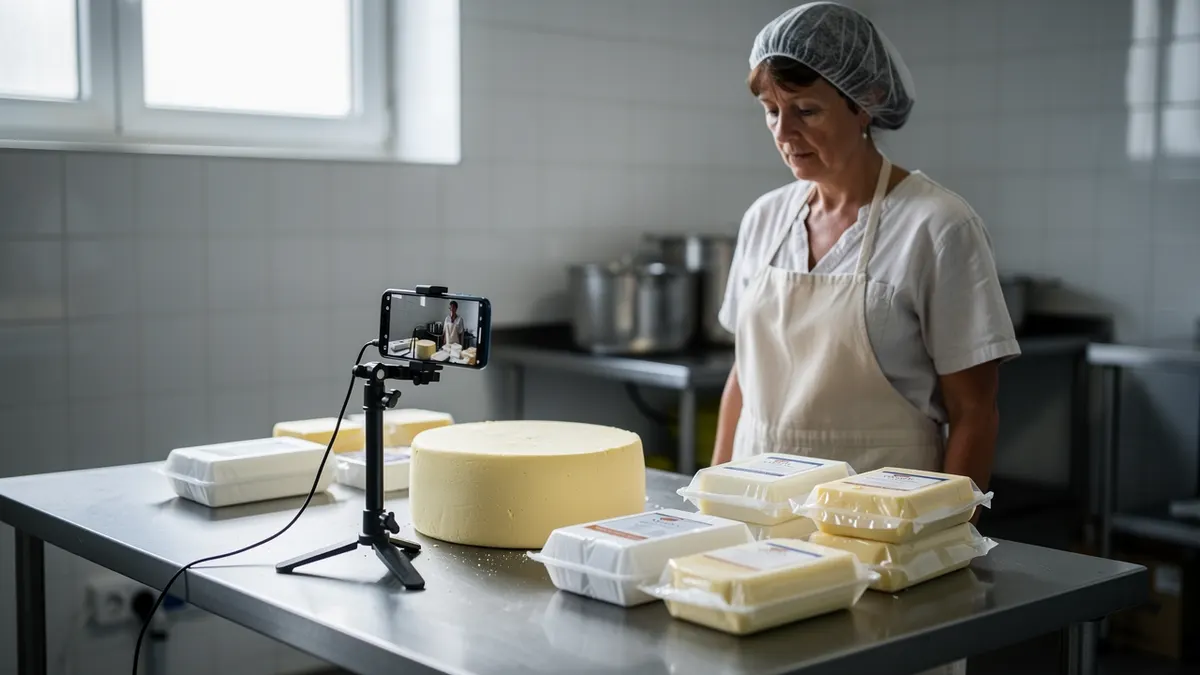
Brittany feeds France, and the food companies behind that are the least covered and best paying clients in the region.
The client map
Six client families.
Food companies and their brands.
Cooperatives and producers.
Technology and digital service companies.
Town-centre shops and restaurants.
Schools and training bodies.
And local authorities and cultural players.
Why food companies pay better
Six concrete reasons.
The subject is technical and puts amateurs off.
The content also serves recruitment, not just sales.
Production cycles come back every year.
A plant needs images no stock library offers.
The client compares to a production budget, not a social media rate.
And a good job gets renewed across several sites.
What a plant orders
Six frequent formats.
A site or know-how presentation.
A recruitment video for a specific role.
Product content aimed at professional buyers.
A team testimonial.
Trade-fair coverage.
And a short series for social media.
Preparing a shoot in a regulated area
Seven points to settle before coming.
The required clothing and who supplies it.
Any ban on glass and detachable objects.
The use of a tripod and lighting.
Which zones can be filmed and which cannot.
The mandatory presence of an escort.
The real time slot, often outside production.
And who approves the images before release.
Claims, a subject of their own
Six rules of caution.
Never promise an effect on health.
Do not turn a quality into a medical promise.
Reuse the wording on the packaging.
Have every spoken line checked by the client.
Disclose the commercial nature of the content.
And have any applicable rule confirmed with a lawyer.
The weather is part of the plan
Six useful habits here.
Plan an indoor alternative for every exterior.
Announce a window rather than an hour.
Protect the microphone from wind.
Shoot exteriors first while the light is there.
Avoid days with changing skies for a series.
And put a fallback date in the quote.
The student audience
Six clients that depend on it.
Local shops and restaurants.
Residences and housing services.
Schools and private courses.
Venues and nightlife spots.
Mobility services.
And campus associations and events.
How to build a price here
Six lines to show.
Preparation and reading the protocol.
The real time on site, often constrained.
The number of deliverables and their formats.
The number of revisions included.
The rights line, with duration and territory.
And the option of a subtitled version.
What a student and technology city orders
| The buyer | Their typical order | Their rhythm |
|---|---|---|
| A digital company | A tool demonstration | Per release |
| A regional food brand | The product and its origin | By season |
| A town-centre business | Short videos | One-off |
What a tool demonstration requires
A demo account, never real data. A client name visible for half a second on screen is enough to make the video unusable, and the reshoot is on whoever filmed it.
What the student pool changes about the market
Plenty of low-priced supply on simple jobs. The answer is not to cut the rate but to target the jobs those profiles do not take: industrial, technical, constrained.
What the platform brings
On UGC MATCH, joining is free and there is no subscription: you are visible by category and country, and the order keeps a record of the brief and the delivery. The brand pays at ordering, the funds are not released straight away, and payment goes out on approval. The platform retains 10% of the price on the creator side, who therefore keeps 90%, and charges the brand a 6% service fee, with a minimum of 1.50 EUR.
One last marker: the client who opens a production line to you is not looking for a videographer, they are looking for someone reliable. That reputation is what gets invoiced here.
Sources
- Urssaf, official auto-entrepreneur portal
- Service Public, how to become a micro-entrepreneur
- Service Public, crossing the micro-entrepreneur turnover thresholds
Checked on 26 August 2026. Thresholds and rates change: where this guide and the official source disagree, the official source is right.