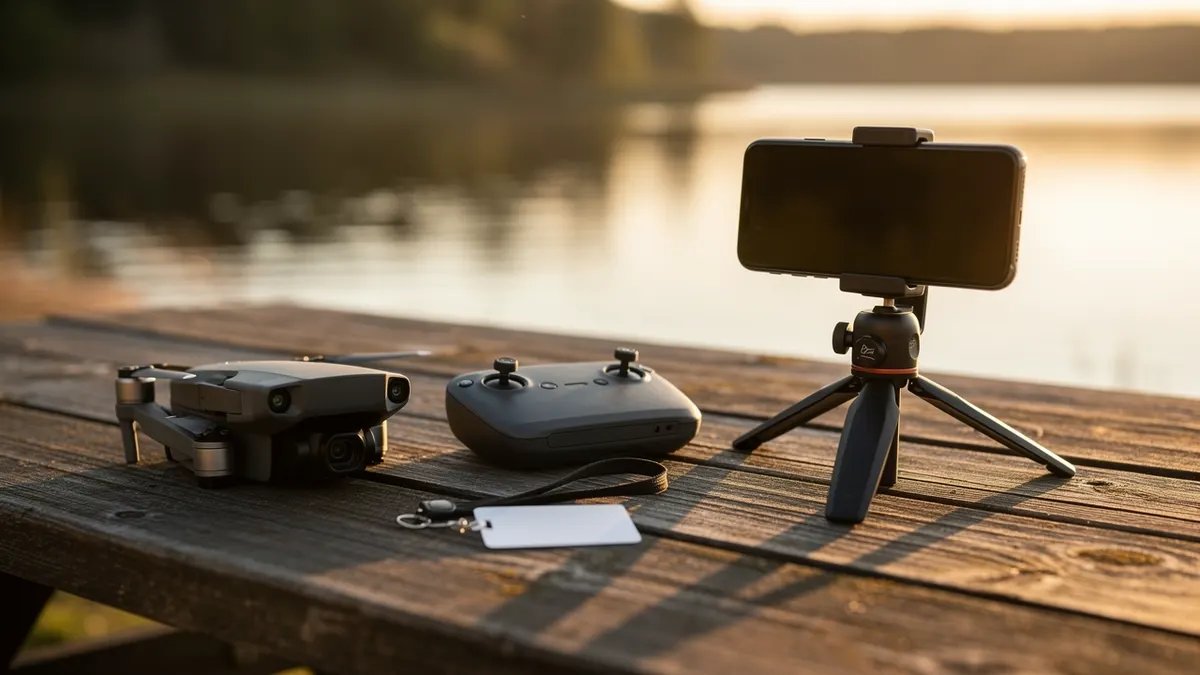
A brand asks for one aerial shot. Three seconds over the lake, the product on the dock, then back to the creator's hands. The creator owns a drone, has flown it for two years on weekends, and says yes. In the United States that yes changes the rules the flight is run under, because the Federal Aviation Administration splits drone flying by purpose: flying for fun is one regime, and flying for work or business is Part 107, which begins with a certificate the weekend flights never needed.
What the shot is worth in a quote is a pricing question, and this cocoon's rates guide sets out how an American creator prices a deliverable: the license rather than the filming, the usage window, the exclusivity, the raw files. This guide is about the American layer under the shot: the certificate Part 107 requires, the registration and Remote ID that follow, what the recreational route actually covers, and the rules a paid flight cannot waive on its own.
Two regimes, decided by why you are flying
Flying for work or business
The FAA's page for certificated remote pilots states the line: if you have a small drone that is less than 55 pounds, you can fly for work or business by following the Part 107 guidelines. A creator filming a paid deliverable is flying for work, and the regulation behind the page is explicit about who may hold the controls. Under 14 CFR 107.12, and except for the case the rule reserves for a foreign-registered aircraft, no person may manipulate the flight controls of a small unmanned aircraft system unless that person has a remote pilot certificate with a small UAS rating and satisfies the requirements of 107.65, or is under the direct supervision of a remote pilot in command who has the ability to immediately take direct control of the flight.
The three steps to the certificate
The FAA's page sets out three steps. Learn the rules, which means reading 14 CFR part 107 itself and checking whether the intended operation needs a waiver. Pass the Unmanned Aircraft General, Small knowledge test at an FAA-approved knowledge testing center; to be eligible for the remote pilot certificate the FAA asks that you be at least 16 years old, able to read, write, speak and understand English, and in a physical and mental condition to safely fly an unmanned aircraft system; the page describes the FAA Tracking Number and the IACRA profile a candidate creates before registering for the test, and Form 8710-13 afterwards. Register the drone, which costs $5 and is valid for 3 years, selecting the option to fly under Part 107. Since 16 September 2023, a drone that requires an FAA registration number must also broadcast Remote ID information, unless it is flown within a Federally-Recognized Identification Area.
What recreational flying is, and is not
The FAA's recreational page is written for someone who wants to fly just for fun, and it has its own list: register the drone if it weighs 250 grams, 0.55 pounds, or more; take the free online TRUST test, which is required by law, and carry proof when flying; follow the rules, including flying within visual line of sight; and respect the airspace, because other aircraft do fly low. That regime is real and it is not the one a paid shot belongs to. A creator who has flown for fun for years has met the recreational requirements and has not met Part 107, which is the regime the paid flight is in.
| What the creator is doing | Which FAA regime the pages describe | What the FAA asks of the flight |
|---|---|---|
| Filming a paid deliverable for a brand | Part 107, flying for work or business | A remote pilot certificate with a small UAS rating, or direct supervision by someone who holds one and can take control |
| Flying the same drone on a weekend, for fun | Recreational flyers | Registration at 250 grams or more, the free TRUST test and proof of it, visual line of sight |
| Any drone that requires an FAA registration number | Both | Registration, $5 for 3 years under Part 107, and Remote ID broadcast since 16 September 2023 unless flown in a FRIA |
| A night shot, or a shot over people or moving vehicles | Part 107, since the Operations Over People rule | No waiver where the operation meets the requirements defined in that rule, plus an airspace authorization for night work in controlled airspace under 400 feet |
| A shot beyond visual line of sight | Part 107 with a waiver | Visual line of sight operation is one of the ten regulations the FAA lists as subject to waiver under 107.205 |
| Flying near an airport | Both | The FAA says to avoid flying near airports, that operators must avoid manned aircraft, and that they are responsible for any safety hazard their drone creates in an airport environment |
What a paid flight cannot decide on its own
The FAA's page lists the regulations that may be waived under 107.205, and the list reads like a shot list: operation from a moving vehicle or aircraft, operation at night, visual line of sight operation, the visual observer, operation of multiple drones, yielding the right of way, operation over human beings, operation in certain airspace, the operating limitations for small unmanned aircraft, and operations over moving vehicles. The page also notes that the Operations Over People rule became effective on 21 April 2021, so pilots operating under Part 107 may fly at night and over people and moving vehicles without a waiver as long as they meet the requirements defined in that rule, while airspace authorizations are still required for night operations in controlled airspace under 400 feet. What a client asks for, a crowd shot, a sunset shot over a road, a follow shot from a moving car, is therefore not automatically available; it is a question of the rule and of the authorization behind it.
What usually stops a creator from raising this is that the drone is already in the bag and the client is already asking, whereas the certificate takes a test and the authorization takes a request, and neither can be produced on the morning of the shoot.
What to tell the brand
A brand that asks for an aerial shot is buying a regulated operation, and the honest answer is one of three. The creator holds a Part 107 certificate and the shot is within the rules, in which case the quote includes it. The creator does not, in which case the shot is subcontracted to someone who does, or dropped. Or the creator flies under direct supervision of a remote pilot in command who can immediately take control, which is the second branch of 107.12 and a real arrangement, not a formality. The creator program guide in this cocoon describes how an American brand documents what it asked a creator to do, and an aerial shot belongs in that file.
The brief for a paid aerial shot
- Decide before quoting whether the shot is flown under a Part 107 certificate, subcontracted to a certificated pilot, or dropped.
- Register the drone and mark it with the registration number, and check that Remote ID is broadcasting unless the flight is inside a FRIA.
- Read the shot list against the rules the FAA lists as waivable, and ask for the authorization the operation needs before the shoot day.
- Keep the recreational flying separate: TRUST and registration cover a weekend flight, not a paid deliverable.
- Tell the brand what the shot requires, and keep the certificate, the registration and any authorization with the invoice.
Sources
- Federal Aviation Administration, Certificated Remote Pilots including Commercial Operators
- Federal Aviation Administration, Recreational Flyers & Community-Based Organizations
- eCFR, 14 CFR 107.12, Requirement for a remote pilot certificate with a small UAS rating
Checked on 22 September 2026. This guide is not legal advice. Where this guide and the official source disagree, the official source prevails.