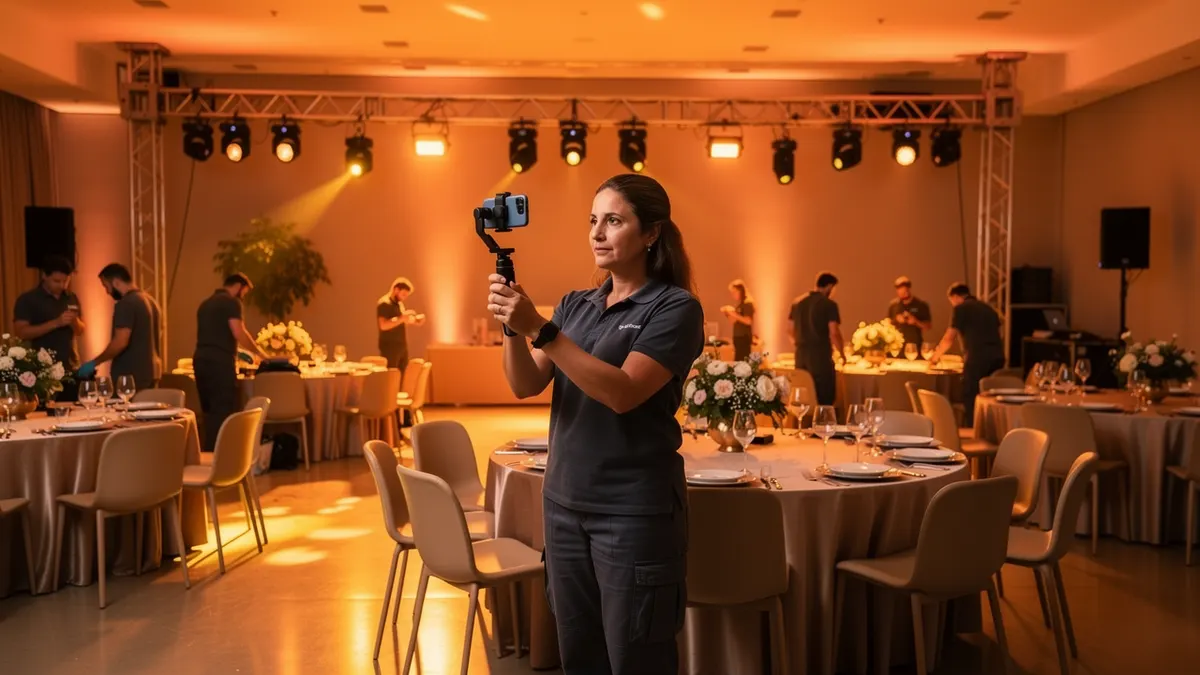
Coming-of-age parties, weddings and graduations are a real industry there, and every supplier in the chain has to prove it delivers.
Why the category buys content
Three reasons, and they hold for every trade in the chain.
The decision comes from a recommendation, but the checking happens on video: somebody asks for a caterer's name, then looks at what they delivered.
Every job is unique and never repeatable: the only possible proof is that of a past job.
And the chain is long: venue, catering, decoration, sound, photography, transport, each selling to the family and recommending the others.
The formats that work
Five, in order of effectiveness.
The set-up and the strike, described above.
The tasting or the trial run, filmed like a working meeting, with the questions the family asks.
The floor plan explained aloud: how many people, what circulation, where the main table goes.
The quote explained line by line, with no amounts, answering the question of what is included.
And the day after: the state of the venue, the equipment packed, what was handed back.
The rules that must be written down
Four points, settled before the event and not during.
Guests' image consent, always
No recognisable person may appear in commercial content without written authorisation. Provide a simple form, given to the organisers in advance, and accept that some people will refuse.
Minors require the agreement of those with parental authority
That point is not negotiable, and it particularly concerns birthday parties and graduations. The authorisation comes from those legally responsible, in writing, with the duration and the media.
Not everything can be published
A religious ceremony, a family moment, a private room: what happens in a private setting does not become public because a supplier was working there.
Alcohol on screen follows rules
Showing alcoholic drinks in commercial communication is regulated, and the applicable rules are checked with the competent authorities before publication.
What is settled before an event
Six points with the hosting family.
Who may appear on camera.
Which moments are not filmed.
Where you stand during the ceremony.
Whether extra lighting is allowed.
Who approves the images before release.
And what happens to the raw footage afterwards.
What is filmed when nothing can be replayed
| Moment | What you must have | Window |
|---|---|---|
| The preparations | Hands, details, the quiet | One hour |
| The arrival | A wide shot, held | Thirty seconds |
| The party | Short shots, without intruding | All evening |
What is agreed with the organisers
The minute-by-minute programme, the off-limits places, the person to alert, and the consent of guests appearing in close-up.
What is backed up before leaving
A copy on a second medium, made on site. A card lost after an event cannot be replaced by anything, and no apology makes up for the loss.
Practical notes for the supplier
Five habits that turn an occasional shoot into a commercial asset.
Ask for the authorisation when the contract is signed, never on the day of the event.
Set up a fixed camera for the installation, running by itself while you work.
Systematically film the detail only you see: the bow retied three times, the tablecloth ironed on site, the spare wheel of the trolley.
Keep a version with nobody on screen, usable immediately, and a version with guests, publishable only when every authorisation is in hand.
And republish twelve months later, in the same season: in this category content does not age, it simply waits for the next family starting to look.