Try-on formats, honesty about sizes, tropical fabrics and how to brief so that the clothes sell.
What really converts
Four formats, in decreasing effectiveness.
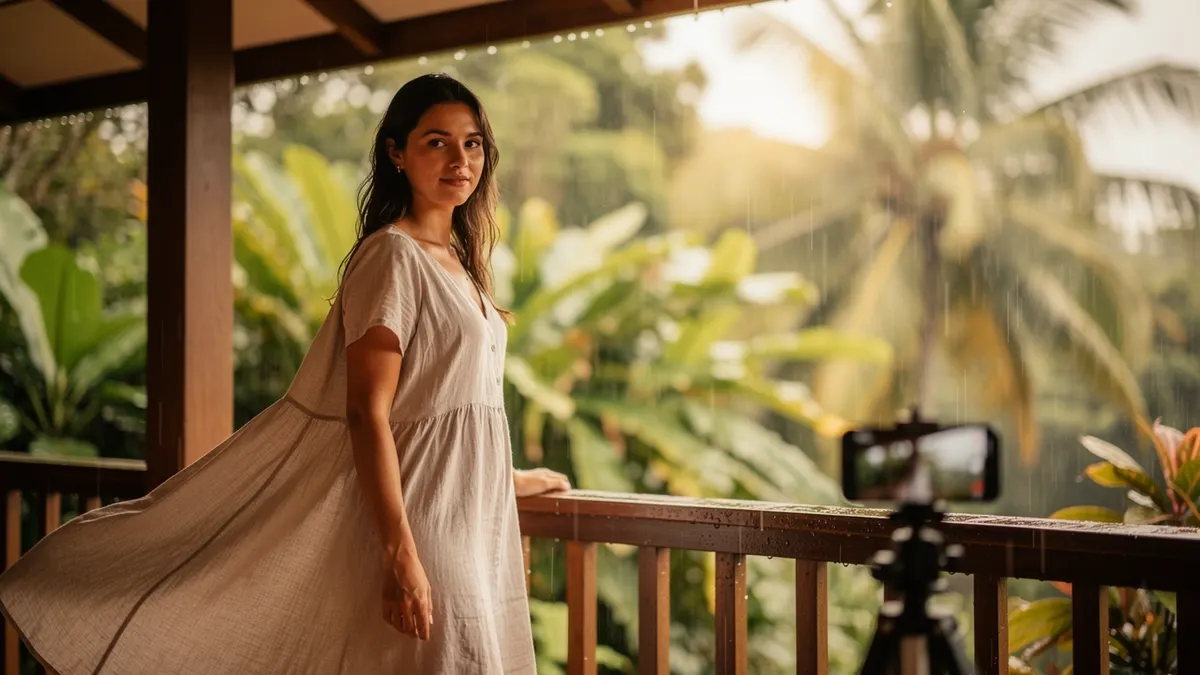
The full try-on: the garment put on, adjusted, seen from the front, the back, in movement.
The same garment worn by different body shapes, which is worth more than ten descriptions.
The pairing: what is worn with it, in a real outfit, not on a mannequin.
And the fabric format, dealt with above.
Honesty about sizes
Four practices, all profitable.
The creator states their measurements and the size taken, out loud.
They say what is tight and what is loose, without softening it.
They show the garment in the positions that cause problems: seated, arms raised, leaning over.
And they indicate when a size up or down would suit better.
One fundamental note: those four practices seem to work against the sale. They do the opposite, because the cost of a return almost always exceeds the margin on one extra sale.
Fabric, the central subject
Three reasons the subject counts more here than elsewhere.
The climate demands breathable materials, and the audience knows it better than the brand.
Local natural materials have a strong argument, provided they are not turned into an unverifiable ecological promise, ground where advertising rules are strict and are checked with a lawyer.
And care decides the lifespan: what bleeds, shrinks or loses shape is said in the video, not on a label nobody reads.
Which creators to engage
Three profiles, with their uses.
The local fashion creator, who knows the codes and the vocabulary here.
Somebody from the target audience, not necessarily a creator, whose body resembles the customers'.
And the travel profile, only if the brand sells for export, because it shows the garment in a setting that sells abroad.
The brief that produces good material
Six points to write, never more than one page.
What the garment has to solve for the person buying it.
The compulsory shots, including the take after an hour.
The measurements to state.
What must not be said, notably any unproven promise of result or durability.
The exact advertising disclosure.
And the rights requested, duration and channels.
The export opportunity
Three reasons a brand from here has a card to play outside the country.
The natural setting is an argument foreign brands pay dearly to reconstruct.
Materials suited to hot climates interest much larger markets.
And short production allows limited series, a strong argument in online selling.
One condition: sizes and shipping times must be stated in the language of the target market, with no approximation.
What you film for a garment
| Shot | What it proves | Trap |
|---|---|---|
| Trying on, in motion | The real drape | A still shot that lies about the fabric |
| The material close-up | Texture and stitching | Light that falsifies the colour |
| A styled outfit | The daily use | A set that steals the show |
What is said about colour
The shade shifts from one screen to another. Filming near a window, with no filter, and saying so out loud avoids half the returns.
What is verified before naming a material
A composition, an origin, a label or a process. Each is read on the tag and confirmed with the brand, never guessed by eye.
The Costa Rican calendar
Three periods, three needs.
The dry season, which concentrates sales of light clothing and events.
The green season, when the talk is of fast-drying materials and light layering.
And the year's end, the only real gift period, prepared from October.
One last marker: in this sector the video that sells is not the one flattering the garment, it is the one answering the question asked in front of the mirror. Does this suit me, will I be too hot, and will it last.