In this market, the online buyer asks three questions before paying, and none of them is about the product itself.
Will it arrive
That is the first question, and it dominates everything else.
The buyer wants to know whether the shop really exists, whether somebody answers, and whether the parcel will leave. It is not a logistics problem, it is a problem of proof.
Three videos answer it. The real place: the workshop, the premises, the packing table. The person preparing the orders, with their face and their first name. And one order followed from start to finish, from the conversation to the handover of the parcel.
Those three videos serve for years, do not go out of date, and belong at the top of the home page rather than on an account.
Will it arrive intact
That is the second question, and it is settled with a single sequence.
Film the real packaging: what protects, what wedges, what closes. Then film the opening, as the buyer will experience it.
Add the journey when it is risky. A fragile product, a liquid, a heavy object: showing that the packaging was designed for that journey beats a promise of care.
Does it match the photo
That is the third question, and it is the one that generates returns.
The answer is a video showing the product with no staging: its real colour under ordinary light, its real size next to a known object, its real material filmed close up.
Two practical consequences. Measurements are said out loud and shown on screen. And a known difference, a shade that varies, an irregular finish, is shown rather than hidden: it turns a future return into an informed purchase.
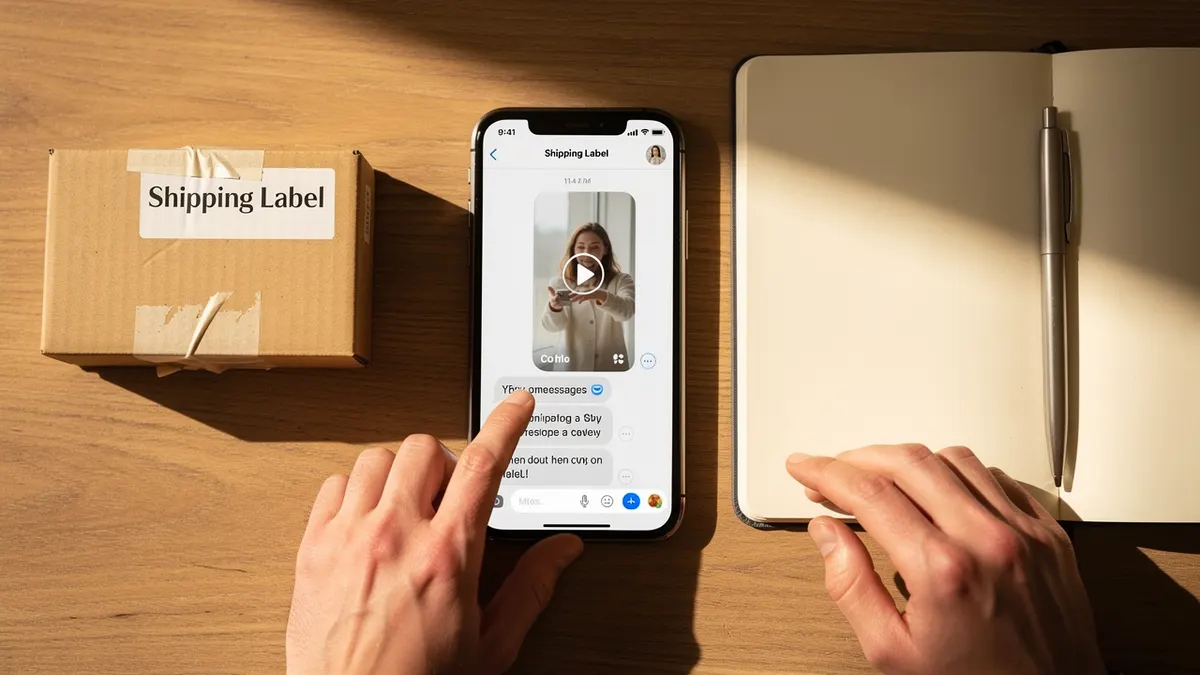
Messaging is part of the setup
That is the particularity described in the box, and it has production consequences.
Plan short, light videos meant to be sent inside a conversation: an answer about size, one about availability, one about how to use it, one about the timescale.
File them in a folder the sales team finds in ten seconds, with explicit names. A video nobody can find when a customer asks the question is worth nothing.
How many pieces to buy
The rule holds in one sentence: one shoot, several uses.
The same session produces the product page, two advertising variants, a messaging answer and a sequence for in-store screens if the brand has any.
That is what makes a shoot profitable in a modest-sized market: it is not the number of videos, it is the number of places where each one works.
The local calendar
It follows two rhythms.
The pay rhythm, which concentrates purchases on certain days of the month. Running a campaign just before is more effective than running it continuously.
And the tourist rhythm, which shifts demand by season and by region.
Add the periods when delivery slows down, and plan in advance the video announcing a longer timescale. An honest announcement keeps a customer, silence loses them.
What is most often missing from a product page
| Gap | What the video adds | Expected effect |
|---|---|---|
| Scale | The object held in hand | Fewer returns |
| Material | A close-up on the touch | Fewer questions |
| Assembly or setup | The gesture filmed in full | Fewer abandoned carts |
What you shoot for a whole catalogue
One set, one frame, a ten-second shot per reference. Thirty products fit in a day.
What is checked before going live
The file name, the linked reference, the orientation and that the first frame is not a black screen.
What brings a buyer back
One thing only, and it can be filmed.
The after-sale: the follow-up message, the way a problem is settled, the answer to a complaint. That is the part nobody shows and everybody judges.
A shop that films how it handles a return sells more than one promising impeccable service. The obligations applicable to guarantees, returns and disclosures depend on your situation and are checked with a lawyer, before announcing them.