Try-on formats, honesty about sizing, the sales calendar and how to brief so the clothes sell.
What really converts
Four sequences, in decreasing effectiveness.
Movement: walking, sitting, raising the arms. A fabric is judged on its reaction, not on its stillness.
The material in close-up and in natural light: weave, thickness, transparency against the light.
The real context: the garment worn in the situation it will serve in, with the shoes and bag that go with it.
And the size comparison on different body shapes, filmed in the same frame.
One shot that almost never converts: the silent catwalk set to music. It shows the garment without answering a single buying question.
Returns, the sector's obsession
Three dominant causes, all treatable in video.
Size, which remains the first cause: it is treated by giving the person's measurements and the size worn, out loud and on screen.
The material, disappointing compared with the photo: it is treated by close-up and by a factual description, with no superlative.
And the colour, which differs by screen: it is treated by filming in daylight, with no filter, and saying so.
One consequence for measurement: in this sector the indicator that counts is not the click rate, it is the return rate per reference, before and after the video goes live.
Which creators to hire
Three criteria, in this order.
A body shape representative of your real customers, not of your campaign photos. Three creators of different shapes are worth more than one ideal profile.
The ability to film in movement, steadily, in natural light.
And ease in saying their measurements and the size worn, without it becoming a subject.
One criterion not to overweight: personal style. It counts for image, but it is the clarity of the information that brings returns down.
What to check before publication
Four points, to be taken seriously.
The advertising disclosure, said and shown in the video.
Claims about composition, origin and care: they have to match the label, and are checked with a lawyer depending on what is stated.
Environmental claims, particularly regulated: they are never improvised.
And the image rights of the people visible, with the same duration as the usage rights.
One arrangement avoiding reshoots: approve the script before the shoot, not the video afterwards. A forbidden sentence forces the whole sequence to be redone.
What the buyer wants to verify
| Doubt | The shot that answers it | What must be said |
|---|---|---|
| The real cut | A full turn, without posing | The size worn and the body shape |
| The fabric | A close-up in movement | The material and the drape |
| The colour | A take near a window | The gap with the website photo |
What is prepared before trying on
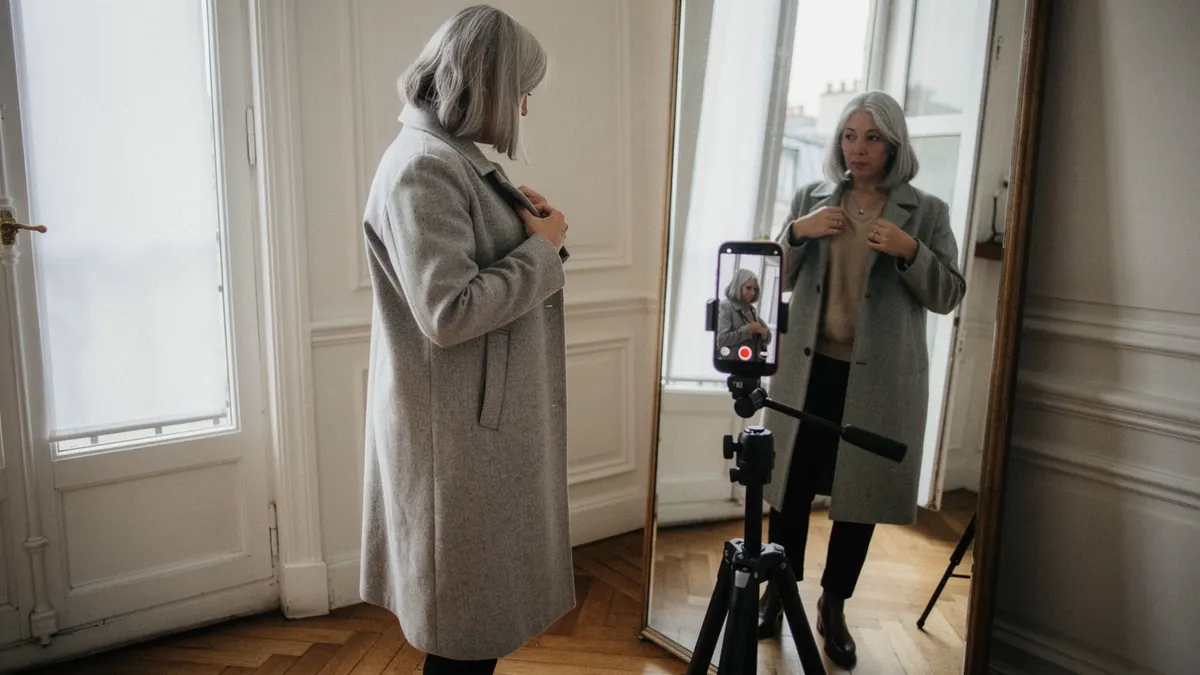
A neutral background, side light, a mirror out of frame, two sizes if possible. A video comparing two sizes answers the most frequent question in the comments.
What is never retouched
The silhouette. An undisclosed alteration misleads about the garment itself, and what the return reveals costs more than the video earned.
The French calendar
Four moments structure the year.
The sales, which concentrate a large share of purchases and whose dates are regulated: videos are ordered six weeks ahead.
The September return, a period of rational buying and renewal.
The end-of-year festivities, where content has to be delivered in early November to be published at the right moment.
And the between-seasons, underused, where advertising competition is weaker and the acquisition cost lower.
One economical practice: shoot two seasons in the same day when the wardrobe allows it, changing the setting and the light. The gain is immediate, and the brand has a reserve when everybody is looking for an available creator.
One last marker, valid for the whole category: the most profitable fashion video is not the most beautiful, it is the most informative. Somebody who says their size, shows the garment seated and describes the fabric earns more money than a polished edit answering nothing.