On a marketplace listing, the photos ask the questions and the video answers them. It is the only place where a video is judged on the return rate rather than the view count.
Filming for a comparison, not for a brand
That is the fundamental difference from a social media video.
In a feed, the video has to stop somebody who was not looking for anything. On a listing, it addresses somebody already comparing three similar products and looking for a reason to decide.
The tone therefore changes completely: no hook, no story, no suspense. The object is shown, handled, and questions are answered.
And the first frame counts more than the first sentence, because playback starts silent, often in a small format.
The four useful shots
They are enough to cover most questions.
The real unboxing, to show exactly what the box contains: accessories, cables, instructions, spare parts.
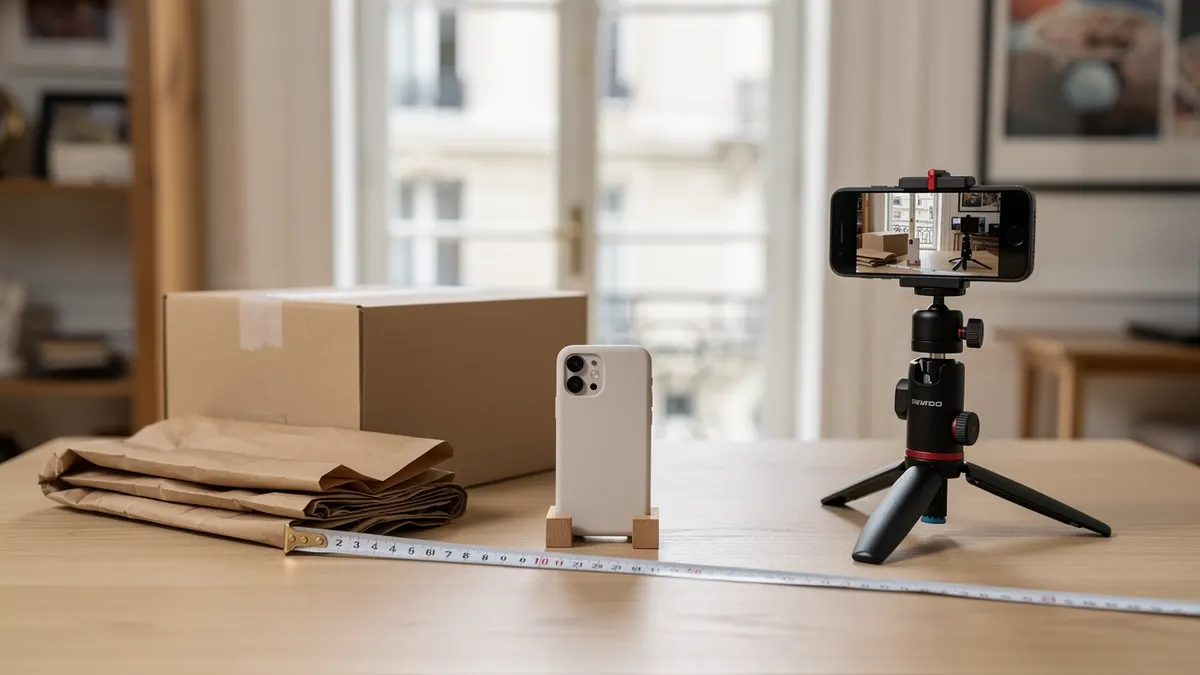
The scale, with a hand or a known object in frame, because size is the leading cause of returns.
The continuous operation, with no cut, including the slightly laborious part: the assembly, the setting, the first start-up.
And maintenance: how it is cleaned, stored, replaced.
Add, where the product allows, a fifth shot: the real noise, recorded at normal use distance.
What the platform does not accept
Four families of rejection, all avoidable.
Unproven claims, particularly on health, safety, efficacy and numbered performance.
Named comparisons with a competing product.
Anything directing people away from the listing, whatever it is.
And content resembling a spontaneous customer review while being commissioned. The distinction between a brand video and a consumer review falls under precise rules, checked before publication.
What to ask the creator for
Five points, written into the brief.
A shoot in neutral light, with no filter, because perceived colour triggers returns.
A wide framing, leaving margin to recrop to square and vertical.
Clean sound, with no music.
The rushes delivered alongside the edit.
And a second short version, ten to fifteen seconds, for advertising on the platform itself.
What counts differently on a selling platform
Six requirements for the material.
A white background for the main image.
A video that names no other retailer.
No price on screen that can go out of date.
A size reference visible in the frame.
A caption with no promotional claim.
And a file that matches the platform's specification.
What the listing demands from a video
| Constraint | What it imposes | Common mistake |
|---|---|---|
| Silent playback | Burned-in subtitles | A voice alone |
| No external element | No price, no third-party logo | A discount on screen |
| A short length | Thirty seconds maximum | A two-minute edit |
What is shown first
The real dimensions, the box contents, the assembly and the use. Those are the four most frequent reasons for returns, and the video handles all four.
What is checked before sending
The required format, a first frame readable as a thumbnail, the absence of any third-party brand, and a file name carrying the reference.
The contractual frame
Three lines that avoid every dispute.
The rights must explicitly cover use on a marketplace, which is neither the creator's account nor classic advertising.
The duration must be long: a product listing lives several years, and a one-year licence forces everything to be pulled at the worst moment.
And the right to modify must be granted, otherwise every format adaptation needs fresh approval.
Finally add the person appearing on screen: their agreement must cover the same duration and the same media as the rest.
Sources
- Urssaf, official auto-entrepreneur portal
- Service Public, how to become a micro-entrepreneur
- Service Public, crossing the micro-entrepreneur turnover thresholds
Checked on 4 September 2026. Thresholds and rates change: where this guide and the official source disagree, the official source is right.