How fashion works as a UGC niche in Brazil, the try-on and styling formats, and how creators and brands work together.
Why fashion UGC works so well in Brazil
Six reasons specific to the market.
Size is the first cause of return, and no photo solves it.
Sizes vary enormously from one brand to another, which makes a personal reference indispensable.
The diversity of bodies is real and the public notices it immediately, or notices its absence.
The climate imposes concrete questions: heat, perspiration, transparency, how the fabric holds.
Online buying dominates in some categories, with slow and costly returns.
And style is discussed in comments, which extends each video's life.
The try-on and styling formats that convert
Seven formats, ranked by effect on sales.
The movement test, dealt with above.
The same garment worn by two different body shapes, the format most requested by serious brands.
The material in extreme close-up, with side light, showing the grain and the transparency.
The wash: what the garment becomes after three cycles, a rare and much-watched format.
Three ways of wearing the same piece, which justifies the price by versatility.
The comparison between two sizes of the same item, when the person ordered both.
And the answer to comment questions, almost always the same: size, material, transparency, care.
What fashion brands look for in a creator
Six criteria, in their real order of importance.
The ability to show the garment in movement, rather than to pose.
A body shape matching their real customers, not their ideal ones.
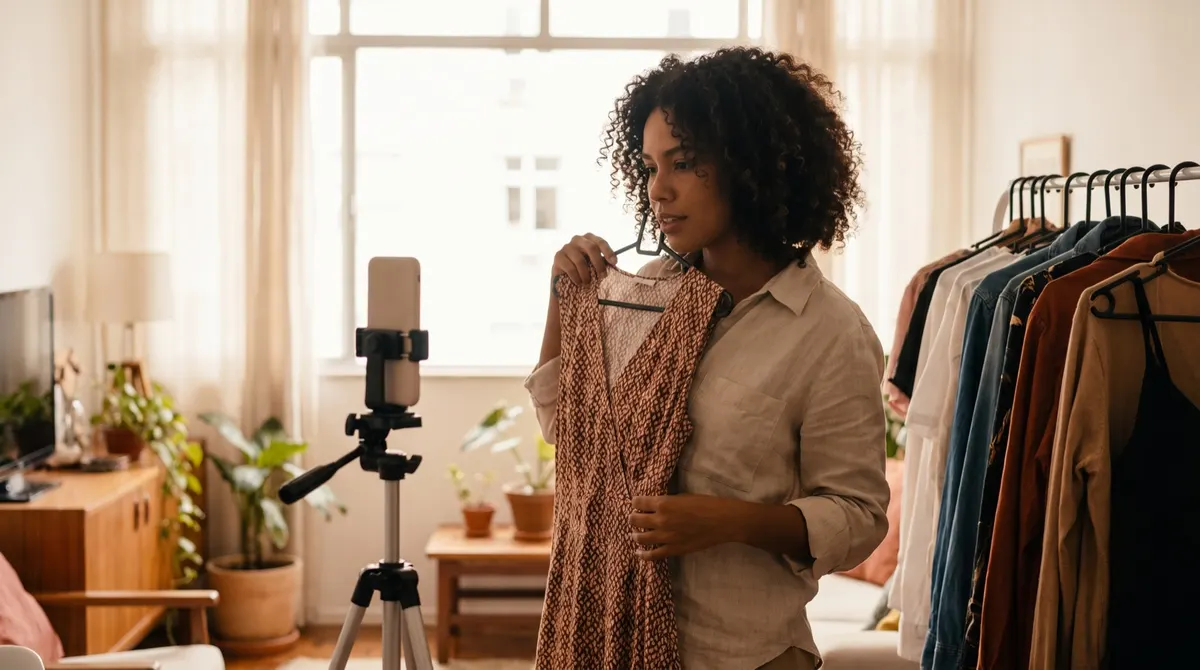
A natural setting and light, resembling an ordinary home.
Honesty about what does not work, which lends credibility to the rest and reduces returns.
Delivery regularity, as in any other category.
And the ability to produce several variants of the same piece in a single session.
How the collaboration actually works
Six points to frame in the quote.
What becomes of the garment after the shoot: return, keeping, or compensation.
Forbidden retouching: no alteration of the silhouette, no skin filter.
The mandatory mentions on composition and care, when they appear.
The obligation to say the size worn and to place it against the usual size.
The duration of rights, often tied to the collection's lifespan.
And the number of variants expected, which completely changes the shooting time.
One remark on sizes: asking a creator not to say the size they are wearing is a bad calculation. That information is exactly what the public is looking for, and its absence is read as concealment.
What a garment video must contain
| Shot | What it solves | The detail that counts |
|---|---|---|
| Walking | The drape in motion | Three seconds minimum |
| The fabric close-up | Material and stitching | Window light |
| The full outfit | The overall style | A neutral background |
What is always said about size
The size worn and the matching measurements. It is the information buyers look for most and the one videos forget most often.
What gives away a series shot in several sittings
Light that changes from one garment to the next. Grouping the whole series at the same time of day settles it before it appears in the edit.
How to break into the fashion niche
Seven decisions to take before the first order.
Choose a precise segment and own it: basics, plus size, sport, workwear, second-hand.
Film your own clothes first, applying the movement test.
Systematically state your size and measurements, which makes you useful and therefore followed.
Refuse briefs forbidding any mention of a flaw.
Shoot in natural light, near a window, never under a yellow lamp.
Keep a neutral but real background that does not date the video.
And invoice the ironing, preparation and changing time, real and systematically forgotten in quotes.
One last marker: in Brazilian fashion, a video showing a garment at its best serves nobody, because the product page already does that. What the brand buys is proof of what the garment becomes when somebody sits down in it.
Sources
- Portal do Empreendedor (MEI), Brazilian government
- Receita Federal, Brazilian tax authority
- Simples Nacional, official portal
Checked on 4 September 2026. Thresholds and rates change: where this guide and the official source disagree, the official source is right.