A January peak everybody targets and a winter that brings training indoors for five months. Where the real opportunity lies.
January is crowded and superficial
Three reasons not to concentrate the budget there.
Advertising competition is at its maximum, which raises the acquisition cost without raising the quality of the audience.
Purchase intent there is emotional and brief: a large share of the memberships taken in January do not survive February.
And the message is identical across every brand, which makes differentiation almost impossible.
One fundamental note: January is not useless, it is simply badly used. The good January video does not promise a transformation, it offers a first ten-minute session.
The indoor season is the real market
Four reasons why February to April is worth more.
The people still training in that period are the ones who actually buy equipment.
Advertising competition falls back, and the cost per view with it.
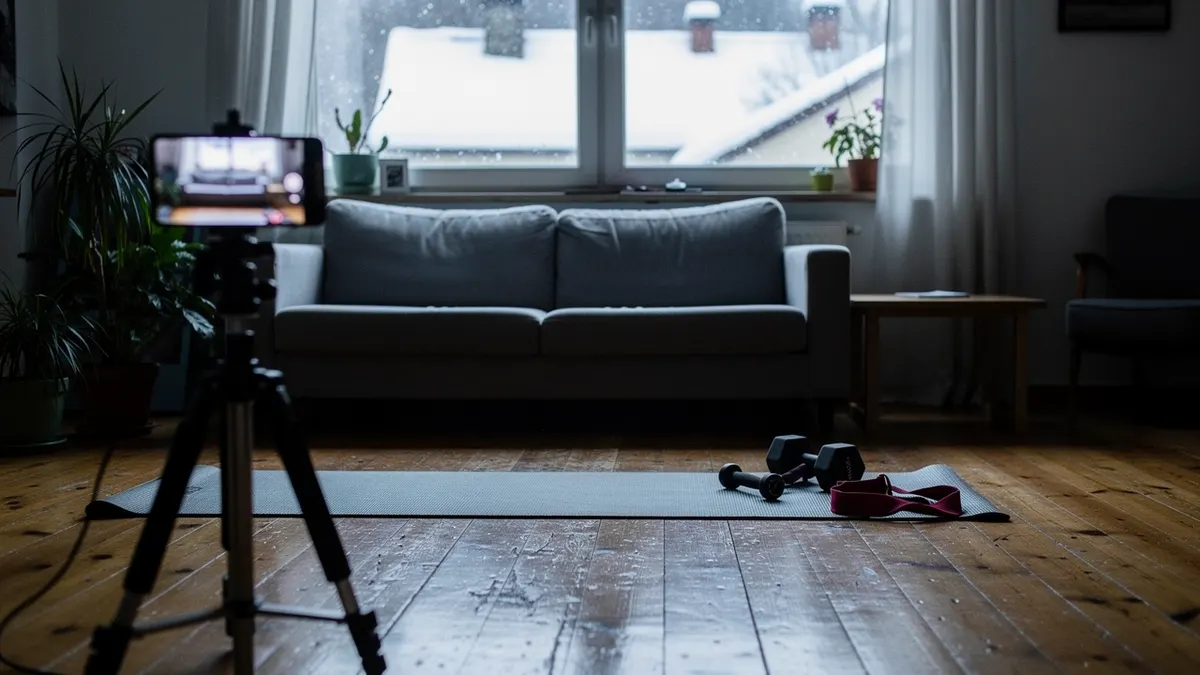
The need is concrete: reduced space, noise, low motivation, short days.
And the questions asked are precise, therefore easy to handle on video.
Claims are the risk
Five sentences never to let through in a script.
Any promise of weight loss, quantified or not.
Any statement of treating, curing or preventing a health problem.
Any nutritional recommendation presented as personalised advice.
Any comparison with a medical treatment.
And any before-and-after suggesting a guaranteed result.
One rule of method: what is allowed depends on the product, the category and the applicable texts, and that is checked with the competent authority and with a lawyer before the shoot, not at the edit. A creator is not a health professional, and must never speak as if they were.
Show the beginner, not the athlete
Four reasons making that choice more profitable.
The target audience recognises itself, which is the condition for acting.
The movement done badly then corrected is the most watched content in the category.
An ordinary body in an ordinary living room gives the product a credibility no studio buys.
And the beginner creator is available, cheaper, and often more reliable than a much-solicited profile.
Two peaks, not one
Three moments to work, with different messages.
January, with the message of the first short session.
The end of winter, when motivation drops and the need for concrete help is at its highest.
And the end of spring, when training moves back outdoors and the equipment changes.
One production consequence: shoot the three versions in a single session, changing the outfit and the hook. The marginal cost is low and the campaign covers eight months.
What is filmed in a gym, and what is filmed at home
| Subject | Best place | Constraint |
|---|---|---|
| Performing a movement | The gym, for the real load | The manager's consent |
| The product consumed | At home, steady light | None |
| The morning routine | At home | A tidy frame |
What is never promised
Weight loss, muscle gain, a time to results, or an effect on pain. Careful wording describes what you do, not what it produces.
What is verified before naming an ingredient
The composition, the dose and the permitted claim. A supplement is not a medicine and that line is confirmed with the manufacturer and a health professional.
What this sector orders
| The buyer | Their typical order | Their limit |
|---|---|---|
| An equipment brand | The gear in use | A technically correct movement |
| A gym or studio | The atmosphere and the class | Consent from those filmed |
| A supplement brand | The routine and the intake | No promise of results |
What is never promised in a fitness video
Weight loss, muscle gain, a stated timeframe. Those claims belong to the manufacturer or to a health professional, and the video limits itself to describing a use and a sensation.
What movement demands technically
A suitable shutter speed and anticipated framing. An exercise filmed too slowly turns to blur, and a repetition framed after the fact ends outside the frame, which forces reshooting the whole set.
What we never film
Four things to exclude from the brief.
The body of a minor, whatever the situation.
An injury, a pain or an accident presented as trivial.
A restrictive diet, regulated and sensitive ground.
And humiliation, even in a humorous register, which costs more in reputation than it brings in reach.
One last marker: in this category, the video that sells is not the one that impresses, it is the one making the first move possible tonight, in a fifteen square metre living room, without waking anybody.