What an agency brings that a creator cannot, what it costs, and why the bilingual requirement changes the calculation.
What an agency really brings
Four things, all real.
Coordination: a single contact who guarantees a date, replaces an absent person, handles the unexpected.
The capacity for simultaneous production: ten videos in the same week, which one creator alone cannot do.
Compliance: in regulated sectors, the habit of having a script approved and archiving the versions.
And contractual responsibility: somebody commits to a result, with remedies.
What it cannot buy
Three things, and they are precisely what makes this format work.
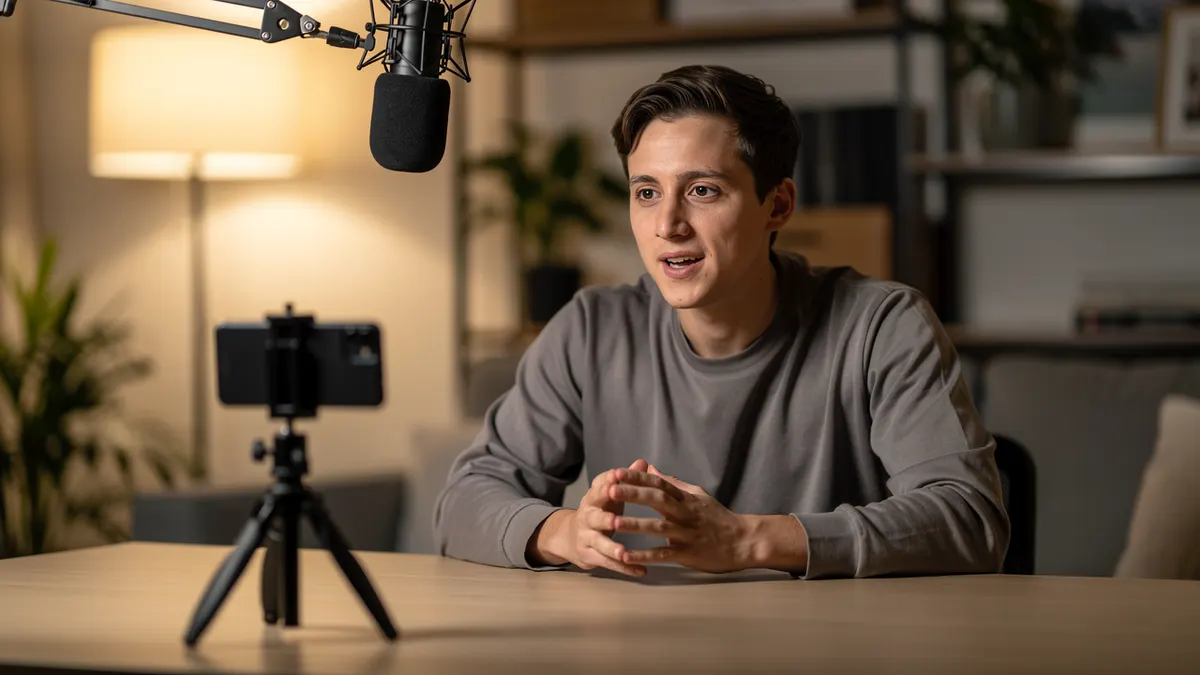
Unacted naturalness: a person talking about their daily life because it is theirs.
The authentic setting: a real kitchen, a real car, real mess.
And the diversity of faces: a batch of ten different creators produces a variety a single team cannot simulate.
One consequence: the more the video has to look like personal content, the more the agency is at a disadvantage, whatever its talent.
The bilingual calculation
Three facts changing the decision in this market.
An agency often charges the second language as a second production, dubbing, subtitling and approval included.
A batch of creators makes it possible to shoot both languages on the same day, with two different people, each a native speaker.
And the result is better: two native voices are worth more than one dubbed voice, in both directions.
One budget consequence: in this market, the cost gap between the two options widens as soon as the second language is added, and it widens in the creator's favour.
The hybrid most brands land on
Three building blocks, and it is the commonest configuration after a year of production.
A batch of creators for the feed and advertising: volume, variety, controlled cost.
An agency or a light production for the brand video, the one serving as a reference on the site.
And somebody in-house for coordination, which replaces a large part of what an agency is bought for.
One note on cost: that configuration is almost always cheaper than the agency alone, and more reliable than the creator alone.
What to ask for in both cases
Four points, identical whatever the supplier.
The rights: duration, territory, channels, with an end date.
The formats delivered, separately, and burned-in subtitles.
The rushes, which will allow re-editing with no new shoot.
And the image rights of the visible people, documented with the same duration as the usage rights.
A fifth, often forgotten point: what happens if you change supplier. Do the existing videos stay usable, and do the permissions follow you.
What each option buys
| Item | Creator | Traditional production |
|---|---|---|
| Typical lead time | A few days | Several weeks |
| Number of variants | High for the same budget | Low |
| Heavy technical control | Limited | Complete |
| Two delivered languages | Often included | Billed separately |
When production remains the right call
A shoot with extras, machinery to be filmed safely, a built set, an original commissioned soundtrack, or a film intended for television.
How the two complement each other
Production delivers the brand film, creators deliver the variants that feed the advertising over the following months. Two budgets, not two camps.
How to decide
Three questions, in this order.
Where will the video be seen: in a feed, on a product listing, or in a presentation?
How many different versions are needed, languages included?
And who, on your side, can devote time to coordination?
One last marker, more useful than the debate itself: it is not a question of quality, it is a question of register. A video too well made for its placement fails exactly like a video too badly made for its own.