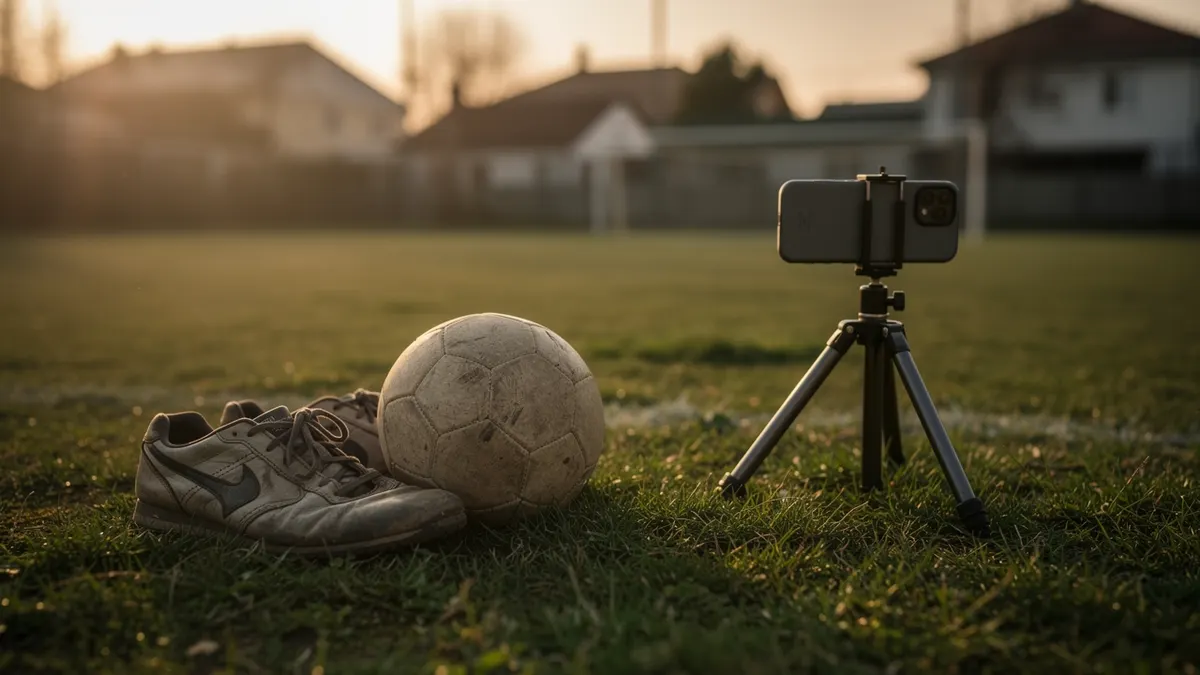
It is the country's most emotional category, and the one where people most often film without having checked what they are allowed to show.
What is protected
More things than people imagine.
The names and emblems of clubs and competitions, official shirts and their marks, match footage, anthems and chants, the image of the players, and sometimes even the colours associated with an identity.
The applicable rules depend on the rights holders and the agreements in force; they are checked before the brief is written, with a lawyer in case of doubt.
What can be done
A great deal, as soon as you stop trying to borrow an identity.
Filming the garment for what it is: the cut, the fabric, the breathability, how it behaves after ten washes, the real size on different builds. Telling the weekend ritual, the journey, the wait, the meal, the atmosphere at home.
The feeling belongs to nobody. It is the signs that belong to somebody.
The supporter's calendar
It resembles no commercial calendar.
The peaks come around important matches, kit changes and competition periods. In between, attention collapses. A campaign built on a calendar month systematically misses its window.
So build your plan on the sporting calendar, and keep content ready to publish rather than content to shoot in a hurry.
Beware of the result
That is the risk peculiar to this category, and it is mechanical.
A scheduled post celebrating anything two hours after a defeat produces immediate and lasting rejection. So plan two versions, one neutral and one celebratory, and somebody with their hand on the scheduling that same evening.
The simplest rule: nothing goes out automatically on a match day.
The creator has to be a supporter
It cannot be acted, and the audience spots it in a second.
The vocabulary, the nicknames, the way of naming a move, what you watch during a passage of play: none of that is learned from a brief. A creator who knows nothing about it produces a video the community will comment on against you.
So cast on genuine knowledge of the subject before any other consideration.
What turns against a brand fastest
Visible opportunism.
Associating yourself with a victory you had no part in, using a sporting tragedy as a hook, or imitating a club's communication with no connection to it. Those three moves produce the same result: the community names them, and it has a long memory.
What this sector orders
| The buyer | Their typical order | What they require |
|---|---|---|
| An equipment brand | The product in motion | Real use, not posed |
| A retailer | The shirt on the rack | Faithful colour rendering |
| A club or academy | Everyday training | Consent from those filmed |
What is never filmed without permission
A club badge, an official crest or a competition shirt. Those elements are protected, and commercial use requires written agreement from the rights holder, not just from the person wearing it.
What movement demands technically
A suitable shutter speed and anticipated framing. A sporting gesture filmed too slowly turns to blur, and an action framed after the fact ends outside the frame, which makes the take unusable.
What to deliver as well
A version with no distinctive sign visible.
It serves when an agreement is not yet signed, when an ad platform refuses the video, or when the campaign has to run in another country where the rights are different. It is shot straight afterwards and costs one extra take.
Sources
Checked on 4 September 2026. Thresholds and rates change: where this guide and the official source disagree, the official source is right.