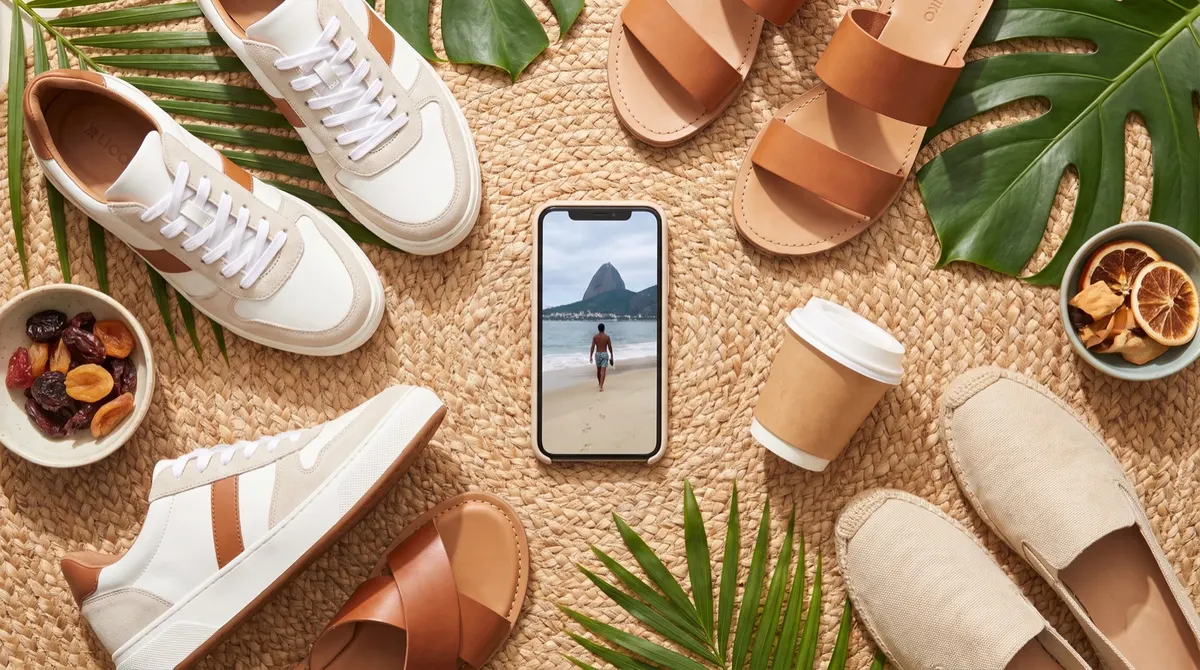
How shoe and sneaker brands in Brazil use UGC, the on-foot and styling formats, and how creators deliver.
Why UGC fits footwear so well in Brazil
Six reasons specific to the category and the market.
Size is the first cause of return, and no photo solves it.
Sizes vary from one brand to another, which makes a personal reference indispensable.
Comfort cannot be seen in an image: it is inferred from a walk, a duration, a wear pattern.
The climate imposes concrete questions: heat, perspiration, rain, uneven ground.
Footwear is a massive online purchase, with slow and costly returns.
And style is discussed in comments, which extends each video's life.
The footwear formats that convert
Seven formats, ranked by effect on sales.
Wear after two weeks, dealt with above.
The walking test: three steps, a kerb, a staircase, filmed from the side.
Scale and fit: the foot inside, the ankle, the lacing.
The comparison between two sizes of the same model, when the person ordered both.
Styling: three outfits with the same pair, justifying the price by versatility.
Cleaning: what the material becomes after a wash, information rarely given.
And the answer to comment questions, almost always the same: size, width, comfort, care.
How to film feet and movement properly
Seven technical rules.
Film from the side, at ankle height, never looking down from eye level.
Rest the phone on a support for walking shots, otherwise the image shakes and the movement becomes illegible.
Choose a real surface: pavement, tiles, earth, rather than a white background.
Keep the direct sound: the noise of the sole on the ground says something about the material.
Film in natural side light, which reveals the texture of leather or fabric.
Plan a fixed shot of the pair set down, useful for the edit and for the product page.
And shoot two tight cutaways, on the lacing and on the heel, which allow clean cutting.
Where to run it and how to handle rights
Six placements and their implications.
The product page, where two videos suffice: the walk and the scale.
Retargeting, where the remaining objection is almost always the size.
Discovery advertising, carried by styling rather than by technique.
Marketplaces, where the video distinguishes one item from ten similar models.
Collection pages, to show the same pair on several body types.
And the creator's account, a distinct service invoiced by the month.
Four rights points specific to this category: the duration tied to the model's lifespan, the ban on retouching the silhouette, the authorisation to use the video on the product page after the campaign, and the fate of the pair after the shoot, to be written into the quote.
What a shoe video must answer
| The question | The shot that answers it | Length |
|---|---|---|
| How it fits | The foot going in, uncut | 6 s |
| How it holds when walking | Three steps in profile | 8 s |
| What material it really is | A close-up of the upper and the sole | 6 s |
What is missing from nearly every video
The size worn and the foot width. It is the information buyers look for most, and the only one that lowers returns.
What is verified before stating a feature
A material, an origin, a waterproofing or a safety standard. Each is read on the label and confirmed with the manufacturer, never estimated by eye or by touch.
Making footwear UGC a repeatable system
Seven practices that turn an order into a flow.
Always shoot the same sequence of shots, which makes each delivery predictable for the brand.
Film on the day of arrival and two weeks later, in the same light and the same frame.
Systematically state your usual size and the one you took, the category's most sought-after information.
Keep a reference surface, always the same, which makes your videos comparable with each other.
Offer the wear format as a paid extra: few creators do it, and serious brands want it.
Name the files with the model and the size, which saves the brand time.
And keep the rushes: a pair filmed today is reworked in six months for a sales campaign.
One last marker: in footwear, the brand is not buying a beautiful image of the product, it already has a hundred. It is buying the answer to the question that causes returns, and that answer is found under the sole, two weeks after delivery.
Sources
- Portal do Empreendedor (MEI), Brazilian government
- Receita Federal, Brazilian tax authority
- Simples Nacional, official portal
Checked on 4 September 2026. Thresholds and rates change: where this guide and the official source disagree, the official source is right.