How skincare and dermocosmetic brands in Brazil use UGC, the routine and results formats, with caution on claims.
Why skincare UGC is so strong in Brazil
Seven reasons rooted in the local market.
The climate makes sun protection and light textures daily subjects, not seasonal ones.
Skin types are extremely varied, and one demonstration never speaks to everybody.
The audience is informed: it knows ingredients, compares them and reads lists.
The price of full routines pushes people to look for opinions before buying.
Pharmacy and dermocosmetics hold a central place in buying habits.
Short videos replace in-store advice, which is missing online.
And the texture of a product, the one thing a photo does not show, can only be judged on video.
The skincare UGC formats that convert in Brazil
Seven formats, from the most useful to the most decorative.
The complete morning routine, filmed in one take, with no cut between steps.
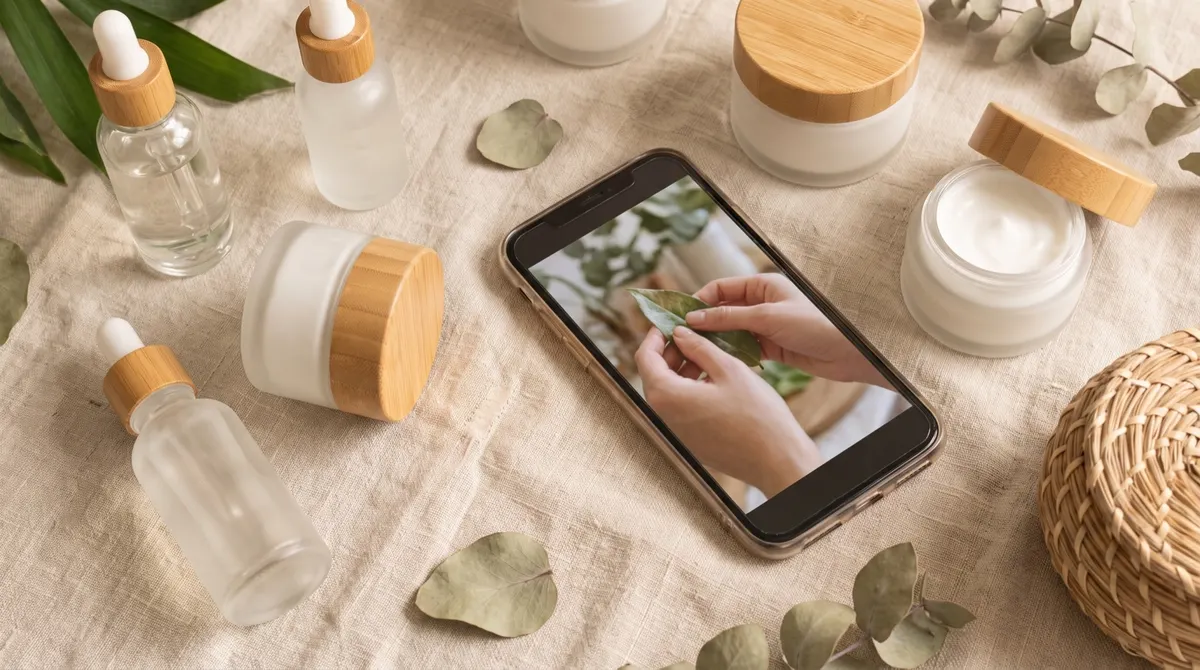
The texture close-up, product on the back of the hand then spread, which answers the first question.
The test under make-up, much in demand for sun protection.
A whole day with the same protection, including the result after four hours.
The thirty-day report, honest, including when the result is modest.
The comparison of two textures for the same need, a rare and much watched format.
And the unboxing, which is only worth anything if it shows the real size of the container, often smaller than imagined.
How creators film skin close-ups
Seven settings that make a skin video credible.
Filming near a window, since side light reveals the texture that front light erases.
Keeping exactly the same position and distance for the before and the after.
Not cleansing the skin just before filming the before, which distorts everything.
Avoiding ceiling light, which hollows out shadows and invents them.
Filming with no make-up on the area concerned, otherwise the demonstration demonstrates nothing.
Coming in to fifteen centimetres for texture, on a stable surface.
And stating the time of day, since morning skin and evening skin are not comparable.
Setting your phone for honest skin
Six checks before the first take.
Turning off beauty mode, dealt with above, and confirming it on a test shot.
Locking the exposure, failing which the camera corrects on its own between two shots.
Locking the white balance, otherwise the skin colour changes mid video.
Cleaning the lens, since a fingerprint acts exactly like a softening filter.
Filming in the highest resolution available, because compression destroys fine texture.
And recording one second of a reference, a white wall or a sheet of paper, which allows the colour to be checked afterwards.
Responsible claims and regulatory care
Seven rules, to be confirmed with a lawyer and with the competent health authority before the shoot.
A cosmetic is not a medicine, and medical vocabulary is to be set aside entirely.
Any claim of treatment, cure or action on a pathology is excluded.
The permitted claims depend on the product's category and registration, which is checked with the competent authority.
A personal result is told in the first person, without being presented as a general rule.
Sun protection has its own particularly strict claims framework, to be repeated word for word.
A skin reaction mentioned in a video has to be reported to the brand, never minimised.
And any wording taken from a health professional has to be validated in writing before release.
How skincare brands and creators work together
Seven working points specific to this category.
The brief provides the closed list of authorised wordings, without which nothing can be filmed.
The timeline is long: a routine is tested over several weeks, which has to appear in the schedule.
The product is sent in advance, and the receipt date governs the delivery date.
The creator documents their skin at the start, without which no follow-up is possible.
The brand approves the script before shooting, normal practice here and not a lack of trust.
Advertising rights are negotiated separately, with a written duration.
And the regulatory review is added to the schedule, which lengthens the cycle compared with other categories.
What is filmed on a skincare product
| Shot | What it shows | The lighting condition |
|---|---|---|
| The texture on a finger | The real consistency | A side window, no filter |
| The application | The gesture and the amount | The same light from start to finish |
| The result on the skin | What it really does | No smoothing, no retouching |
What is said out loud
That the skin shown is the creator's, that the light is unmodified, and that the result applies to that skin only. Three sentences that protect the brand as much as the person on screen.
What is never promised
An effect on a skin condition, marks disappearing, a deep action or a time to results. Those fall under the cosmetics framework and are confirmed with the manufacturer and a lawyer.
Building a series over several weeks
Six steps that turn one shipment into a programme.
Filming the starting point on the day of receipt, never reconstructed afterwards.
Keeping the same framing, the same hour and the same wall throughout the series.
Filming a short sequence every week, even when there is nothing to show.
Noting the other products used, without which no conclusion is possible.
Delivering a final edit plus the rushes, often reused by the brand.
And offering a three-month follow-up, the one thing skincare brands cannot produce themselves.
One last marker: in Brazil, the skincare video that converts best is not the one where the skin is perfect, it is the one where you see the real texture, filmed without smoothing, at the same hour and in the same spot as on day one. Caution about claims is not a constraint suffered, it is what makes the rest credible.
Sources
- Portal do Empreendedor (MEI), Brazilian government
- Receita Federal, Brazilian tax authority
- Simples Nacional, official portal
Checked on 4 September 2026. Thresholds and rates change: where this guide and the official source disagree, the official source is right.