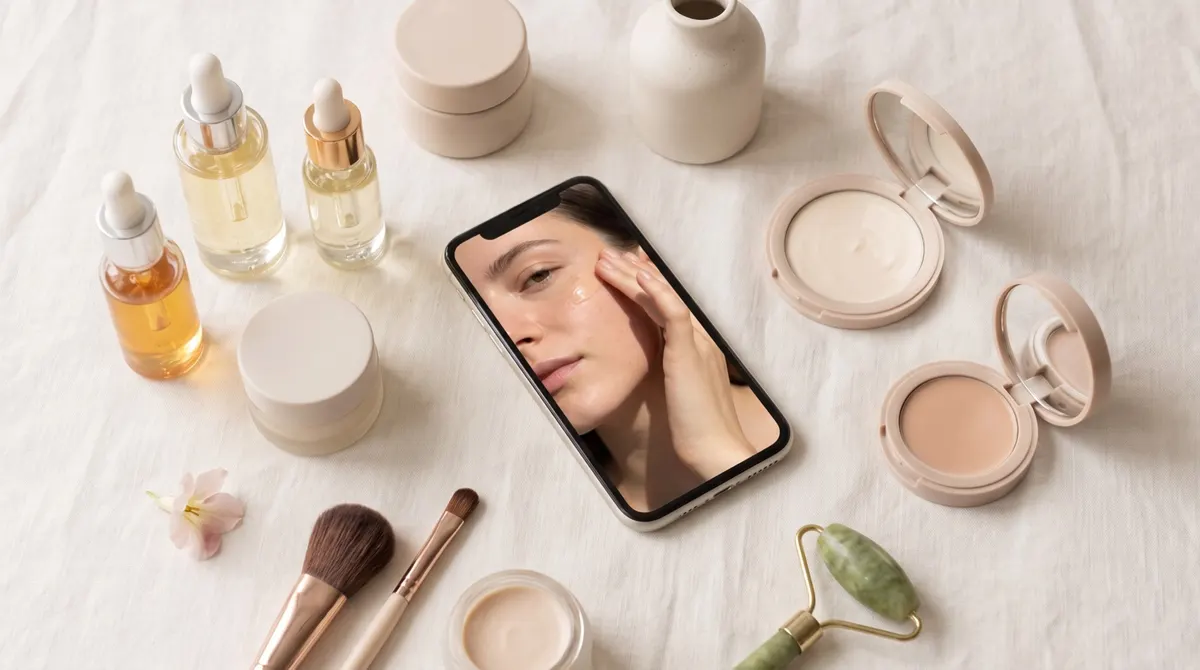
This format sells beauty because it looks true. Here are the videos that convert, the skin tone and skin type brief, the advertising rights and the casting.
Why this format works so well in beauty
Because the purchase rests on a personal question: will this work on my skin, with my tone, my age, my climate. A studio image never answers that. A video shot in a real bathroom, under real light, answers it by showing a result on somebody who resembles the person watching.
What video proves better than a photo
Six elements, all invisible in a still.
The product's texture on application.
The absorption, and how long it takes.
The finish on the skin, matt or luminous.
The quantity actually used.
The look under everyday light.
And the change over several weeks.
The formats that convert
Seven formats, from the most effective to the most situational.
The full routine, morning or evening.
The application in close-up, uncut.
The before and after over several weeks, same framing.
The test on sensitive or reactive skin, said honestly.
The comparison of two textures.
The nuanced opinion, saying what did not suit.
And the answer to one specific objection, price, smell, wear.
How to brief a beauty creator
Seven mentions to write down in full.
The skin type expected, or the absence of any requirement.
The skin tone, if the product depends on it.
The obligation to switch off all image processing, dealt with above.
The light required, natural and frontal.
The mandatory shots, application and result.
The permitted sentences, supplied word for word.
And the partnership disclosure, mandatory and visible.
Which claims are possible
The rules applying to cosmetic claims, labelling and advertising differ by country and change over time. This remains general information: the exact wording is checked with the competent authority and, in case of doubt, with a lawyer. In practice, the brand supplies a list of approved sentences, the creator describes what they do and what they observe, and any health question is referred to a professional.
What must never be said
Seven claims to rule out systematically.
A promise to treat a skin condition.
A comparison with a medicine or a medical procedure.
A result guaranteed within a specific time.
An ingredient claim not supplied by the brand.
Advice that would replace a professional's opinion.
A claim about a skin type that was not tested.
And any absolute wording, with no condition or context.
How to handle the before and after
Six rules that make the comparison credible.
Same framing, same distance, same hour.
Same light, noted at the first shoot.
No make-up in either take.
No image processing, in either one.
A real interval, stated out loud.
And a mention of anything else that changed, routine or season.
How to cast varied profiles
Six criteria, to treat as a production requirement.
Several skin tones, genuinely different.
Several ages, not only one bracket.
Several skin types, from dry to very oily.
Different hair textures, if the product concerns them.
Different climates, humidity changes the result.
And people willing to show their skin without retouching.
How many profiles to test
Six markers for an honest first batch.
Three different profiles at minimum.
Two formats per profile.
A single promise, the same for everybody.
An identical distribution budget per video.
Three weeks before the first reading.
And a silent version for the product page.
What usage rights to provide for
Six elements to write into the quote.
Paid advertising, invoiced separately.
Use on product pages.
A duration of at least twelve months.
The right to recrop and re-edit.
Use of stills pulled from the video.
And the obligation to withdraw if a claim becomes inaccurate.
What to supply before the shoot
Six documents, sent with the product.
The list of permitted sentences, word for word.
The list of forbidden words.
The formulation as it appears on the packaging.
The instructions for use, quantity and frequency.
The approving contact, with their hours.
And the written instruction to switch off all image processing.
How to handle the comments
Six rules, written before publication.
The creator never answers a medical question.
The brand posts a standard reply, prepared in advance.
Questions about an untested skin type go up to the brand.
Comments asserting an effect are not amplified.
Reasoned criticism gets an answer, not silence.
And nothing is improvised, even under a pile of messages.
What to measure
Six indicators, none of them views.
The repeat purchase rate, decisive in skincare.
The product return rate.
The number of questions about skin type.
The cost per video actually run.
The video's lifespan in paid advertising.
And comments raising a health question, to be handled separately.
The most frequent shooting mistakes
Six errors that make a video unusable.
Leaving the beauty mode on, dealt with above.
Filming under yellow bathroom light.
Moving position between the before and the after.
Applying an amount that does not match the instructions.
Showing another opened product in frame.
And cutting just before the result, out of shyness.
What a beauty video costs
Seven markers, to adjust for the product.
A short application format.
A full routine, longer to film.
A before and after over several weeks, dearer by nature.
A batch of three products filmed the same day.
A second vertical version from the same shoot.
Category exclusivity, invoiced separately.
And advertising rights, never included by default.
What is filmed on a beauty product
| Shot | What it shows | The lighting condition |
|---|---|---|
| The texture on a finger | The real consistency | Side window, no filter |
| The application | The gesture and the amount | The same light from start to finish |
| The result | What it does on this skin | No digital smoothing |
What is said out loud
The skin shown is that of the person on camera, the light is unmodified, and the result applies only to that skin. Three sentences that protect everyone.
What is never promised
An effect on a skin condition, a deep action, marks disappearing or a timeframe. Those fall under the cosmetics framework and are confirmed with the manufacturer and a lawyer.
What the platform simplifies
On UGC MATCH, the brief travels with the order, the brand pays at ordering without the funds being released straight away, the video is delivered in a private space, and payment goes out on approval.
One last marker: in this category, the video that sells is not the one where the skin looks best, it is the one where you can see that it changed.