What the video must show, the claims a cosmetic can never make, and why this audience reads the ingredient list.
What can be shown without asserting anything
Five shots, and they carry the whole video.
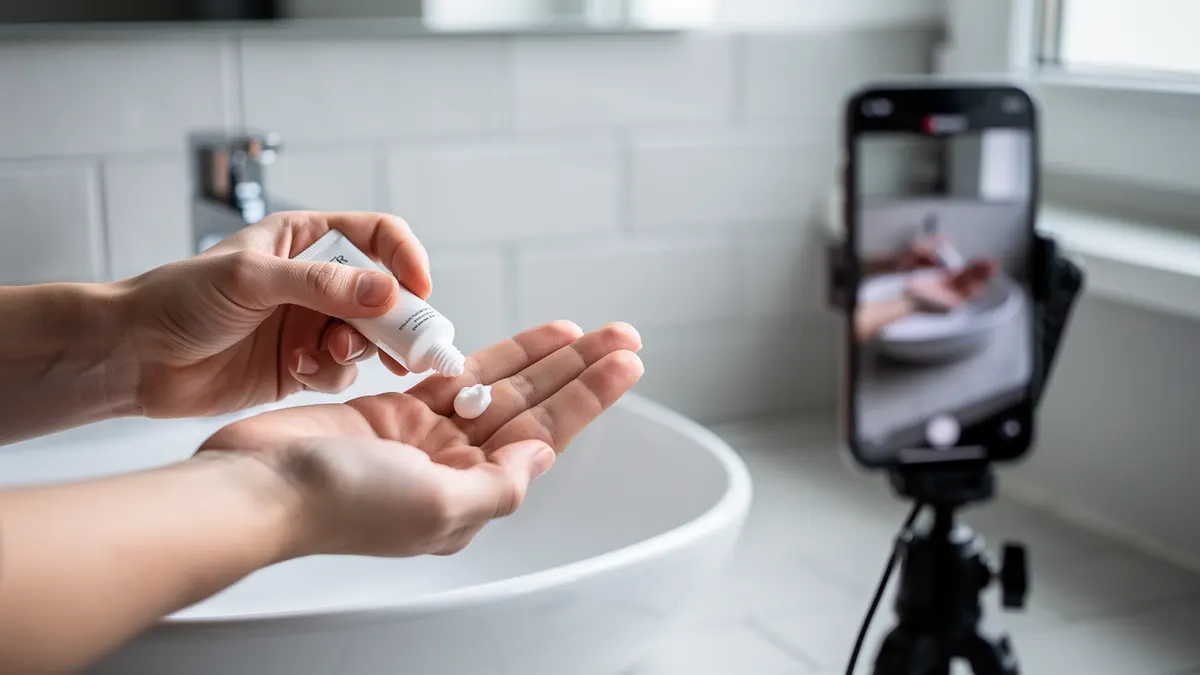
The texture as it comes out: what runs, what stays, what sticks.
The quantity actually used, measured by pea or by pump, counted out loud.
The application in real time, with no speeding up and no cut.
The look at five minutes, then at three hours.
And the product under a garment, on a collar, on a light fabric: the question everybody asks and nobody films.
Before and after is a technical exercise
The most closely watched format in the category, and the easiest to get wrong.
Five conditions for it to be acceptable: same light, same distance, same lens, same time of day, no makeup added between the two takes.
Two further rules. No retouching, no filter, no automatic smoothing by the phone, which must be switched off in the settings. And the time interval displayed on screen, in days.
That format proves nothing on its own: it illustrates an individual experience, and it must be presented as such.
What convinces in this category
Four things, in order.
The length of use: a video shot on day twenty-one is worth ten videos shot on day one.
Consistent conditions: same bathroom, same light, same angle.
The sensory description: smell, texture, absorption time, how it feels afterwards.
And mentioning what did not work: that is what makes all the rest credible.
What not to do
Five formulations that get a video pulled.
Announcing a cure, a treatment, an action on a disease or an inflammation.
Promising a permanent effect or a change of structure.
Comparing by name with a competing product while asserting superiority.
Attributing an effect to a specific ingredient with no basis supplied by the brand.
And presenting a cosmetic as a substitute for medical advice, including as a joke.
What the light decides
| Source | Skin rendering | When to use it |
|---|---|---|
| Side window | Visible texture, soft shadows | Applying a skincare product |
| Front ring light | Smoothed skin, catchlight in the eye | Make-up |
| Ceiling light alone | Marked under-eye shadows | To avoid |
What is shown in close-up
The texture leaving the bottle, the spread on the back of the hand, the absorption after thirty seconds. Those are the three shots buyers actually look for.
What is not said on camera
A therapeutic effect, a duration of results, a comparison with a treatment. The permitted vocabulary is tightly framed, to be confirmed with a lawyer.
The brief
Four elements to supply to the creator, and they avoid half the revisions.
The written list of authorised wordings, word for word, with those that are forbidden.
The exact routine: at what time, on what skin, in what quantity, how many times a week.
The length of the test before shooting, with a start date.
And the number of creators planned: in this category one test means nothing, because the result depends on the person as much as on the product. Three to five different profiles, filmed in the same conditions, are the minimum for a useful conclusion.