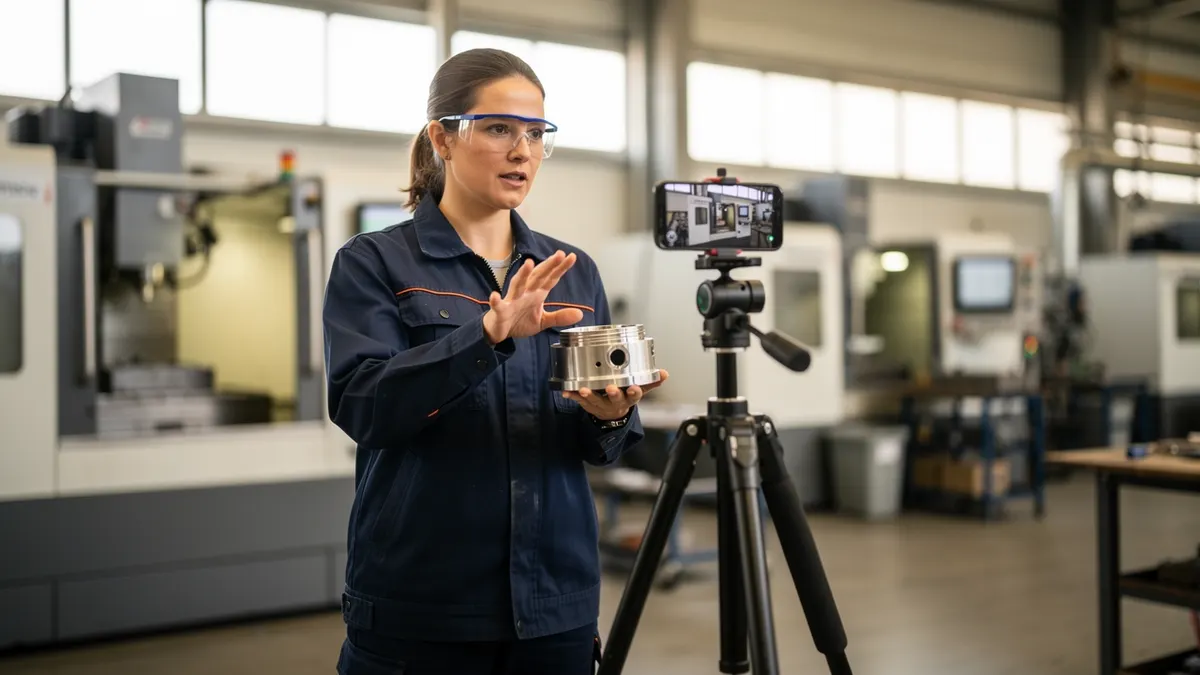
It is the least covered category on the market and one of the best paid: industrial companies, often family-owned, that need video every month and find nobody to produce it.
The end client does not want to appear
That is the most disconcerting particularity for a creator coming from consumer content.
In an industrial company, nobody wants to be filmed, least of all the managers. The good news is that it is not necessary.
What works: the hands, the machine, the material, the workshop, the technical movement, the control screen, the finished part.
When a person does appear, it is an operator, filmed in three-quarter view, working, and their written agreement is signed before the shoot.
What convinces a professional buyer
Four elements, all verifiable.
Real capacity: the line in operation, at normal speed, with no accelerated editing.
Consistency: the same check repeated, traceability, documentation.
Service: what happens when a part breaks, who answers, within how long, with which parts available.
And the numbered reference, when it can be documented: tolerance, throughput, consumption, lifespan. Those values are technical claims and are taken word for word from an approved document.
The tone
It is descriptive, never promotional.
A professional buyer knows the trade better than the brand, and spots an approximation immediately. A video that exaggerates loses credibility for the whole range, not only for the product shown.
The writing rule is simple: describe what happens on screen, give the conditions, and stop there.
Where it is used
Five uses, and only one is public.
The sales email, described above.
The tender response, where a capacity video replaces ten pages of description.
The trade fair, on screen, on a loop, with no sound.
Internal training and onboarding of new staff, which is the most stable budget in the category.
And recruitment, which is often the way in: a company looking for apprentices and technicians has a permanent need, a dedicated budget and no solution.
What to plan for
Five points, settled before the shoot.
The authorisations to access the site, the zones and the people filmed, requested in writing in advance.
The safety rules visible on screen: equipment, pedestrian routes, forbidden zones. A video showing non-compliant practice will not be published.
Industrial secrets: ask for the list of what must not appear, it always exists.
The language, with a systematic English version for companies that export.
And the rights, long ones: this kind of content serves three years, not three weeks.
What a video can do in a long cycle
| Stage | What the video brings | Format |
|---|---|---|
| Discovery | Showing the problem solved | One minute |
| Evaluation | Detailing one precise function | Three minutes |
| Decision | A named customer testimonial | Two minutes |
What is filmed on an industrial site
The machine running, the operator's gesture, the control screen. Each shot needs a permission, safety equipment and an escort.
What is approved before any release
The script, the figures quoted, the faces and anything identifying an end customer. In this sector a missing approval blocks the video for months, to be confirmed with the management.
How to enter this category
Three steps, in that order.
Choose a sector you can film with no special equipment, then learn its vocabulary for a week.
Shoot an example, even with no client: a machine, a workshop, a technical movement filmed at a craftsperson's in your town.
Then write to the companies in the area talking about recruitment rather than content. That is the word that opens the door, and the budget already exists.