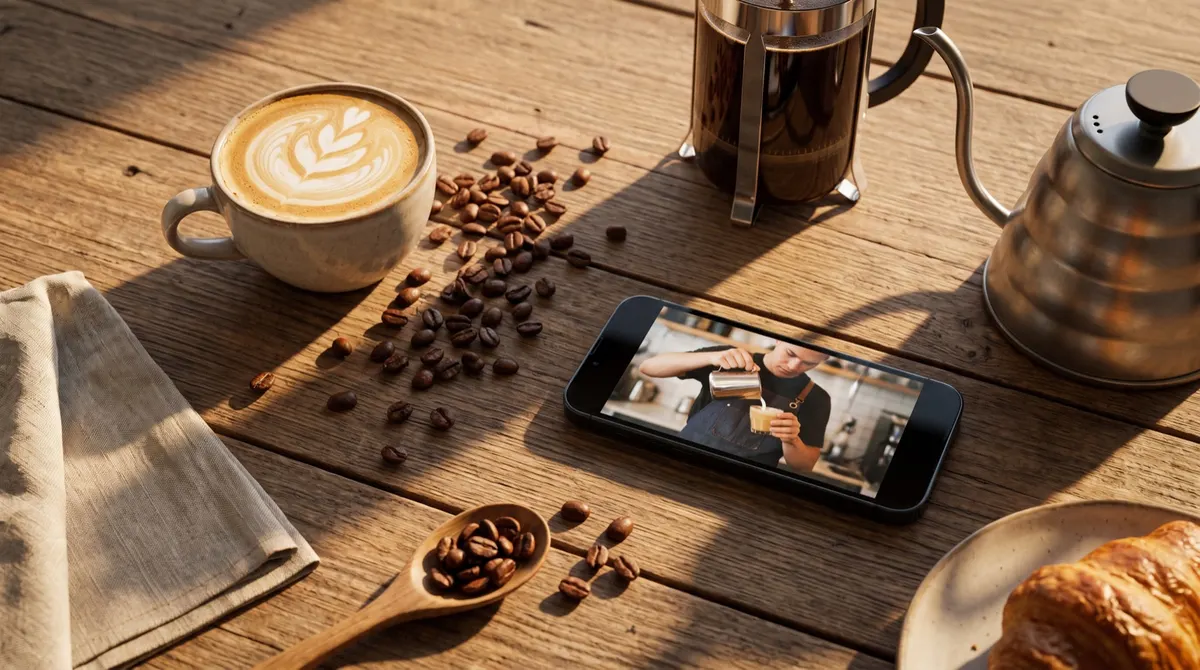
Coffee sells on the ritual, the gesture and the sound. The shots that convert, the brief, the rights, and how to run a first campaign.
Why this product films so well
Because it brings together three things that are rare in one video: a repeated gesture everybody recognises, a substance that moves on screen, and an immediate reaction. Most products have to create those three elements, coffee already has them.
The shots that sell a drink
Seven shots, to ask for in this order.
The pour, filmed level with the cup.
The grounds falling, in close-up.
The steam, shot against the light.
The first gesture of the morning, before any words.
The extreme close-up on the crema or the foam.
The wide shot of the place, for one second.
And the reaction after the first sip.
The formats that convert best
Seven formats, from the most common to the most specific.
The morning ritual, with no commentary.
The method explained in three steps.
The honest tasting, in the creator's own words.
The comparison between two methods.
The cold summer recipe.
The unboxing with a freshness check.
And the answer to a price objection.
How to film the sound
Six settings that change everything.
Recording with no music, always.
Bringing the microphone close to the source, not the mouth.
Turning off the extractor, the dishwasher and the radio.
Filming the pour in a single take.
Keeping one second of silence before the first gesture.
And redoing a take if a stray noise goes through.
What to prepare before filming
Seven items, on the worktop.
A clean cup with no awkward reflection.
A cloth to wipe between takes.
Water at the right temperature, ready.
The pack opened, with the label readable.
A light source behind the steam.
A neutral background, with no cluttered dishes.
And scales if the method calls for them.
What to write in the brief
Seven blocks, never more.
The expected brewing method.
The equipment the creator must have.
The main message, in one sentence.
The mandatory shots, listed.
What must not be claimed.
The format and the length.
And the usage rights, written down plainly.
Tasting words that land
Six simple markers, with no jargon.
Smooth, with no bitterness at the finish.
Fruity, on the tart side.
Round, with a thick texture.
Strong, to be drunk with milk.
Light, suited to the afternoon.
And long on the palate, staying after the sip.
What must not be said
Six claims to rule out.
A promise about health or energy.
An effect on sleep or concentration.
A named comparison with a competitor.
An unverified origin claim.
An unsupported environmental statement.
And a claim about caffeine content with no source.
These points fall under precise rules that vary by country: the wording is checked with the brand and, in case of doubt, with the competent authority.
Filming mistakes specific to this category
Seven reflexes that spoil the result.
Filming a cup sitting still, with no movement.
Adding music over everything.
Framing too wide to see the texture.
Filming under yellow kitchen light.
Leaving a fingerprint on the glass.
Serving coffee that has gone cold.
And talking during the pour.
Other drinks that follow the same rules
Six neighbouring categories.
Tea and infusions.
Hot chocolate.
Plant-based drinks.
Syrups and lemonades.
Energy drinks, with the same claim precautions.
And alcohol-free cocktails.
The usage rights to write into the quote
Seven points.
The licence duration.
The territories.
Use in paid advertising.
Use on the product page.
Use in the shop or café, screens included.
The right to crop and to subtitle.
And the price of a renewal.
Where to find creators who know the subject
Six selection criteria.
Brewing equipment visible in their videos.
Accurate vocabulary about methods.
A believable kitchen setting.
Clean sound on the existing examples.
A language matching your market.
And examples in the same category.
A simple first campaign
Seven steps, in order.
Decide the distribution budget over four weeks.
Order three videos, three different angles.
Choose three distinct creators.
Write a one-page brief.
Ship the packages at the same time.
Launch the three creatives at equal budget.
And change nothing for two weeks.
The recurring objections, and the shots to avoid
Seven objections to handle on camera.
The price per kilo looks high.
The method seems complicated.
The equipment needed is expensive.
The taste might not suit.
The quantity looks too large for one household.
Keeping it fresh after opening worries people.
And the delivery time is uncertain.
How to show a recurring purchase
Six ways to make a subscription concrete.
Filming the next pack arriving.
Showing the delivery schedule.
Explaining how to push a shipment back.
Showing a month of stock stored away.
Comparing with buying one at a time.
And saying in one sentence how to stop.
What to ask for at delivery
Six items with the files.
The vertical version and the square version.
A version with no subtitles.
The pour shot isolated, reusable.
The sound alone, if the brand wants to recut.
The list of shots delivered.
And a reminder of the rights granted.
The shots to avoid entirely
Six images that work against the product.
A chipped or stained cup.
A spoon scraping noisily.
A shot of a dirty hand.
Liquid spilled on the worktop.
A crumpled, badly opened pack.
And foam that has collapsed before the shot.
What to measure, ask for and plan
Six indicators, in this order.
Three-second retention.
The click rate to the shop.
The add-to-basket rate.
The acquisition cost.
The repeat-purchase rate over three months.
And the creative's lifespan.
The questions to ask a creator before ordering
Seven questions, in one message.
Which brewing method do they use day to day.
What equipment do they already own.
Where do they film, and in what light.
Can they record clean sound with no music.
How many shots can they deliver per video.
What turnaround do they announce.
And in which language do they speak to camera.
A drinks brand's calendar
Six moments that shape the year.
The September return.
The end-of-year holidays, briefed in October.
January and new habits.
Spring and cold formats.
Summer and iced recipes.
And the launches of new lots or origins.
What is filmed on a coffee
| Shot | What it triggers | The technical detail |
|---|---|---|
| The grounds falling | The suggested aroma | A dark background, raking light |
| The extraction | The gesture and the real time | No cut during the flow |
| The first sip | The suggested taste | A close-up at cup height |
What is prepared before switching the camera on
Two cups, a cloth, hot water ready. The good take often comes on the third attempt, and the worktop must still be clean by then.
What is verified before talking about the product
An origin, a variety, a roast or a method. Each is read on the bag and confirmed with the roaster, because a wrongly stated origin commits the brand.
What the platform brings
On UGC MATCH, joining is free and there is no subscription: you filter by category, language and country, and the order keeps a record of the brief and the delivery. The brand pays at ordering, the funds are not released straight away, and payment goes out on approval. The platform retains 10% of the price on the creator side, who therefore keeps 90%, and charges the brand a 6% service fee, with a minimum of 1.50 EUR.
One last marker: in this category, the best video is almost never the one that talks most. It is the one you can watch without sound and listen to without picture.