
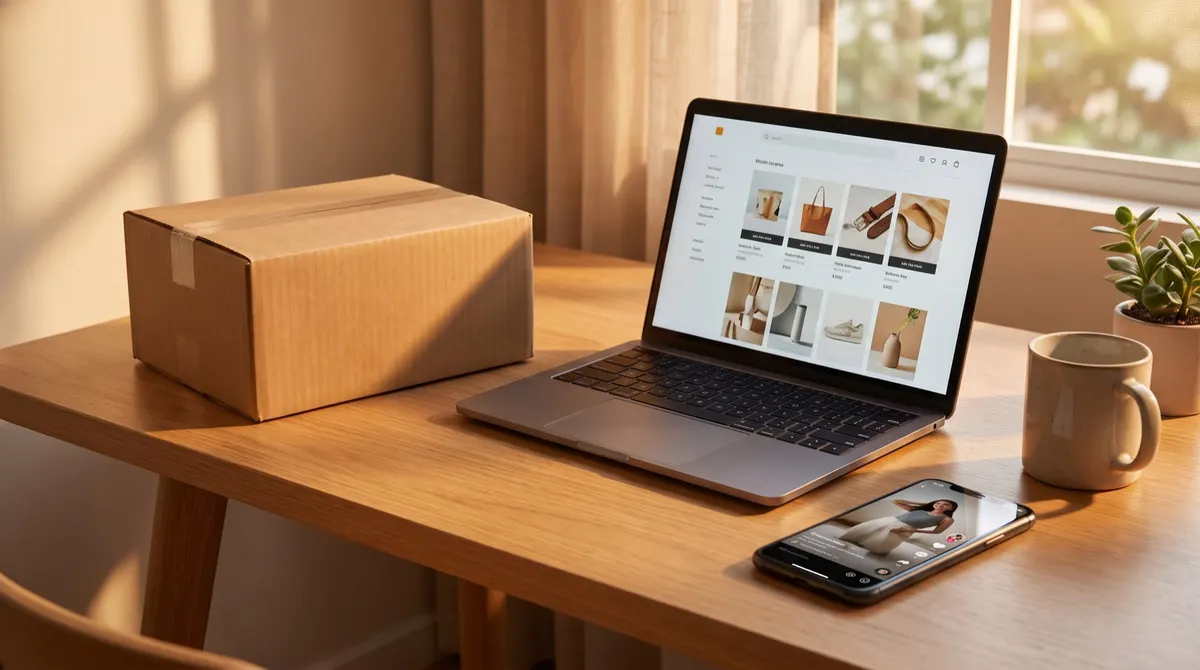
Here is where these videos really sell online: advertising, product pages, emails, retargeting. And how to produce them at volume.
Where these videos really sell
Six placements, from the most profitable to the most discreet.
Paid advertising, where the native format beats the polished creative.
The product page, where video answers the remaining objections.
Abandoned-basket emails.
Retargeting, with a shorter version.
The marketplaces that accept video.
And the homepage, as a silent banner.
Which types of video convert best
Seven formats, from the most effective to the most situational.
The demonstration in real use.
The unboxing with a size check.
The before and after, where the product allows.
The answer to one specific objection.
The comparison with what the customer uses today.
The nuanced testimonial, which also says what does not suit.
And the questions and answers format, cut from the comments received.
How to brief a product-led video
Seven mentions to write down.
The single promise, in one sentence.
The main objection to remove.
The mandatory shots, product alone included.
The expected length per placement.
The three edits requested, dealt with above.
The permitted claims, supplied word for word.
And the ban on quoting a price or a promotion.
Why never to state a price in the video
Because a price changes, a promotion ends, a currency varies with the country it runs in, and a video that states an amount becomes unusable the day the rate moves. The same rule applies to delivery times and stock. Everything variable goes on the page, never in the image.
What usage rights to provide for
Six elements to write into the quote.
Paid advertising, invoiced separately.
Use on product pages, much in demand here.
The marketplaces where you sell.
A duration of at least twelve months.
The right to recrop and re-edit.
And the raw files, essential for producing other edits.
How many videos to start with
Six markers for an honest first batch.
Three different creators, not one.
Two formats per creator.
A single promise, the same everywhere.
An identical distribution budget per video.
Two weeks before the first reading.
And a silent version for the product page.
At what pace to produce afterwards
Six markers for lasting.
A new batch as soon as the previous one's performance dips.
A hook swap before a whole-video swap.
One new promise to test each quarter.
One new creator in three, to avoid uniformity.
A re-edit of old rushes, cheaper than a shoot.
And a clean stop on videos that never worked.
How to embed video on a product page
Six technical rules.
Place the video after the first photo, never before.
Load a compressed version, weight hurts speed.
Provide a fallback image if the video does not load.
Burn in the subtitles, it is read without sound.
Keep it short, a product page is not a feed.
And check how it renders on a low-end phone.
The objections that block an online purchase
Seven doubts video can remove, one by one.
The real size, compared with a familiar object.
The quality of the material, seen close up.
The assembly or installation time.
What is actually in the box.
Compatibility with what the customer already owns.
How easy returns are, if that is an argument.
And the difference from the cheaper version on the market.
How to adapt the video to each placement
Seven adjustments, without going back to the location.
In advertising, open on the objection, not on the brand.
On the product page, open on the product, with no hook.
In email, keep six seconds and no speech.
In retargeting, show the product from the first frame.
On a marketplace, respect the imposed format.
In a homepage banner, remove all burnt-in text.
And everywhere, burn in the subtitles.
What to ask for besides the edit
Six deliverables that extend the value of the shoot.
The raw files, sorted by shot.
Three stills pulled from the video.
A version with no music.
A version with no subtitles.
A horizontal version, even if you have no use for it today.
And the list of shots filmed but not used.
How to test a hook without reshooting
Six things that can be done in the edit.
Replace the first three seconds with another shot.
Move the objection to the start.
Change the first line of the subtitles.
Open on the result instead of the problem.
Cut the introduction entirely.
And test the same video with and without music.
How to measure without telling yourself stories
Seven indicators, none of them views.
Acquisition cost, per video and not per campaign.
The add-to-basket rate from the product page.
The page's conversion rate, with and without video.
The product return rate, often tied to size.
The video's lifespan in paid advertising.
The number of recurring questions in the comments.
And the cost per video actually run, not per video delivered.
The most expensive mistakes
Six reflexes that waste a budget.
Ordering a single video and drawing conclusions from it.
Running the same creative until it is completely spent.
Using an advertising video as-is on the product page.
Forgetting to ask for the raw files.
Neglecting subtitles, on a placement read without sound.
And changing two things at once in a test.
Where to source at volume without losing coherence
Six methods, from the most reliable to the slowest.
Recruiting among your customers, they already know the product.
Filtering a marketplace by category and by format.
Building a core of three recurring creators.
Adding one new profile each quarter.
Keeping one brief, adapted per product.
And keeping every rush in the same place.
Where the video serves on an online shop
| Placement | What it solves | Useful length |
|---|---|---|
| Top of the listing | The product's real appearance | 10 to 15 s |
| Under the description | How to use it | 20 to 30 s |
| In the cart | Doubt about size or quantity | Under 10 s |
| After purchase | The first use | Under 30 s |
What is measured honestly
The add-to-cart rate of the listing with video against the same listing without, over the same period and the same traffic. Comparing two different products measures nothing.
What has no place on a listing
A price on screen, a stock figure, a delivery-time promise. These three change and make the video unusable long before it has paid for itself.
What the platform takes on
On UGC MATCH, the brief travels with the order, the brand pays at ordering without the funds being released straight away, the video is delivered in a private space, and payment goes out on approval. Joining is free and there is no subscription.
One last marker: an e-commerce library is not built by ordering more videos, it is built by pulling more edits out of each shoot.