This is the category where people most spontaneously film what should be filmed least. And the good news is that the sale does not depend on it.
Who buys and what they check
The parent, and they check very concrete things.
How long it takes to set up, how much room it takes, whether it can be washed, whether it lasts until the next age, whether it can be carried, and how much noise it makes. Those questions are mundane and nobody answers them on video.
Add the cost in use: an object used for two years is not comparable to one used for three months, and that is the calculation the parent makes in silence.
What can be shown without the child
Almost everything.
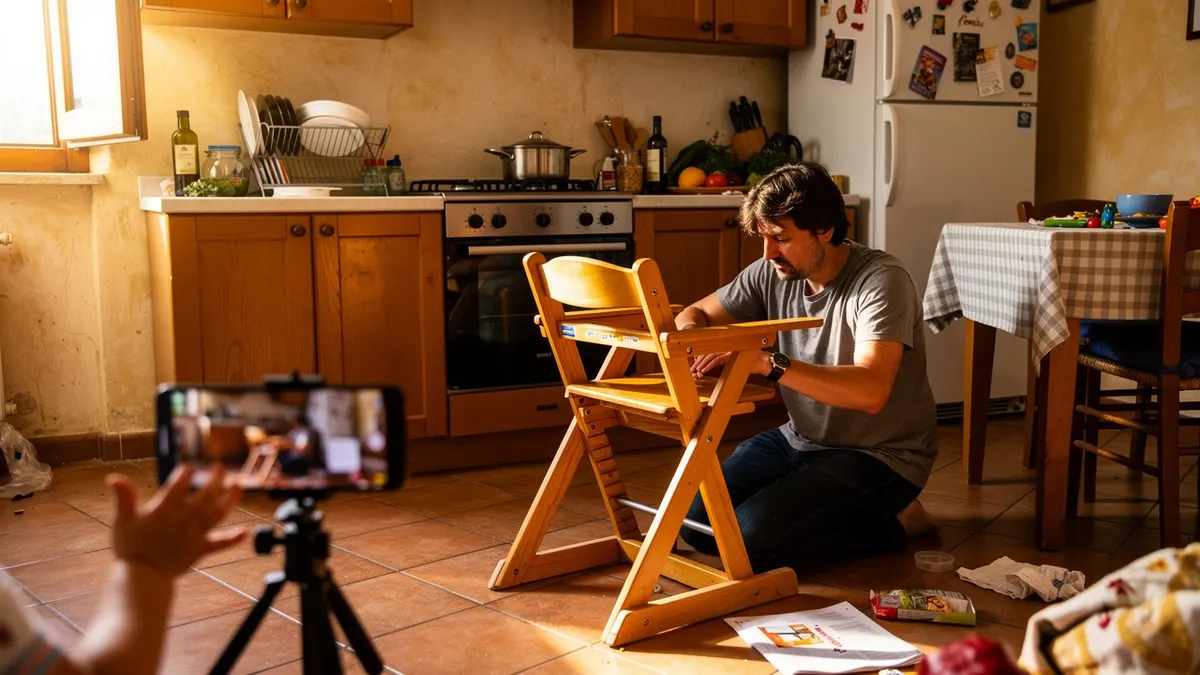
The adult's hands assembling, folding, tidying, cleaning. The object in the real space: the corridor, the car boot, the kitchen table. The evening routine, when everything has to be quick. And the size comparison with a familiar piece of furniture.
Those shots are filmed with no particular constraint, and they are the most watched.
When a child appears
The rules are stricter and the agreements more demanding.
The written agreement of those holding parental authority is necessary, with conditions depending on the place, the age and the intended use. Added to that are rules specific to advertising addressed to children or featuring them, whose scope depends on the channel and the product.
Those points are checked before the shoot, with a lawyer in case of doubt, and never after going live.
What must never be asserted
A safety level, a compliance, an effect on development, a professional opinion.
Claims relating to safety, standards, recommended age and alleged benefits fall under precise rules: they are copied from the product's approved documentation, never from memory, and checked before the brief is written.
Also avoid any staging suggesting unsupervised use.
The category's calendar
It follows the school year and the festivities, not the usual commercial seasons.
The start of term, the end of the year, birthdays and holiday periods concentrate the purchases. Between those peaks, demand is about everyday life: tidying, carrying, occupying, making things last.
Shoot ahead, when creators are available, and keep versions with no identifiable season for the rest of the year.
What this sector orders, and its safeguards
| The buyer | Their typical order | Their absolute condition |
|---|---|---|
| A nursery-goods brand | Use by an adult | No risky demonstration |
| A games publisher | The game in use | Written parental consent |
| A children's clothing brand | The garment worn | No identifying detail |
What is never filmed, even with consent
A child alone with a product that requires supervision, a scene contradicting a safety instruction, or a misuse. These images circulate for a long time and serve as a model for other parents.
What to check with the manufacturer
The recommended age and the product's warnings. Those are regulatory statements, they appear on the packaging, and a video that contradicts them exposes the brand as much as it misleads.
Which creator to hire
A parent, not an actor.
The way of holding a child, of folding a pushchair one-handed, of tidying while talking: those movements are not learned from a brief, and those who do them every day recognise immediately those who do not.
So choose somebody for whom it is real daily life, and agree with them in writing what appears on camera and what does not.