The strictest claims regime, why a single sentence attracts a formal warning, and how to brief without risk.
What that changes on a shoot
Four differences, immediately.
The script is written in advance, word for word, and it is not rewritten on set.
Improvisation is banned: a sentence added to sound natural is exactly the one causing the problem.
The setting is checked: a white coat, a stethoscope, medical scales place the video in a different regime.
And the mandatory statements are planned from the framing stage, not added in the edit in a corner of the screen.
One casting consequence: avoid people presented as health professionals, unless there is a written agreement and a check on their own obligations, which add to yours.
What works anyway
Three angles, entirely permitted and rarely exploited.
Taste, texture, smell, ease of preparation: concrete, verifiable, and nobody films it properly.
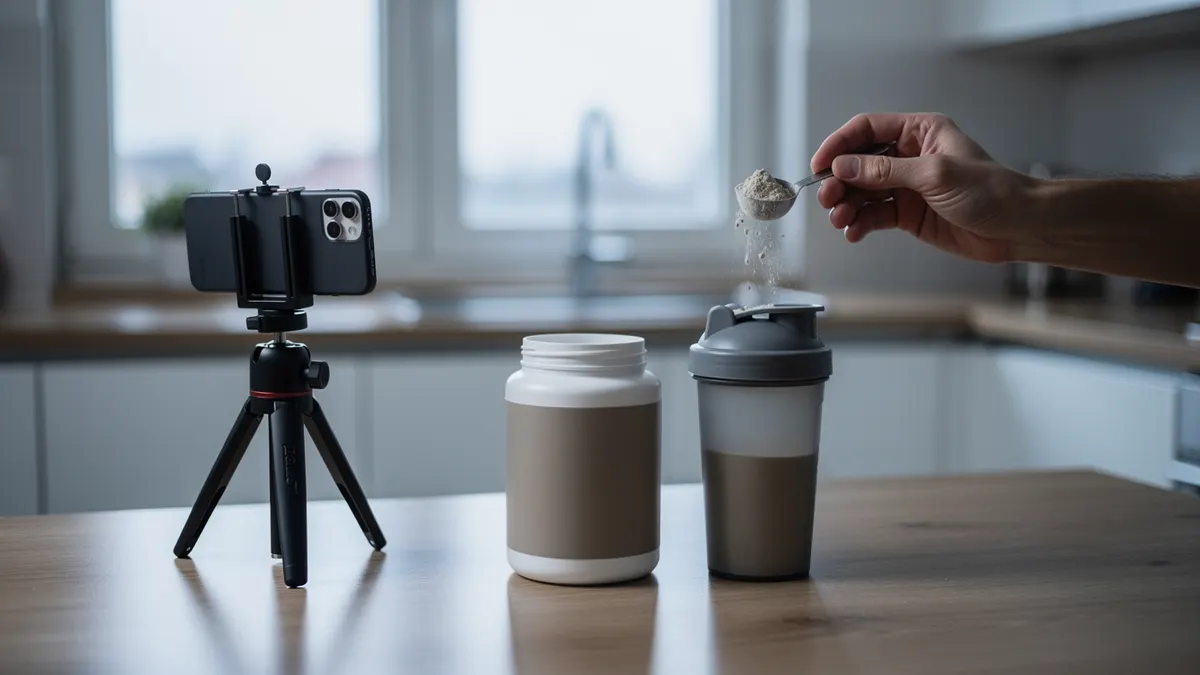
Format and practicality: the size of the dose, the scoop, the lid, what fits in a bag.
And the routine: at what time of day, with what, how long it takes.
A fourth angle, often the strongest: the price per serving, calculated on screen, compared with the previous format of the same product. No claim, one useful piece of information.
What the brief must look like
Five elements, without which there is no shoot.
The list of permitted sentences, with the exact wording to be spoken.
The list of forbidden sentences, including near-equivalent turns of phrase.
The mandatory statements, with their place and their display time.
The name of the person who approves, and the approval deadline.
And the takedown procedure: who removes the video, within what deadline, if a rule changes.
One simple rule: if the brand does not supply those five elements, it has not prepared the campaign, and the risk will land on the creator.
What to buy for a test
Four pieces, and none of them talks about effects.
A preparation video, thirty seconds, no speech.
A format comparison video, with the price per serving.
A video about carrying and using it away from home.
And a frequently-asked-questions video, drawn from the messages customer service receives.
That batch costs little, is approved quickly, and gives a base reusable for a year.
What is possible and what is not
| Element | What remains possible | What is ruled out |
|---|---|---|
| The product | Showing the packaging and the label | An unauthorised health claim |
| The use | The gesture, the intake during the day | A promised effect |
| The testimonial | A personal experience described | A result presented as general |
What is read on screen rather than spoken
The label, the composition and the stated dosage. Rephrasing an official text is almost always what turns a permitted sentence into a forbidden one.
What must appear in every video
The advertising disclosure and the warnings required by the regulation, including the reminder that a supplement does not replace a varied diet, to be confirmed with a lawyer.
What to check before publication
Four checks, in this order.
The final script matches the approved version word for word.
The on-screen text contains no claim absent from the script: it counts as published text.
The mandatory statements are readable, for long enough, on a phone.
And the advertising disclosure is visible from the start, in the form expected there.
One last, often forgotten point: comments are part of the publication. An improvised reply under the video can contain the very claim the whole script avoided, and it binds in the same way. Plan who answers, with which prepared replies, and what is never answered in public.