It is one of the largest hair care markets in the world, with an audience that knows its hair type, its vocabulary and its routines better than most brands do.
Why the category depends on creators
Three reasons, and they stack.
The result depends on the hair type, which makes any brand image non-transposable: the audience is not asking whether the product works, it is asking whether it works on their own hair.
The vocabulary is precise and shared: curl type, porosity, protein, hydration, transition, cut. A brand using it badly disqualifies itself in one sentence.
And the community checks: compositions are read, compared and discussed publicly, often by people who know more about it than the marketing department.
The formats that work
Five, in order of effectiveness.
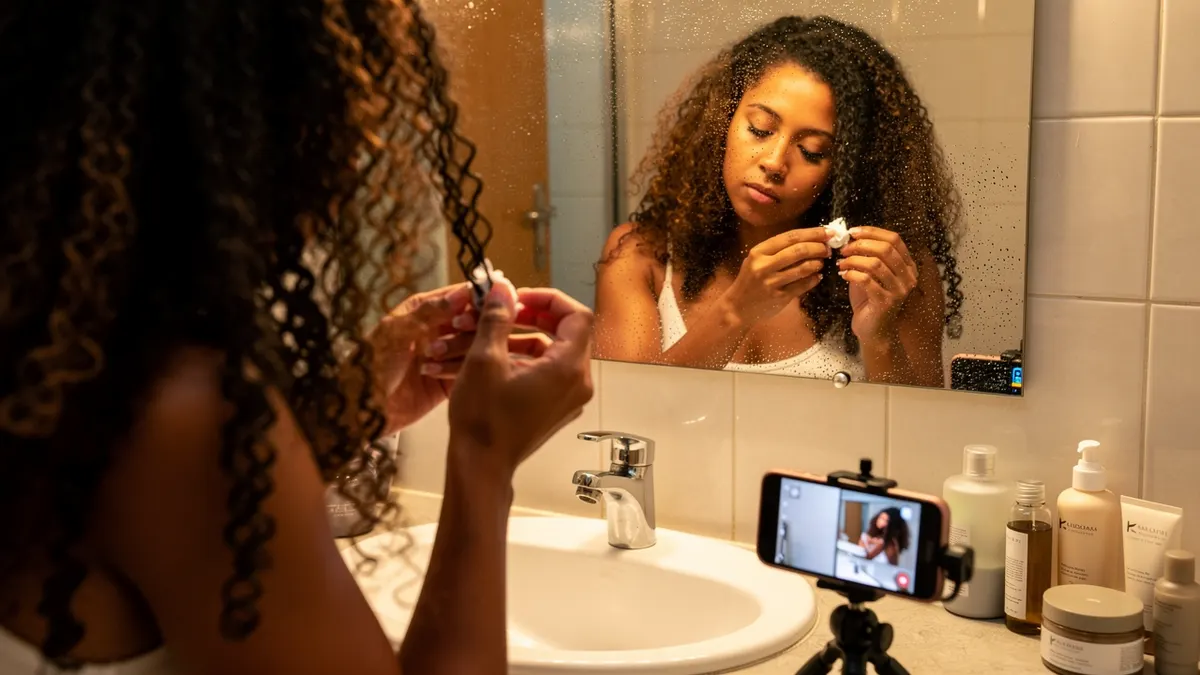
The complete routine, filmed in one take on wet hair, with the quantities shown.
The three-day test, described above.
The comparison between two products in the same range, to help choose rather than to buy.
The result on several hair types, filmed on the same day, in the same light: the most expensive and most convincing format.
And the transition, over several months, the most watched content in the category and the least produced, because it requires patience.
Claims to handle with care
That is the part exposing the brand as much as the person speaking.
Three families of claims are regulated: composition, the claimed effect, and everything touching scalp health or hair loss.
Three practical prohibitions. Never promise a lasting change in the structure of the hair without a documented basis. Never present a cosmetic product as a treatment. And never mention an ingredient while attributing to it an effect the label does not claim.
The working rule is simple: the brand supplies the authorised wordings in writing, the creator repeats them word for word, and the rest is cut in the edit. The applicable rules depend on the product and are checked with the competent authorities before publication.
Light and framing decide credibility
That is the technical constraint specific to this category.
A curl reads against the light and disappears in frontal light. So film near a window, with the light to the side, and keep exactly the same position for every take in the series.
Two further rules. Change neither the background nor the clothing between before and after, otherwise the comparison proves nothing. And show the length against a fixed reference, a wall, a pattern, a garment, rather than by hand.
What the video must show without speeding up
| Step | The shot | Real duration |
|---|---|---|
| Wet hair | The texture before the product | 5 s |
| The application | The gesture, section by section | 20 s |
| The drying | The curl forming | 15 s |
What makes the result verifiable
The same frame, the same light and the same angle before and after. A before filmed under a yellow lamp and an after by a window prove nothing at all.
What is said and what is left out
The hair type, the leave-in time and the real frequency. No promise of lasting transformation or repair, to be confirmed with a lawyer.
Practical notes for the brand
Four points that change the result.
Choose several hair types from the first campaign, rather than one followed by variants later. That is what lets each part of the audience recognise itself.
Send the product at least three weeks before the expected delivery: this category needs time, and a routine tested twice proves nothing.
Ask for the original sound: the noise of the product, the water, the comb and the rustling are part of the demonstration.
And keep long rights. A transition video stays useful for three years, and it is the most durable asset in this category.