This is the category where the room to speak is narrowest. What may be said cannot be guessed, cannot be paraphrased, and is never improvised in front of a camera.
An authorised claim is not an opinion
This is where campaigns get stopped.
What may be said about a natural health product, an over-the-counter medicine or a device depends on the product, its status and the market. The permitted wording comes from the brand's approved documentation, is used word for word, and is not reworded, not even to sound more natural.
Those points are checked with the competent authority and with a lawyer before the shoot. A paraphrase that seems equivalent almost never is in regulatory terms.
Personal experience is the safe register
Provided it is not turned into a promise.
Describing what you did, when, in what context, and what you felt is a different register from a statement about the product's effect. The first recounts, the second promises.
The practical marker: anything containing "it cures", "it lowers", "it replaces", "in X days" leaves the safe register. Anything containing "I took it in the morning", "I keep it there", "the taste is like this" stays in it.
What is never filmed
Four things, without exception.
A prescription, a record, a patient label. Advice that replaces a professional opinion. A comparison between two products on their effectiveness. And the testimony of somebody describing an illness resolved by the product: it is the most tempting and the riskiest content in the category.
Pharmacists and professionals are a separate case
Their appearance is regulated, and not only by law.
The rules applicable to a health professional taking part in a commercial communication, to the statements to include and to the ethical rules of their professional body depend on the province and the profession. They are checked with a lawyer and with the body concerned before any shoot.
Where it is possible, a professional explaining how to read a label, without naming a brand, produces useful and durable content.
The pharmacy aisle and online sales
Buying behaviour has shifted without the content following.
Part of the purchases are decided online and collected in store. So the video has to answer both moments: what is seen on the product page, and what is looked for on the shelf.
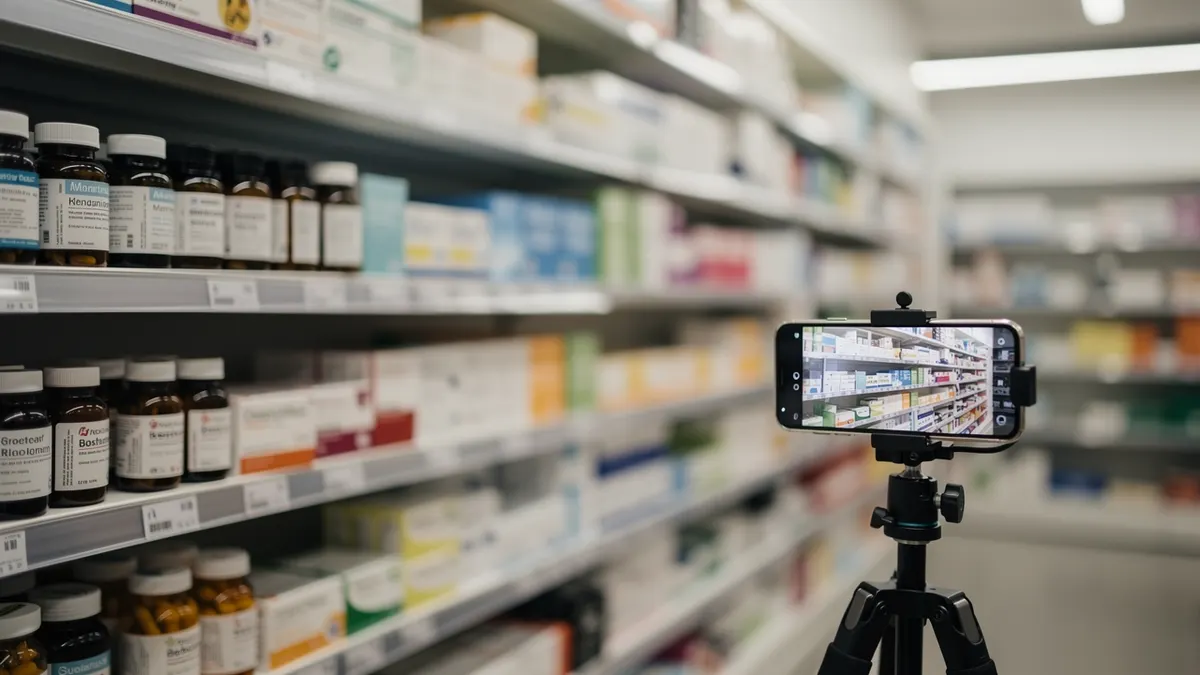
Always deliver a short vertical version for the page, and a shelf version filmed in store, with the written agreement of the outlet.
What is said and what is not
| Subject | Sayable | Forbidden |
|---|---|---|
| Use of a product | What the leaflet states | A promised effect |
| Advice | A pointer to a professional | A personal recommendation |
| Comparison | No brand named | A prescription product |
What is gathered before the shoot
The internal procedure, the approved sentences, the consents, the list of filmable aisles and the approver's name.
What is confirmed with a lawyer
The mandatory notices, the sector's advertising restrictions and the language of release.
Bilingual, and the label with it
That is the detail foreign brands forget.
The requirements about the language of communication and about labelling depend on the province and the type of product, and are checked before distribution. So film the packaging from the angle that shows the compliant face, and plan two shoots rather than a dub.