How materials, tools and renovation brands in Brazil use UGC, the before-and-after and how-to formats.
Why this content converts for materials brands
Six reasons specific to the category.
The purchase is intimidating: the person fears botching the job more than the price.
The product demonstrates itself entirely, from the gesture to the result, which is rare.
The quantity needed is a central question badly handled by product pages.
The public actively searches for tutorials before buying, which gives the content a very long life.
The categories involved are numerous: paint, coverings, tools, plumbing, electricity, furniture.
And the content is shared, because it is useful beyond the brand.
The formats that work
Seven formats, ranked by effect on sales.
The clean-up and the mess, dealt with above.
The before and after filmed without a cut on the decisive part, the rest being speeded up.
The real quantity: how much product for how much surface, and what is left at the end.
The real time: how many hours, in how many sessions, with what drying time.
The minimum tool kit: what you really have to own, and what you can do without.
The mistake and its correction, the category's most-watched format.
And the result after six months, which answers the one question nobody handles.
How creators film concrete demonstrations
Seven technical rules.
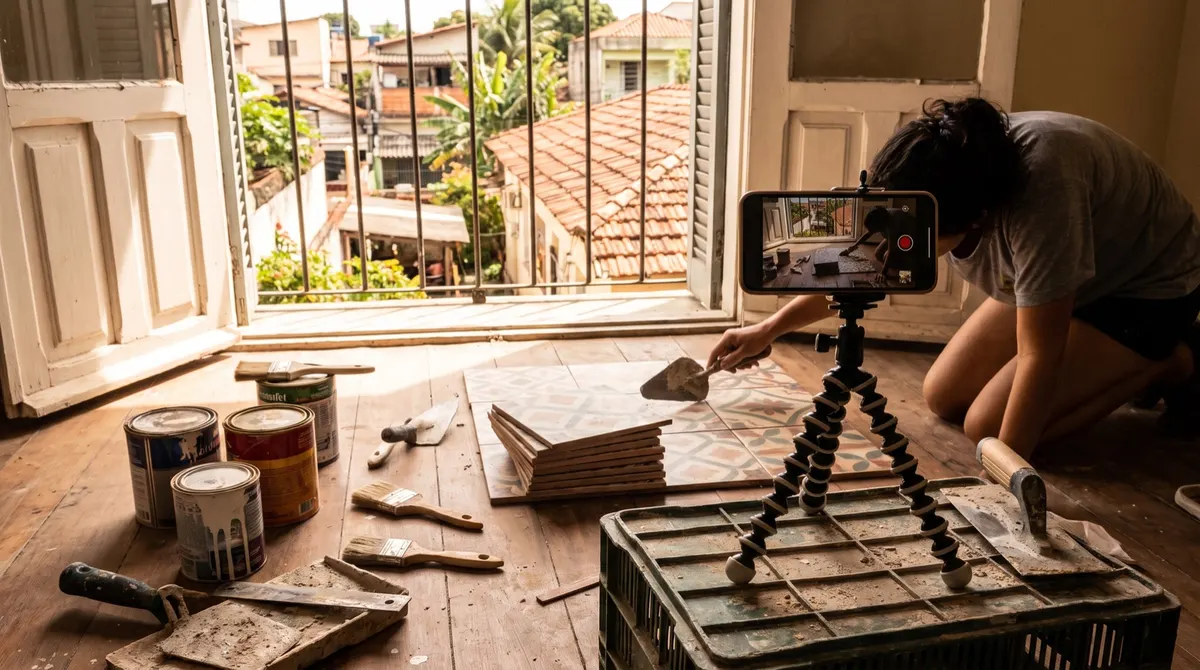
Set the camera down and do not move it: continuity proves the gesture is real.
Film from the side, not over the shoulder, so the gesture is legible.
Keep the direct sound: the noise of the tool and the material carries information.
Show the whole hands, including when they are dirty.
Plan a second device or a separate take for close-ups, rather than zooming.
Clean the lens before every session, which dust makes indispensable.
And film the preparation, often more useful than the gesture itself.
Safety, which is not negotiable
Six points to respect systematically.
Show the protection: goggles, gloves, mask, when the product or tool requires them.
Never film a dangerous gesture, even if it works and even if it is common.
Respect the label's instructions, particularly on ventilation and mixing products.
Do not show work on an electrical or gas installation that belongs to a professional.
Explicitly refer to a professional when the subject requires it.
And check with the competent authorities and with the brand what may be stated about a material's performance.
Where the content runs and how to distribute it
Five placements, with their logic.
The product page, where quantity and real time replace an instruction leaflet.
Retargeting, where the remaining objection is almost always the difficulty of doing it.
Search: this content is actively looked for, so it works for a long time with no budget.
Marketplaces, where the demonstration distinguishes one item from ten identical products.
And discovery advertising, carried by the mistake-and-correction format rather than by the product.
What is filmed on a building site
| Sequence | What it proves | The constraint |
|---|---|---|
| The starting state | The comparison point | Film before touching anything |
| The technical gesture | Real know-how | A safety distance |
| The result | What it looks like | The same light as at the start |
What makes a comparison honest
The same angle, the same hour, the same focal length. Change one of the three and a proof becomes an illusion, and the viewer feels it without being able to explain it.
What is never said without a document
A compliance, a standard, a long-term warranty or a thermal performance. Each is proven by a document from the tradesperson or the manufacturer, to be confirmed with a building professional.
Usage rights, licence and brief
Seven points to write before producing.
The duration of rights, long in this category because the product stays in the catalogue.
The authorisation to use the video on the product page after the campaign.
The list of authorised statements on performance, durability and coverage.
The explicit prohibitions: dangerous gestures, off-label uses, mixtures.
The fate of the loaned equipment after the shoot.
The location of the shoot and its authorisation, when it is not the creator's home.
And the real production time, longer than elsewhere: a job is not filmed in an hour, it requires several sessions and drying times.
One pricing remark: this category is underpaid relative to the time it demands. A creator invoicing by the video loses money; a creator invoicing by the session, counting preparation, drying and clean-up, works properly.
One last marker: in renovation, the brand is not buying the beauty of the result, it is buying proof that somebody ordinary managed it in a real home. Show the dust, the time and the clean-up, and you answer the only thing preventing a purchase.