Home and decor as a UGC niche in Brazil, the formats that sell and how creators and brands work together.
Why decor works so well in Brazil
Seven reasons rooted in the local market.
The home is a permanent topic of conversation, and content grafts onto it naturally.
Buying often happens in stages, one piece of furniture at a time, which creates a series of occasions.
The climate imposes particular solutions, ventilation, light textiles, plants, each of them a subject.
Renting is common, hence the massive interest in reversible fittings.
Thrifty DIY is valued, not hidden, unlike in other markets.
Small urban floor areas make every storage tip immediately useful.
And the public shares this kind of content heavily in private messages, which gives it a second life.
The formats that sell
Seven formats, from the most effective to the most decorative.
The before and after of a single corner, dealt with above, and the best performer of all.
Assembling furniture in fast motion, which answers the real objection to buying.
Fitting out a rented space without drilling, with no marks and no damage.
Sorting a cupboard, filmed from chaos to result, with no hidden cut.
Testing the resilience of a fabric or a surface, stains and washes included.
A room tour with a stated budget, giving the price of each element.
And the cheap version of a trend item, a heavily shared format here.
How creators shoot at home
Seven practical moves that make a decor video credible.
Always filming from the same angle for the before and the after, otherwise the comparison proves nothing.
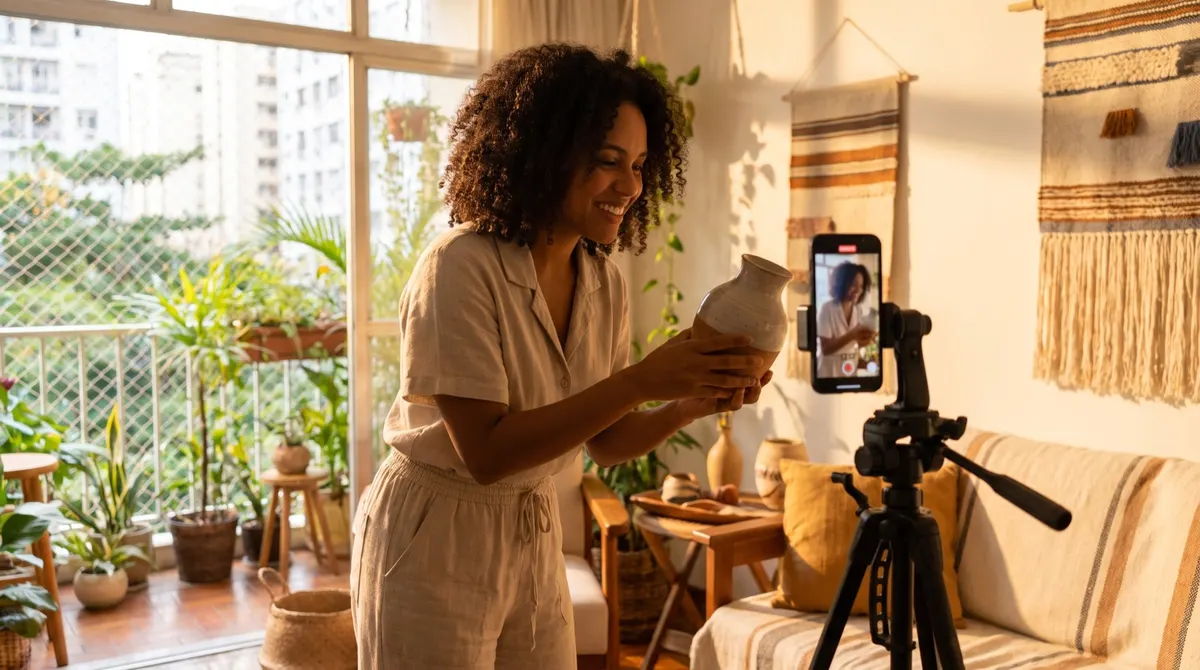
Using daylight, switching off ceiling lights that turn everything yellow.
Filming late in the afternoon, when the light is low and the contrast soft.
Showing real dimensions with a familiar object in frame, rather than a number.
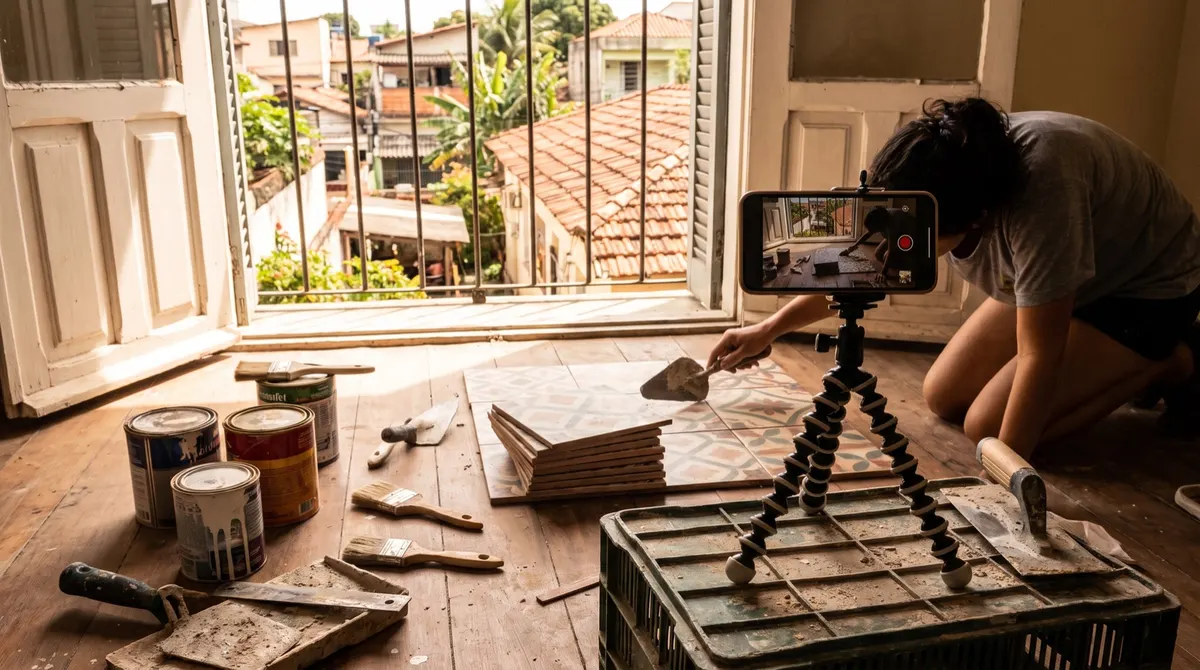
Filming the action, not only the result: screwing, drilling, folding, placing.
Keeping the home's flaws, marked walls and worn floors included, which create credibility.
And recording the sound of the materials, very effective on textiles and wood.
The constraints of light and small spaces
Six solutions to problems everyone meets.
A dark room is filmed in daytime with every door open towards the lit rooms.
A narrow space is filmed from the doorway, never from the centre, which flattens perspective.
A well-placed mirror replaces a lamp, and it shows on screen.
A warm lamp and a cool lamp in the same shot produce a dirty rendering.
A ten-second wide shot at the start situates the space and avoids confusion afterwards.
And the phone's wide angle should be avoided, because it suggests volumes the delivery will contradict.
How brands use the content
Seven uses, beyond social media.
The product page, where a video of real use reduces pre-purchase questions.
Advertising by room, kitchen, bedroom, entrance, each with its own objection.
The seasonal catalogue, fed by creators rather than by a studio.
After-sales service, which sends the assembly on video rather than a manual.
Retailers' pages, which willingly accept ready-made content.
Launch campaigns, where several real interiors beat a single studio set.
And the reply to negative reviews, a video showing correct assembly defusing most complaints.
Price, rights and the logistics of large furniture
Six points to settle before accepting an assignment.
Bulky furniture implies delivery, assembly and sometimes collection: that is invoiced.
Assembly time belongs in the production price, and is counted in hours, not in videos.
A creator who keeps the furniture receives a benefit in kind, which does not replace a fee.
Advertising rights are negotiated separately, with a written duration and scope.
Category exclusivity, common in decor, is paid for and limited in time.
And the state of the home after the shoot has to be provided for, especially where a wall gets drilled.
What decides the purchase of a decor object
| The question | The shot that answers it |
|---|---|
| How big is it really | The object next to a hand or a chair |
| What material is it | A close-up with a finger running over it |
| How does it live in a room | A wide shot of the whole room |
What gives away a poorly prepared series
Light that changes between two shots of the same object. Shooting the whole series at the same time of day settles it before it shows up in the edit.
What is verified before naming a material
A wood species, an origin, a treatment or a standard. Each mention is read on the product sheet and confirmed with the brand, never estimated by eye.
Where to start in this niche
Six steps for getting going with no stock and no budget.
Choose a single corner of your home, the most imperfect one, as the subject of a first video.
Film the before today, even without a product, because it cannot be refilmed afterwards.
Handle a concrete objection: it holds, it cleans, it dismantles, it fits.
Publish three videos on different rooms, to show your range.
Approach the brands whose products you already own, the most credible application there is.
And offer a batch of three videos rather than one, which matches how these brands buy.
One last marker: in Brazil the decor niche rewards consistency more than talent. A creator documenting their own home room by room for six months builds a portfolio no studio can manufacture, because nobody can invent a credible before.
Sources
- Portal do Empreendedor (MEI), Brazilian government
- Receita Federal, Brazilian tax authority
- Simples Nacional, official portal
Checked on 4 September 2026. Thresholds and rates change: where this guide and the official source disagree, the official source is right.