How drinks brands in Brazil use UGC, from energy drinks to beer and juice, with the formats and the advertising rules.
A drink sells a context, not a liquid
Five reasons that explain all the rest.
Taste cannot be filmed: what is filmed is the moment of drinking.
The category is crowded: what sets a brand apart is the occasion it occupies, not the recipe.
The purchase is impulsive and repeated, so triggered by an association, not by a demonstration.
Brazilian heat installs a permanent occasion that few categories possess.
And the gesture, opening, pouring, toasting, carries more information than any sentence.
The formats by segment
Six segments, with the format that works for each.
Energy drinks: the moment of use, before effort, the night of work, the commute. Short format, fast rhythm.
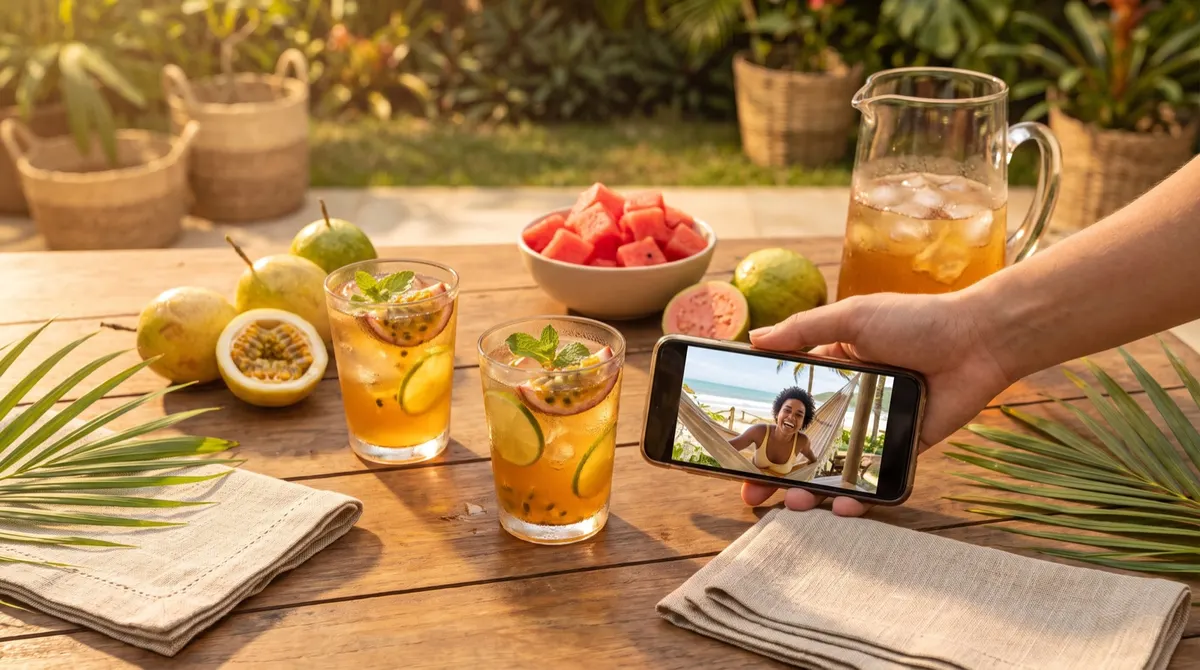
Juices and fruit drinks: preparation at home, the colour, the ice, the children or breakfast.
Water and functional drinks: the routine, the bottle, sport, hydration through the day.
Coffee: the morning ritual, the machine, the noise, the smell suggested by the gesture.
Alcoholic drinks: the social context, the meal, the table, dealt with below with their own rules.
And new products: discovery, the first opinion, the comparison with the known version.
Filming a drink to create desire
Six technical rules.
The shooting time, dealt with above: everything happens in a minute and a half.
The glass clean, wiped, with no fingerprint, filmed at three quarters and not head on.
Light from the side or behind, never from the front: that is what makes the liquid shine.
A dark background for a clear drink, a light background for a dark one.
The sound of pouring, of ice, of the can: it carries freshness better than the image.
And the first shot held two seconds longer than needed, to let the edit breathe.
The advertising rules to respect
Six points to check before shooting.
Alcoholic drinks obey specific communication rules, bearing notably on timing, audiences and permitted depictions. What applies is checked with the competent authorities and with a lawyer, before the shoot.
No content should address minors nor feature them when the category forbids it.
No health or performance claim that is not authorised for the category concerned.
Clear identification of any commissioned or paid content.
No association between alcohol consumption and driving, work, sport or personal success.
And a check that the chosen creator meets the age conditions required by the category.
Seasonality is half the strategy
Five windows that structure the year.
Summer and the end-of-year holidays, when consumption at home soars.
Carnival, the strongest consumption occasion, to be prepared several weeks ahead.
Heat waves, unpredictable but highly reactive: content must be ready in advance.
Major sporting events, which move consumption towards the home and the bars.
And the return in the autumn, the moment of routines and functional drinks.
One production consequence: in this category, you do not shoot at the time of the campaign, you shoot before. A summer video filmed in summer arrives as the window closes.
What you film on a drink
| Shot | What it triggers | Technical detail |
|---|---|---|
| The pour | Immediate craving | A dark background to see the colour |
| The condensation | Freshness | A glass taken from the cold just before |
| The first sip | Suggested taste | A close-up at glass height |
What is prepared before the take
Two identical glasses, ice on the side, a cloth. The good take usually comes on the third attempt, and the set has to still be clean.
What changes everything if the drink is alcoholic
The partnership disclosure, the responsible-consumption warning, and targeting restricted to adults. The rules vary by country of release and are confirmed with the competent authority and a lawyer.
What to order
A reasonable initial order for a drinks brand.
Two different moments of use, one home preparation, one pouring shot for advertising, and two hook variants on the best of the four. Five videos, two creators, two sessions.
One last marker: in drinks, the video should not explain the product, it should make the moment desirable and immediately recognisable. That is why the category's most profitable shot remains the simplest, a glass being filled, filmed during the ninety seconds when it is perfect.