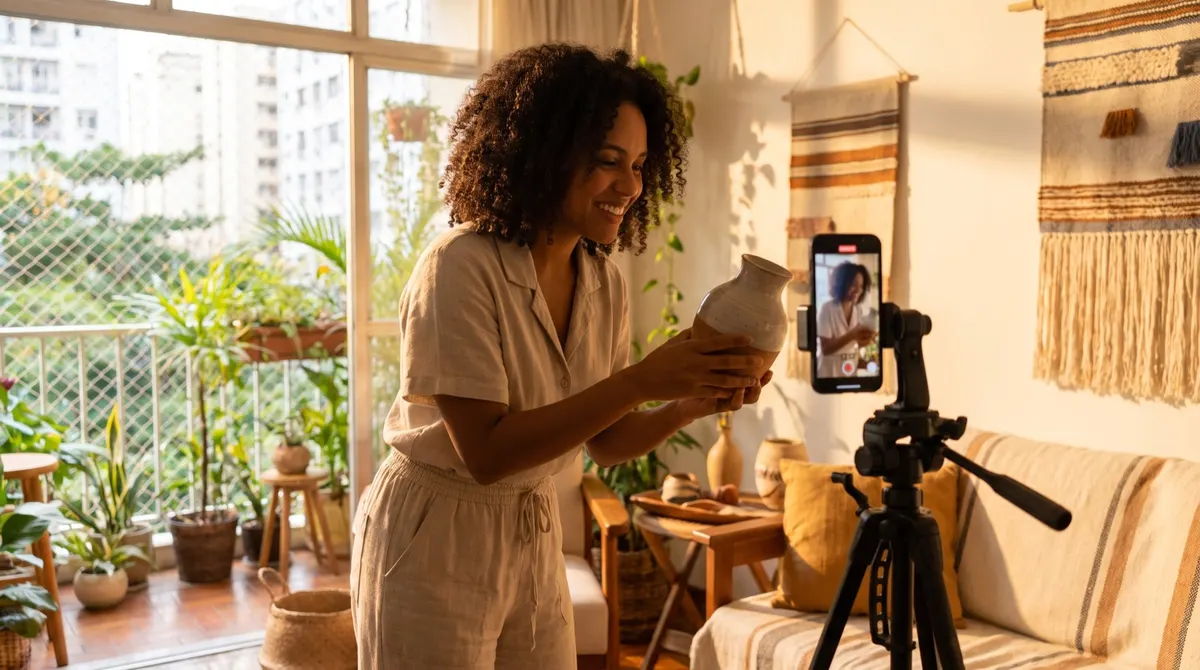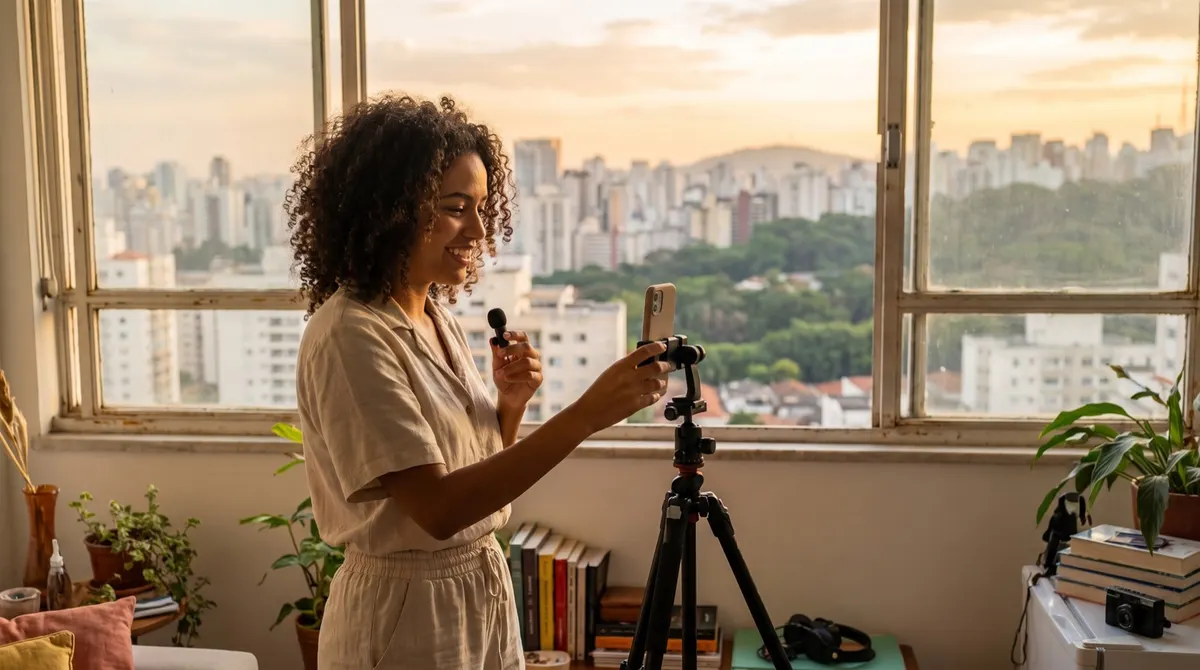

Practical lighting for UGC: natural light, ring light and simple set-ups for a professional look at home.
Start with your window
Seven rules for using daylight.
Stand facing the window, never with your back to it.
Film late morning or mid-afternoon, when the light comes from the side.
Avoid the vertical midday sun, which hollows the features.
Use a white curtain as a diffuser when the light is too hard.
Step back a metre rather than sticking to the glass, which softens the result.
Check the shooting hour and keep it: that is what makes your videos consistent.
And identify a second window in the home, for days when the first gives nothing.
Adding a cheap ring light
Six useful applications, and two mistakes to avoid.
Use it in addition to the window, never as the only source.
Place it slightly to the side and a little above the eyes, not straight ahead at face height.
Turn its power down: most creators set it twice too bright.
Use it mainly in the evening, when no window gives anything.
Choose one with a temperature setting, so it can be matched to the ambient light.
And put it on a stand, not held in the hand.
The two mistakes: putting it straight ahead, which flattens the face and removes relief, and leaving it at its default temperature, which clashes with the window.
Never mix colour temperatures
Five points to know.
Daylight is cool, domestic bulbs are warm, and the two together produce a complexion impossible to correct.
One rule suffices: one family of light per shot.
If you cannot switch off a source, move away from it or close the door of the room concerned.
Screens switched on in frame count as a source, often a blue one.
And fluorescent and low-energy lamps can flicker, which shows on the image and not to the eye.
Softening hard light and sculpting shadows
Six free techniques.
The white curtain, already mentioned, the best diffuser in the house.
A sheet stretched in front of a too-strong window.
A white wall on the side opposite the window, which bounces light back and softens shadows.
A sheet of paper or light card on the table, under the face, for the same effect.
The shade of a wall or doorway outdoors, which replaces any equipment.
And stepping back from the product: raking light creates relief, frontal light erases it.
Light your face first, then the product
Six priority rules.
The face is set first, because it carries the trust.
The product is set afterwards, often by moving it rather than moving the light.
A shiny material is filmed with light from the side, never from the front, on pain of reflections.
A matt material tolerates more frontal light.
A liquid or a glass is filmed in partial backlight, which makes it exist.
And the background must stay darker than the subject, otherwise the eye drifts to it.
Three sources, three results
| The source | What it gives | Its limit |
|---|---|---|
| A side window | The most natural light | It changes within an hour |
| An overcast sky | A soft, even rendering | None, it is ideal |
| A continuous lamp | The same light at any hour | A quality ceiling reached fast |
What ruins an image more than anything
The ceiling light switched on overhead. It hollows the eyes, yellows the skin and flattens the relief. Turning it off is the first adjustment, before any purchase.
What is checked before each take
That the light does not change during recording. A passing cloud is enough to make two shots unmatchable, and you only notice in the edit.
Check the result before shooting
Five checks that take a minute.
Film ten seconds of test and watch them on another screen, never on the one that filmed.
Check no horizontal bands appear, a sign of flicker.
Check that white is white: a wall, a sheet of paper, a t-shirt.
Lock the exposure before speaking, which stops the image changing mid-take.
And redo that check at every change of room or hour, because light moves faster than people think.
One last marker: in UGC nobody expects studio lighting, and an over-polished image even reduces effectiveness. What is expected is a stable image, of one colour, where the face can be seen. Those three things are obtained by switching off a lamp and turning towards a window.