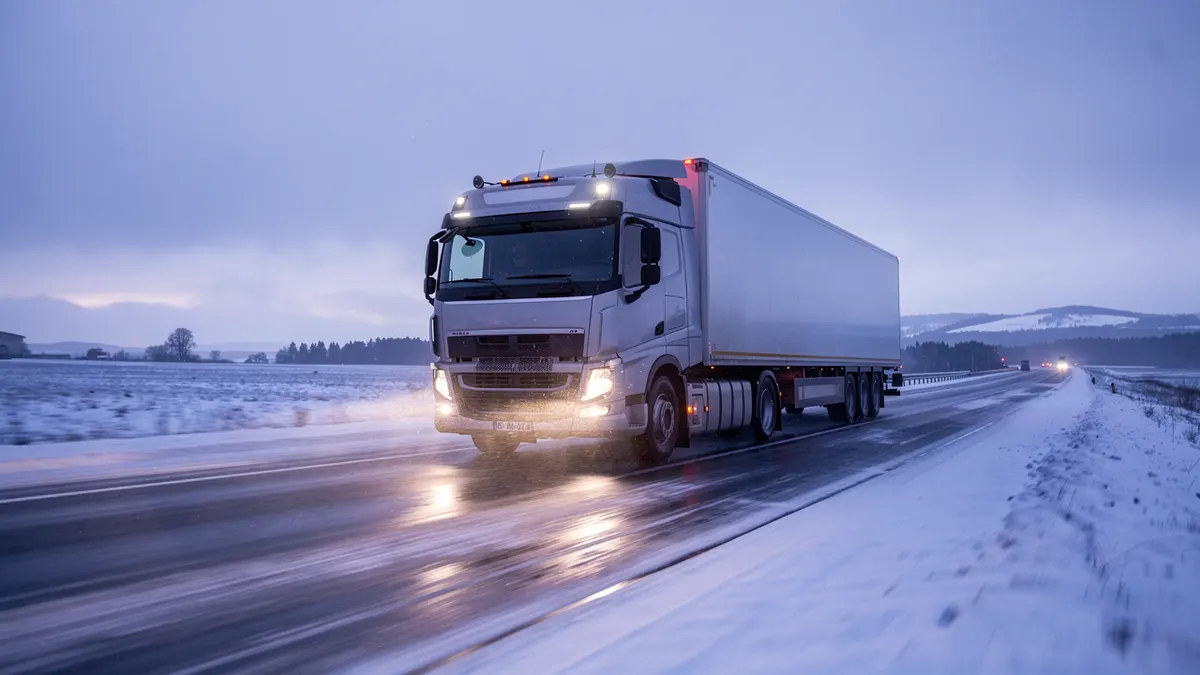
The country runs on freight, and every one of those companies is short of drivers. It is a recruitment market disguised as a content market.
The rhythm of life decides, not the pay
That is the conclusion every company in the sector eventually reaches.
At comparable pay, what makes somebody accept or refuse a job is the rhythm: the regularity of returns, the predictability of the schedule, the length of the runs, the possibility of choosing.
The content must therefore show a typical week, not an exceptional day. The departure, the night, the break, the return, and what the person does at the weekend.
It is a boring format to write and extremely effective, because it answers the only question that counts.
Show the reality of the road
Without prettifying it, and without dramatising it.
A video that is too smooth convinces nobody in this trade: the people watching know the work, or know somebody who does it.
So show the wait at loading, the paperwork, the cold, the queue, the cab. And also show what the company does to make it bearable: equipment, facilities, planning, contact.
The contrast between the two is what makes the message credible.
The warehouse is a different message
It does not address the same audience, and it is filmed differently.
Warehouse jobs attract people looking for stability, fixed hours and a single place. What interests them: the team, the temperature, the noise, the real physical load, the hours, how you progress.
The same campaign cannot cover both. Two series of videos, two tones, two broadcast schedules.
Business clients want proof of capacity
That is the second use of content in this sector, and it is underexploited.
A principal is not looking for a beautiful image: they want to know whether you can hold a volume, meet a time window and handle an incident.
Three videos answer that. The fleet and the warehouse in real operation, with no staging. The tracking of one shipment from departure to delivery. And the handling of a problem: a delay, damage, a reshipment.
The last is the most convincing, because everybody knows incidents happen, and nobody ever shows how they are dealt with.
Winter is both the proof and the constraint
That is the local particularity, and it can be filmed.
A company showing its vehicles and teams in real winter conditions proves a capacity no sales pitch replaces: de-icing, chains, closed roads, longer journey times, equipment that holds.
Two production rules. Film in winter, not in June with a voice-over talking about snow. And plan the time: everything takes longer, including a shoot.
What is filmed on a logistics site
| Subject | What it proves | Constraint |
|---|---|---|
| Preparing a parcel | The care taken | Traffic areas |
| Loading | The real capacity | Vest and instructions |
| Tracking on screen | Traceability | No customer data visible |
What is arranged with the site manager
Access, mandatory equipment, areas closed to pedestrians and an escort for the entire duration of the shoot.
What is systematically blurred
Faces without consent, plates, addresses on labels and any screen showing a customer name. An uncleaned shot is dropped, not fixed.
What to plan for
Four points, all settled before the shoot.
The authorisations: sites, docks, secure areas, people filmed. They are requested in advance and in writing.
The safety rules, visible on screen: equipment, pedestrian routes, forbidden zones. A video showing non-compliant practice will not be broadcast, and rightly so.
Language, with two spoken versions when the campaign covers the whole country. The applicable obligations depend on the medium and on your situation, and are checked with a lawyer.
And the disclosures tied to job offers, which follow their own rules depending on the province and are checked before publication.