Bedding is the hardest product to sell on video: you cannot taste it, wear it, or try it beforehand. And yet you keep it for years.
In Argentina two local realities decide what the video has to show, and they have nothing to do with the usual arguments.
The night starts late, so the argument changes
People eat late, go to bed late, and the day still begins early. A video promising eight hours of sleep speaks to someone who does not have eight to give.
What matters here is the quality of what is left: falling asleep quickly, not waking at three, getting up without pain in the lower back.
That is also why the nap keeps a real place. Content treating it as a weakness misses its audience; content showing a sofa, an afternoon and twenty minutes lands correctly.
Delivery is the decisive moment, and nobody films it
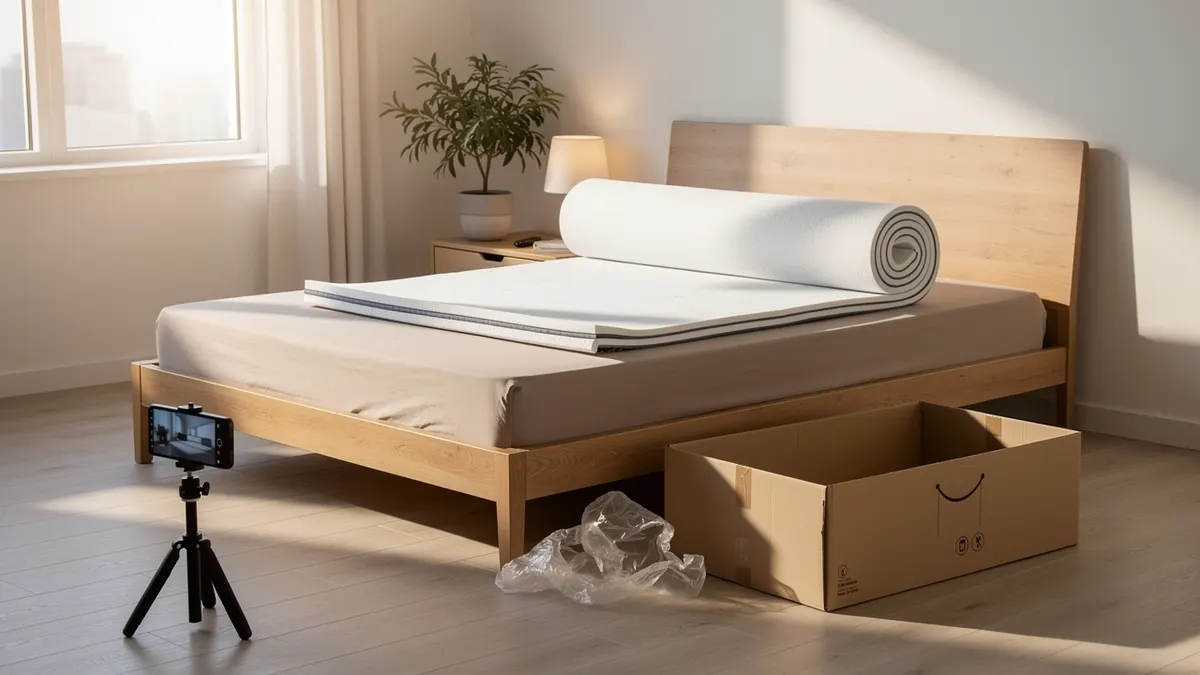
A mattress arrives compressed, in a narrow box. It has to be carried up, often by an old staircase, sometimes without a lift, through a doorway not designed for it, then left to regain its shape.
That is the buyer's main worry, and it is almost always absent from videos, which start once the bed is already made.
Filming the staircase, the corridor, the opening of the box and the mattress unfolding answers the question everyone asks and nobody voices.
What makes a video credible in this category
Time. A piece shot on the first evening proves nothing. A follow-up at three weeks, then at three months, is infinitely more convincing, because that is exactly the period the buyer fears.
The real bedroom. Small, with a wardrobe too close to the bed, a window onto the street. A catalogue bedroom carries no information for someone living in a city flat.
Noise. The street, the neighbours, the traffic. Showing that you sleep despite it is more useful than a silent, perfect shot.
The couple. Two people who do not sleep the same way, one who moves, the other who wakes. It is the most common situation and the least filmed.
What to ask a creator for
A two-stage shoot, with a delayed follow-up. It is the only structure that makes the testimonial plausible in this category.
The complete unboxing, uncut, with the difficult passage if there is one.
And a sentence on what displeased or surprised. An entirely positive bedding video reads as an advertisement, and this is the one sector where excess enthusiasm backfires fastest.
What really decides the purchase
The guarantee and the possibility of returning. Nobody buys a mattress without knowing what happens if it does not suit.
A video explaining that part, calmly, showing the real conditions, removes more obstacles than a firmness demonstration.
What the buyer wants to check
| Doubt | The shot that answers | Length |
|---|---|---|
| The height with the base | The mattress in place, tape beside | 8 s |
| The firmness | The edge when you sit down | 6 s |
| The upkeep | The cover taken off completely | 15 s |
What is filmed at delivery
The box, the unpacking, the time it takes to regain shape, the smell mentioned and the first assembly.
What requires coming back later
The state after a month, how it behaves in the wash, how the seams hold.
The most frequent mistake
Selling the product in the manufacturer's vocabulary: density, layers, technologies. The buyer does not compare them, they cannot.
They compare situations: the back on waking, the partner who moves, the heat in summer, the staircase on delivery day. A video speaking to those four things beats ten spec sheets.
Sources
Checked on 27 August 2026. Thresholds and rates change: where this guide and the official source disagree, the official source is right.