Two audiences watch the same video, and only one pays. Everything else follows from that asymmetry, including the calendar.
The person paying is often not the parent
That is the particularity of this market, and it changes the message.
A large share of toys is bought by grandparents, uncles, aunts, family friends. That buyer does not know the ranges, does not know what the child already owns, and above all is trying not to get it wrong.
What they want to know holds in three points: what age it really suits, how much time it occupies, and whether the object will last more than a week.
A video answering those three questions sells better than a video showing an enthusiastic child.
Two pieces, never a mixed one
A single edit cannot address both audiences.
The piece for the adult talks about durability, storage, safety, cost per hour of play. It can do entirely without a child on screen.
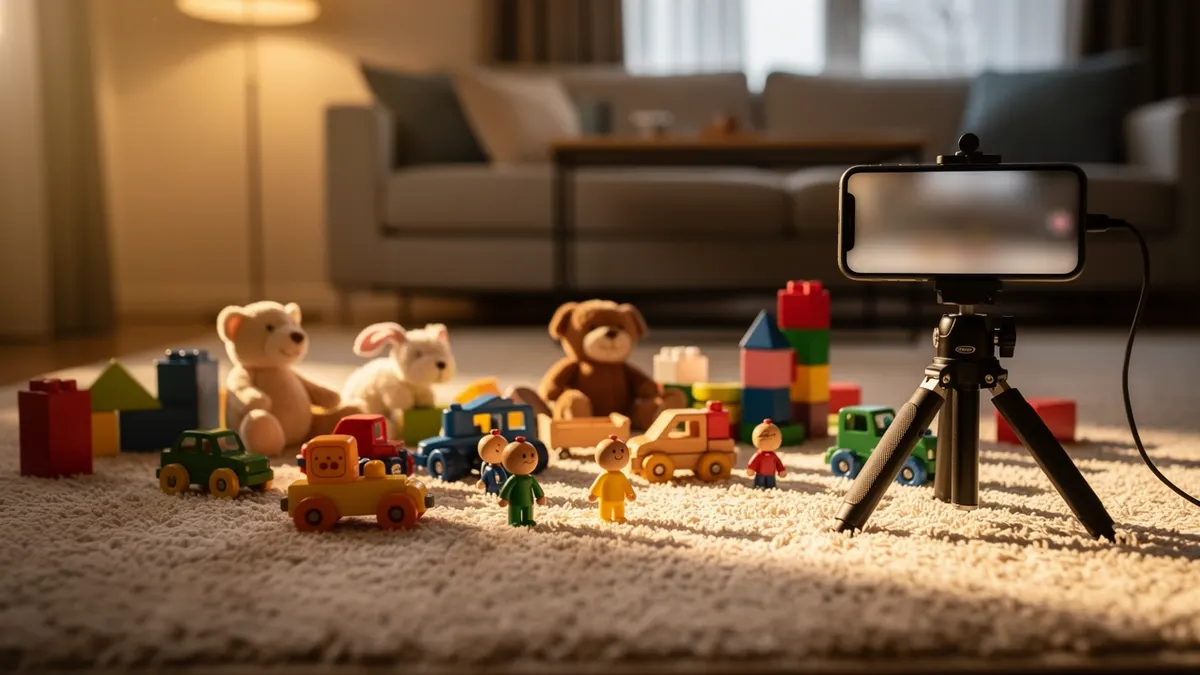
The piece about play shows the object in action, from the point of view of the hands, with no sales talk.
Mixing the two produces a video that speaks to nobody: too commercial for one, too childish for the other.
What a creator must never say
Advertising aimed at minors is regulated, and the framework covers form as much as substance.
Three prohibitions that recur everywhere: direct incitement to buy addressed to the child, the promise of popularity or superiority linked to owning the object, and showing a toy used in a way that contradicts its manual or its age range.
The applicable rules, the identification of the advertising nature, the mandatory statements and the conditions for filming a minor depend on your situation and are checked with a lawyer, before the shoot. Add the written authorisation of the legal representatives for any minor appearing on screen, obtained before the take and not after.
Durability is the adult's argument
It is what the category shows least and what the buyer looks for most.
Three sequences are enough: the object after a month of use, the real storage, and what happens when a piece is lost or breaks.
The last is the most useful. A toy whose part can be bought again, or which keeps working incomplete, reassures immediately.
Add the question of noise and space, which decides many purchases in a flat.
What the rules impose when a child appears
| Point | What is needed | Otherwise |
|---|---|---|
| Permission | Written consent from both parents | No release at all |
| Timing | Outside school hours, short duration | A shoot that unravels |
| Wording | No direct call to the child to buy | A rejected ad |
What is filmed without showing a face
The hands opening the box, the game in progress seen from above, the tidying up at the end: the toy is the subject, not the child.
What is said on camera
The age shown on the box, the number of pieces, whether batteries are needed, and nothing about an educational benefit, to be confirmed with a lawyer.
The category's calendar
It holds in two dates and one rule.
The mid-year peak, at the time of the festival devoted to children, and the end-of-year peak, described in the box.
The rule: campaigns are shot at least two months ahead, which means filming the second while the first is still running. Brands ordering three weeks before the date get what is left, not what they wanted.