A UGC creator's media kit looks nothing like an influencer's. It carries no audience, no impressions, no community chart. It carries the only thing a brand needs in order to decide: what you film, what it looks like, and what it costs.
From Argentina it also has to answer three questions a local client never asks.
The three lines specific to an Argentine creator
A good share of your potential clients are not in Argentina. They are in Mexico, Colombia, Spain, sometimes further. For them your profile raises three unknowns that have to be cleared immediately, otherwise the conversation never happens.
Which language you deliver in. Say whether you shoot in rioplatense, in neutral Spanish, in English, and whether neutral comes at no extra cost. It is the line that opens or closes the most markets.
How you get paid. One line does it: the currency you invoice in and the payment methods you accept. A foreign client who has to guess this postpones the decision, and later never comes.
When you are reachable. Time zone, and a response window. A Spanish brand that discovers on the third follow-up that your working days only half overlap takes you off the shortlist.
One page
Past one page it does not get read. The brand opens the file on a phone between two meetings and decides in twenty seconds. Anything that does not help that decision is dead weight.
What goes in it
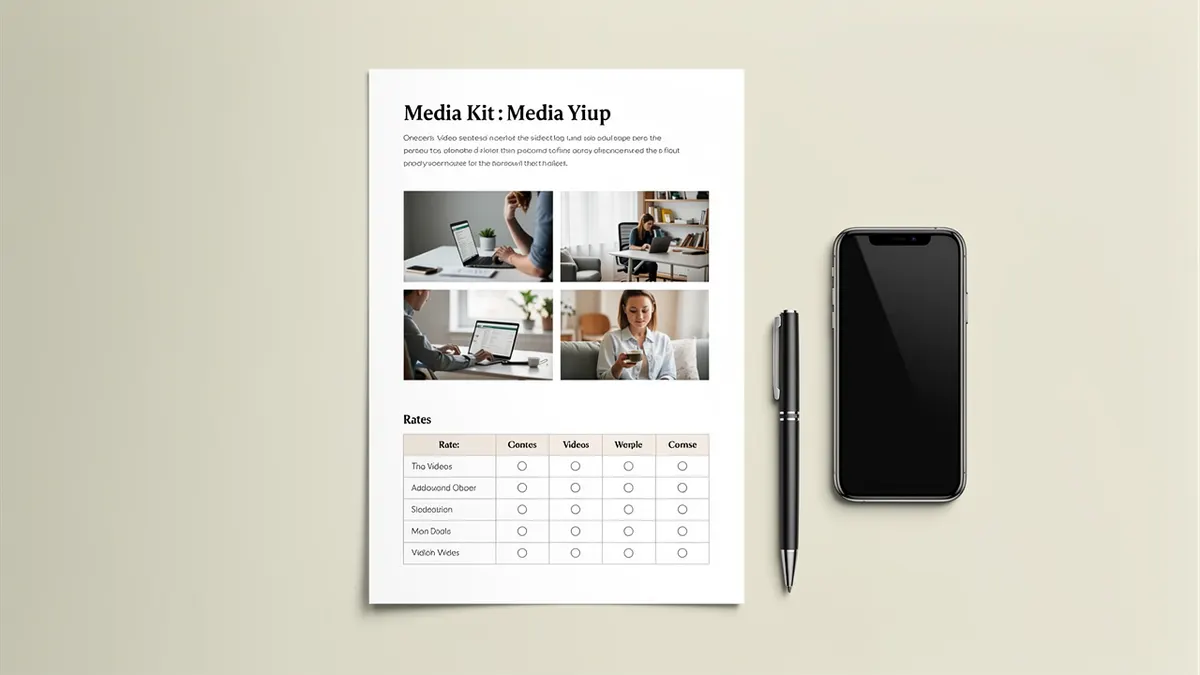
- Your name and one positioning line. "UGC creator, beauty and skincare, Buenos Aires, delivery in neutral or rioplatense." Not "passionate about content".
- Your niches, two or three, never ten. Specialisation sells better than range.
- Your languages and registers, as above.
- Four stills from your best pieces, each with a direct link to the video.
- What you deliver: formats, lengths, number of hooks per piece, subtitles included or not.
- Your usual turnaround. A delivery stated in working days beats any adjective.
- Your rates, with numbers.
Why showing prices speeds everything up
The classic objection is that a published price removes room to negotiate. In practice the opposite happens: it screens out those with no budget and makes those who have one write to you.
From Argentina, publishing does something creators elsewhere never have to think about: it saves you rebuilding the grid every couple of months. State the price in whatever currency you use as a reference and add one sentence on how it converts at invoicing time. The grid stays valid, only the conversion moves.
What to take out
Follower counts. Analytics from your personal account. Sentences about your passion. Holiday photos. And any overloaded template where the text fights the design.
The practical format
A portable document, plus a link to a folder holding the videos. The link matters more than the file: nobody hires off screenshots.
If you have a profile on a UGC marketplace, that link can replace the whole kit, since it already shows niches, languages, rates and pieces in one place, and it stays current without you thinking about it.
How often a media kit gets updated
Six occasions that force a change.
A new sample better than the oldest one.
A price increase.
A new language on offer.
A new type of product you have filmed.
A change of city or coverage radius.
And a link that no longer works.
What goes on each page
| Page | What you put on it | What you leave out |
|---|---|---|
| First | Name, city, languages, two samples | A biography |
| Second | Categories filmed, formats delivered | A list of software |
| Third | Price range, lead time, rights | A rate with no scope |
What gets updated
The best sample, the price range, a language added, the date of the update.
What gets checked before sending
That the link opens on a phone, that nothing is heavier than it needs to be, and that the file name carries yours.
Update it every three months
Drop an old piece, add a recent one, raise the price when the portfolio justifies it. A media kit unchanged for a year mostly says the creator has not changed either.