Three pieces are enough to start applying. What decides is not their beauty, it is what they prove to someone who can check nothing.
Because the client is often elsewhere. They will not meet you, will not visit your flat, and will never know whether the video they are watching took an hour or three days.
What worries them is therefore not your talent. It is improvisation.
The piece nobody puts in their portfolio
A video shot in accordance with a demanding brief, presented next to the brief itself.
Invent it: three compulsory shots, an imposed length, a sentence to say word for word, an element forbidden on screen. Then shoot the piece and display both together.
That proves in ten seconds what no successful edit proves: that you can execute, not only create. For a client who can control nothing remotely, it is the most reassuring information there is.
The other two pieces
The single-take demonstration. A product used from start to finish, without a cut. Continuity proves it actually works, which an edit never will.
Speaking to camera. Thirty seconds, your voice, with no music to fill the gaps. It is the piece that decides whether you will ever be trusted with a testimonial, and the one most people avoid.
The language question
A significant share of demand comes from outside. One of your three pieces should exist in a second language, filmed by you, not dubbed.
It is not a matter of a perfect accent: it is proof of capability. The client selling in English needs to know you can do it, and they will not guess.
What to show around the videos
How you deliver: clean file name, stated format, version without burnt-in text. Say it in one line beside the link.
Your usual lead time in working days, counted from receipt of the product and not from the order.
Those two pieces of information are worth a fourth video. They answer what the client actually wonders after watching.
How to shoot them in one afternoon
Three products you already own, a single setting per piece, one written sentence per video.
Three takes per shot, the first two deleted without being watched. That rule removes the stakes from the first sentence, the only difficult moment.
Ten seconds of headphone listening before each real take. Sound decides more often than image.
What a sample must contain
| Part | What it proves | Length |
|---|---|---|
| First three seconds | That you can hook | 3 s |
| Middle | That the product works | 15 s |
| End | That you can close | 5 s |
What can be filmed with what you already own
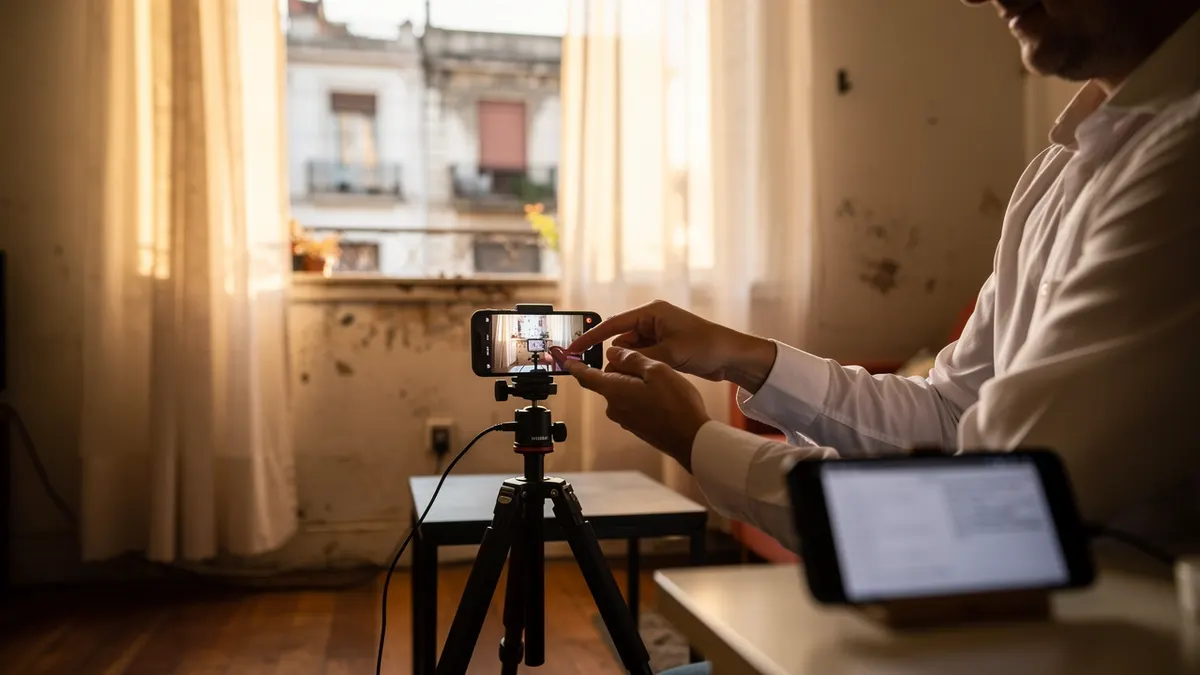
A product from the cupboard, a window, a plain wall: the first sample does not wait for an order.
What disqualifies a sample
An uncredited but recognisable brand, protected music, burnt-in text unreadable on a phone.
Three recurring formats, and what they prove
| The format | What it demonstrates | Its useful length |
|---|---|---|
| The unboxing | The real condition on arrival | 15 to 20 seconds |
| The demonstration | The gesture and the result | 20 to 30 seconds |
| The testimonial | Trust and tone | 20 to 40 seconds |
What separates a good example from a pretty video
Answering an objection. A pleasant video that removes no doubt does not sell, whereas a shot showing the real size or an acknowledged flaw settles the question that was blocking the purchase.
What to look at in an example before drawing on it
The distribution context. The same video does not have the same value on a product page and in paid advertising, and copying a format without knowing where it served often leads to a disappointing result.
What disqualifies a portfolio
A link asking for access permission. Nobody will request it.
Pieces more than a year old. They say you stopped, even if that is false.
And ten videos instead of three. A busy client opens the first, and if it does not match their category, they close without seeing the other nine. Sort by field, not by date.
Sources
Checked on 4 September 2026. Thresholds and rates change: where this guide and the official source disagree, the official source is right.