What to put on a page, what to remove, and why stating your languages converts abroad.
The distant client's doubt is not artistic, it is logistical
Four worries, in the order they arise.
Will the product arrive, in how long, and who pays the import charges and taxes.
Will the person reply within a useful time.
Will the files be usable as they are, the point dealt with above.
And will the invoice be acceptable to a foreign accounts department.
One direct consequence: a media kit answering those four points beats a prettier media kit handling none of them.
What the first page must contain
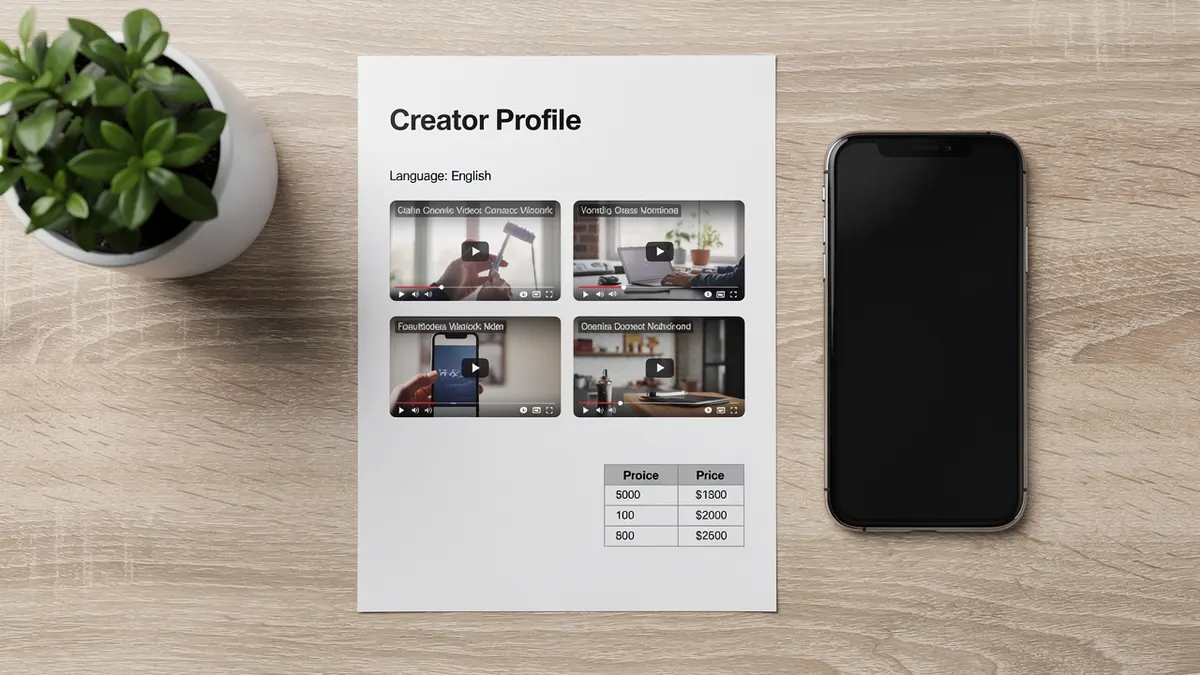
Seven elements, and nothing more.
The name, the city and the country.
The category and the formats produced.
Three examples visible without an account or a sign-up.
The usual turnaround, in working days.
A price range, even a wide one.
The languages spoken, with the real level and the accent, information worth one line and which often decides the order.
And the link to the delivery folder.
What to say about remote work
Five clarifications that remove five rounds of messages.
How you receive products, with the delivery address and what happens if something is held at customs.
Who bears the import charges and taxes, a point that must be written in black and white.
The number of revisions included.
The file transfer method and how long the files stay available.
And the payment method accepted, with the currency.
One precaution: customs and tax arrangements vary with the value and nature of the product, and are checked with the competent authority or with an accountant before announcing anything.
What reassures without being seen
Four discreet but decisive signals.
A stable professional address and a means of contact not depending on a social network.
A registered business number, which makes the invoice acceptable.
Dated examples, showing continuous activity rather than an old peak.
And a sentence stating what you do not do, which signals somebody who knows their trade.
What to remove
Five elements that weaken a media kit.
Audience figures put forward, which move the conversation towards another trade.
Vague mentions of the "passionate about storytelling" kind, which say nothing.
Logos of brands you have not worked with directly.
Personal presentation pages that delay the useful information.
And anything requiring a heavy file to be downloaded to read three lines.
What a one-page kit contains
| Block | What it gives | Length |
|---|---|---|
| The identity | Name, city, languages, formats | Two lines |
| The samples | Three links to videos | Three lines |
| The terms | Starting rate, lead time, revisions | Four lines |
What replaces audience statistics
The number of videos delivered, the on-time rate, and the type of brands already served. A creator producing for brands sells a service, not a reach.
What is updated before each send
The rate, the availability and the sample closest to the target client. A generic kit sent as is reads like a mass mailing.
The format and its upkeep
Four practical rules.
A web page reachable by link, lighter and easier to update than a document.
A backup document in a universal format, for companies that archive.
An update every three months, changing the examples first.
And an English version, indispensable for North American and European clients.
One last marker: a media kit is not there to convince, it is there to remove the reasons for saying no. Every doubt lifted on that page is one exchange fewer, and it is that gap that makes a brand choose a distant creator over one from its own country.