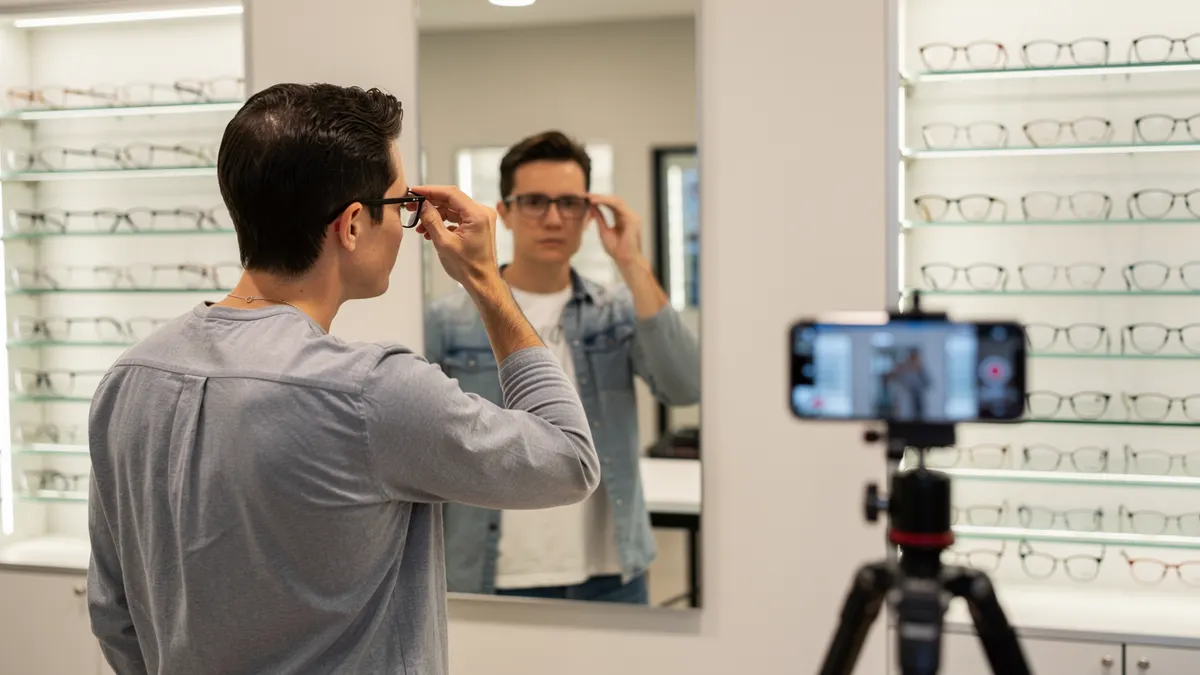
Glasses are bought with a face, not with a spec sheet. Here is what the video has to show and what it must never promise.
Several faces, never one
Three reasons, all commercial.
A single face informs about the frame, not about its effect: the buyer can deduce nothing for themselves.
Three faces turn the video into a decision tool, not an advertisement.
And assumed diversity widens the audience: the country is vast, face shapes and complexions vary, and a campaign shot on a single type of face shows.
One practical consequence for the shoot: keep the same framing for all three. The comparison is only readable if nothing else changes.
Showing the real size
Four shots settle most of the returns.
The frame held in a hand, next to an everyday object.
The width of the face at temple height, straight on, with no forced smile.
The profile, showing the length of the arms and the position behind the ear.
And wearing it in movement: walking, leaning over, pushing the glasses back up. That shot answers the real question, whether they stay put.
Add the measurements said out loud and shown on screen. A frame is chosen on three figures, and the buyer looks for them.
What cannot be promised
That is the most sensitive part, and the rule is simple: the video shows, it does not diagnose.
Four practical prohibitions, to have approved with a lawyer before the shoot.
No promise of improved sight, correction, eye rest or medical protection.
No claim about a health problem, even phrased as a personal experience.
No comparison with a medical device or a treatment.
And no advice that would replace an examination: the referral to a professional has to be explicit.
One casting consequence: if a person practising a health profession appears, they come under their own professional rules, in addition to yours, and that is checked before filming.
Virtual try-on has to be explained
Three points, and they raise conversion as much as they cut returns.
Show how the try-on is launched, by filming the screen: half of buyers do not know the feature exists.
Say what it approximates: position and proportion, not the exact colour or the felt weight.
And show the limit honestly: a virtual try-on does not replace the feel on the nose and behind the ears.
A video stating the limit is more effective than a video hiding it, because a buyer disappointed on arrival returns the product and does not come back.
What the camera must make visible
| Element | The shot | The difficulty |
|---|---|---|
| The frame on the face | Front, then profile | The reflection in the lens |
| Weight and hold | A head movement | A shot that is too short |
| The finish | A hinge in close-up | The focus |
What kills the reflection
A broad source placed behind the camera, never in front of the subject, and a slight tilt of the head. A lens mirroring the window ruins the take.
What belongs to the health professional
Any correction, any advice about eyesight and any claim about eye protection. Refer to the professional and say so on camera, to be confirmed with a lawyer.
The frame and the prescription are two sales
Three differences to handle separately.
The frame is bought on appearance and comfort: that is the ground of creator video.
The lenses are bought on a prescription, with technical options poorly understood in a short video: coating, index, filter.
And the final fitting is a professional's work: they are the ones adjusting it, and saying so strengthens credibility instead of weakening it.
One arrangement that works: a short video for the frame, a separate explanatory video for the ordering process with a prescription. Mixing the two produces a long video nobody finishes.
One last marker, valid for the whole category: the best indicator is not the view count, it is the return rate per reference. A frame whose video honestly shows the size comes back less often, and that is where the margin sits.