Glasses sell on two things a studio photograph does not show: how they look on a real face, and the quality of the service that comes with them.
Who buys this content
Three families, with different needs.
Chains and retail groups, which buy volume: try-ons, new arrivals, seasonal operations.
Independent opticians, who buy proximity: their shop, their team, their neighbourhood. That is the most regular and least served client.
And frame brands, which sell through resellers and lack content showing their products worn.
That third family is the most interesting for a creator: it needs images usable by all its points of sale.
What to film
Five sequences, in order of usefulness.
Wearing them on several different faces. That is the only information the audience really wants: what this frame looks like on a face shape resembling theirs.
The three-quarter and the profile, almost always absent from brand visuals, even though that is the angle from which thickness and fit are judged.
The material detail: the hinge, the arm, the weight in the hand, the finish.
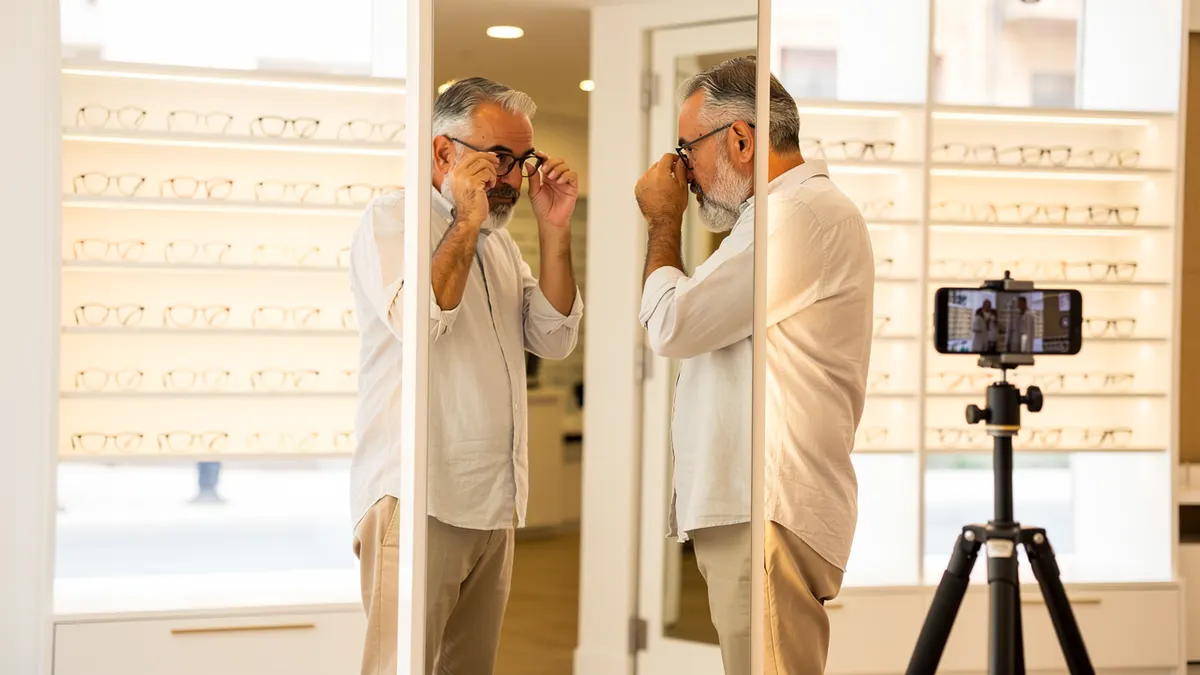
The in-store sequence: the welcome, the measurement, the adjustment, the handover. That is what sells an independent optician.
And the aftercare: the adjustment redone free of charge, the small repair, the check-up appointment. The least filmed and most decisive part.
What ruins a video in this category
Three technical faults, all avoidable.
The reflection in the lens, showing the room, the window or the operator. It is corrected by moving the light source or tilting the head very slightly, not in the edit.
Framing that is too tight, preventing any judgement of the proportion between frame and face.
And speeding up the try-on, which removes exactly the time the viewer needs to picture themselves.
Practical notes for the brand
Four points that improve the result.
Send several models, not one. Comparison is what makes the video.
Give the exact reference, to be displayed legibly, because models look alike and the person will have to ask for it in store.
Supply the list of authorised claims, with their wording, as described in the box.
And accept showing the price or not showing it, but decide beforehand: a filmed price dates the video, a hidden price drives part of the audience away.
What matters when glasses are on camera
Six points that stand in for a fitting.
The width of the frame against the face.
How it sits on the nose after two minutes.
The reflection in the lenses in daylight.
The weight, visible in the movement.
The frame colour with no cast.
And the view from the side, not only head on.
What the camera must make visible
| Element | The shot | The difficulty |
|---|---|---|
| The frame on the face | Front, then profile | The reflection in the lens |
| Weight and hold | A head movement | A shot that is too short |
| The finish | A hinge in close-up | The focus |
What kills the reflection
A broad source placed behind the camera, never in front of the subject, and a slight tilt of the head. A lens mirroring the window ruins the take.
What belongs to the health professional
Any correction, any advice about eyesight and any claim about eye protection. Refer to the optician and say so on camera, to be confirmed with a professional.
The Spanish calendar
It is more marked than elsewhere, for two reasons.
The sun, which keeps the sunglasses category active far longer than in other markets, and shifts the buying peaks.
And the start of the school year, which concentrates eye tests and prescription renewals for families.
The consequence is simple: spring campaigns are shot in winter, under a light that does not resemble that of the broadcast. So film in a bright, neutral place, or accept shooting twice a year.