Gear that fails outdoors ends in a return and a bad review. Why these brands need creators who really practise.
What the buyer is trying to check
Five points, in this order.
How it holds up over time, dealt with above.
The real fit: what a loaded pack does, a shoe after three hours, a jacket over several layers.
Behaviour in local conditions: heat, dust, rock, not only rain and cold.
The real weight and bulk, to be compared with a known object.
And repairability: what can be replaced, what can be resewn, what writes the product off.
Heat is the constraint, not cold
Four consequences for the content.
The question asked here concerns breathability, sun protection and water, not thermal insulation.
Practice hours are shifted: very early in the morning or at the end of the day, which changes the available light.
Fabrics behave differently in strong heat, and that has to be visible in the image.
And safety takes another form: water reserve, shade, telling somebody your route.
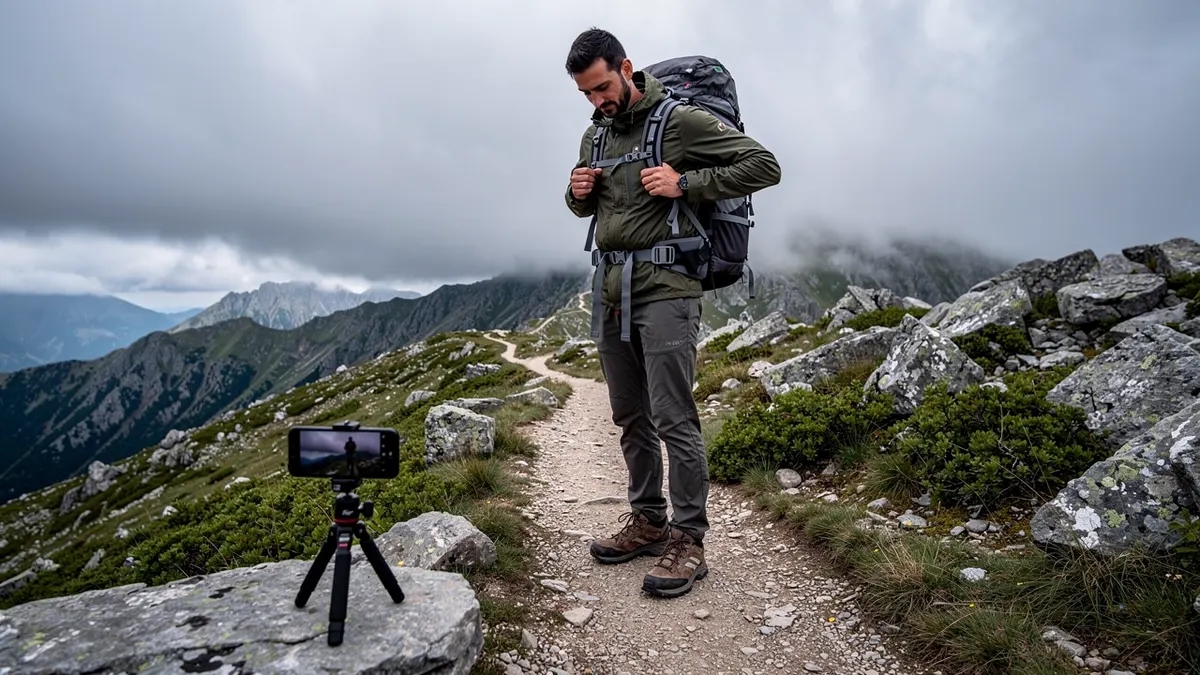
One shooting consequence: mountain content is filmed over two days within the same outing, not in one take, because heat and light change everything between six in the morning and midday.
The two audiences
Two profiles, two distinct contents.
The regular practitioner, who wants technical detail, figures and limits. They buy expensive and rarely.
The beginner, who wants to know where to start, what is really necessary and what is not. They buy often and progressively.
One frequent mistake: producing a single content for both. The first finds it hollow, the second understands none of it.
The calendar
Four periods, four needs.
Spring, the moment for buying gear for the season.
Summer, when practice moves to altitude and the subject becomes heat.
Autumn, the best shooting period, with stable conditions and long light.
And winter, which concerns a different practice and a narrower audience.
The creator must practise
Four reasons, all verifiable by the audience.
Technical gestures cannot be imitated, and a handling error destroys credibility in a second.
The vocabulary is specific, and using it wrongly is noticed immediately.
The comments will ask precise questions that have to be answered.
And the terrain chosen must match the product's real use, which supposes knowing where to go.
One casting consequence: in this category, competence largely outweighs audience. A creator with few followers but a real practice sells better than a followed profile discovering the gear in front of the camera.
What is filmed on an outing
| Shot | What it proves | Where to take it |
|---|---|---|
| The departure | The preparation and the gear | At the meeting point |
| The effort | Real use in real conditions | Halfway |
| The arrival | Recovery and how it felt | At the end, unedited |
What is secured above all
A passable location, a companion, and the site manager's consent where access is regulated. Filming alone on isolated terrain is never a production choice.
What is not turned into a claim
A performance, a time, a distance or a stated resistance. Those figures are checked with the manufacturer, and the video shows what it shows, without extrapolating.
What this sector orders
| The buyer | Their typical order | Their season |
|---|---|---|
| A technical clothing brand | Use in real conditions | Depending on the discipline |
| An equipment maker | Assembly and handling | All year |
| A rental firm or guide | The departure and the supervision | The high season |
What makes an outdoor video credible
Difficult conditions. A jacket filmed in the rain proves what a studio never will, and that is exactly what the brand cannot obtain any other way.
What to prepare before setting out to film
Battery life, cold and the return. Batteries kept warm, protected kit, a known route and a stated return time: these points are as much about safety as filming, and they are settled before leaving.
What cannot be promised
Five statements to set aside.
Any promise of safety, ground where liability is heavy.
Any performance figure presented as guaranteed.
Any route recommendation without mentioning conditions and the level required.
Any unproven environmental claim, governed by strict rules.
And any comparison with a competing product not resting on a documented test.
One general precaution: the applicable disclosures and the limits of what may be asserted are checked with a lawyer before the shoot, particularly for safety equipment.
One last marker: in this category the best video is not the one with the finest landscape, it is the one showing the object damaged and explaining why that does not matter, or why it does.