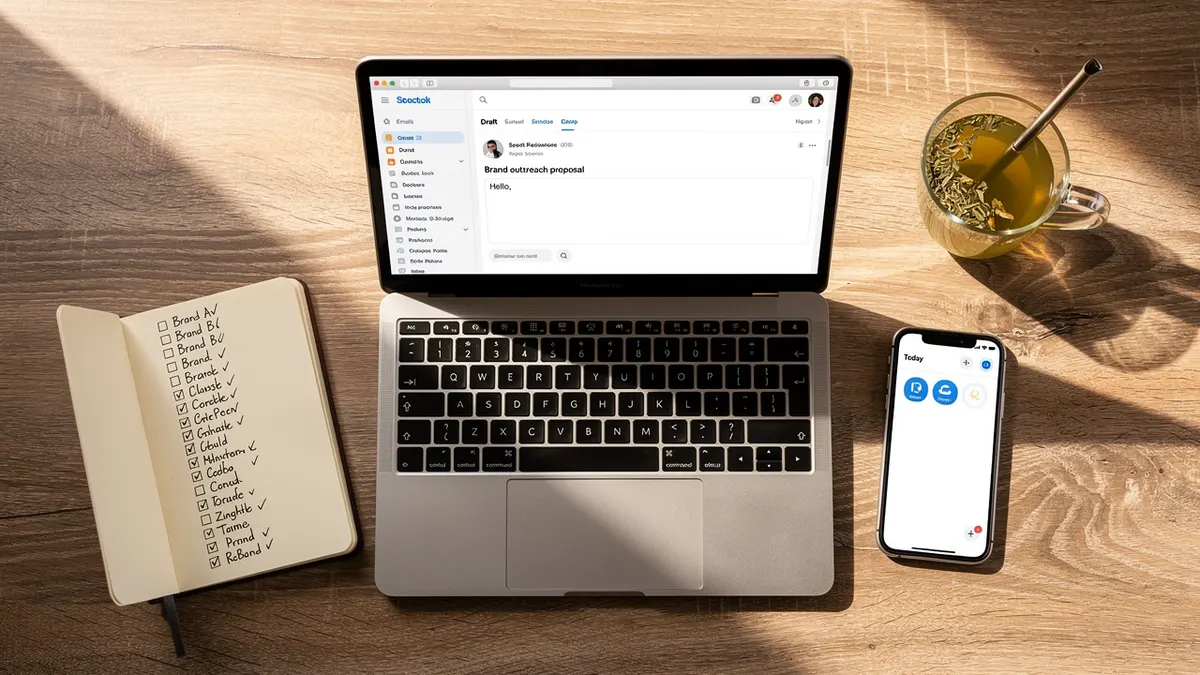
Prospecting is the skill that separates a creator who waits from a creator who works. There is nothing mysterious about it: a list, a message, and regularity.
In Argentina it has one particularity that changes everything: you prospect on two channels, and they are not the same conversations.
Two channels, two prospections
With a local brand, instant messaging is the default professional channel. A shop replies on the same number displayed in its window, the conversation is short, the tone direct, and a decision can be made within the hour.
With a foreign brand, email remains the norm. The pace is slower, the first message is read by someone who receives many approaches, and nothing is decided before your work has been seen.
Both demand the same seriousness but not the same writing.
On messaging, get to the point in the first line, with no opening formula. Nobody reads a paragraph of introduction on a chat screen. One sentence on what you noticed about them, one on what you are offering, a link, and a closed question that can be answered with a yes or a date.
By email, structure it: a subject line that says what this is about, four lines at most, two linked examples, and a signature carrying your delivery languages. That last detail puts you ahead of many other applications.
Who to write to, in order
Small online retail brands, which burn through content fast and buy again. Neighbourhood shops, where the owner replies. Gyms, studios and salons, which buy all year. Businesses that have just launched, which pay less but hand you portfolio.
And, as soon as you have something to show, foreign brands looking for Latin American Spanish. Those justify learning email.
What to have before sending anything
Six showable pieces, a decided price, and a link that loads fast on a phone. Without all three, every message ends at the first reply, because the next question is always the same one.
The rhythm that produces results
Prospecting almost always fails for the same reason: it happens in waves, stops as soon as a client arrives, and restarts from zero when the work ends.
Twenty messages a week, every week, beats a hundred messages one month and nothing for two. It is not a question of volume, it is that replies arrive with a delay: this week's come from what you sent last month.
Keep a simple list with the date of the first message, the date of the follow-up, and the reply. One follow-up only, seven to ten days later, worded without reproach. A significant share of positive answers arrives on that second message.
What makes a message fail
The visible copy-paste, which a recipient spots in the first line. Open flattery, which announces a request. The heavy attachment, never opened. The absence of examples, which makes the rest pointless. And the missing price, which forces one more exchange before anyone knows whether the conversation has a point.
What each channel gives
| Channel | Observed reply rate | What it requires |
|---|---|---|
| Direct message on the brand's account | Low but fast | A sample that matches the product |
| Email to the recruitment contact | Medium | A precise subject line, no attachment |
| Referral from a client | The highest | Having delivered once without a hitch |
What gets prepared once
The message template, the list of ten brands, the link to two samples, the price range.
What gets redone every week
Ten sends, five follow-ups at ten days, and updating the answer table.
And meanwhile, let what does not sleep do its work
Prospecting has gaps: busy weeks, shoots, holidays. A public profile showing your fields, your languages and your rates keeps receiving enquiries while you are writing to nobody, and it gets you found by brands you would not have thought of.
It complements prospecting, it does not replace it. Together they give a flow; either one alone gives fits and starts.
Sources
Checked on 4 September 2026. Thresholds and rates change: where this guide and the official source disagree, the official source is right.