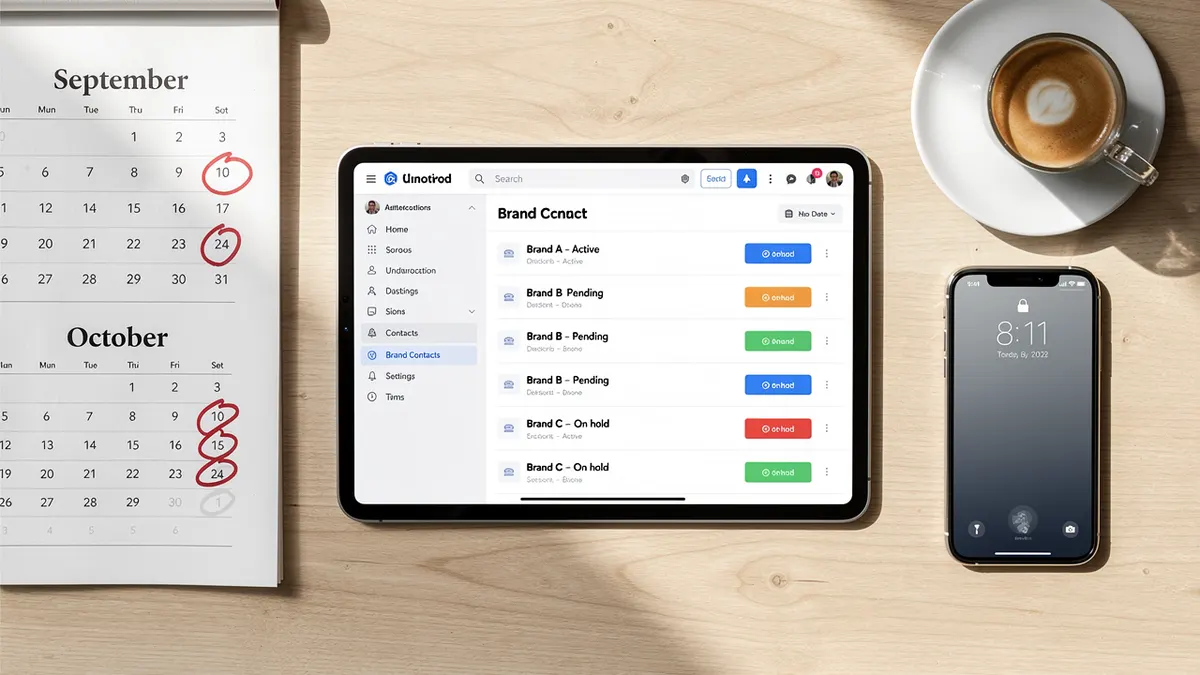
Prospecting is not a matter of talent: it is a matter of list, message and regularity. All three are corrected separately.
Where to find brands in Spain
Five sources, in decreasing yield.
The ads served to you
A brand paying for advertising has a budget and a need for creative. Note the ones that keep coming back: their video is often mediocre, and they know it.
Marketplaces
Sellers managing their own listings need video to convert, and they look at no follower count.
Search by keyword and by place
It gives the small local brands, the ones appearing nowhere else.
Trade fairs
The programme and the exhibitor list are public, often months in advance. It is a qualified, free list that nobody uses.
Small agencies
They subcontract regularly, and one contact can produce several jobs a year.
What a message that gets answered looks like
Four lines, not one more.
A precise element observed at their end, named.
A concrete idea, with format and length.
The price and the lead time.
Two examples, chosen in their category.
No personal introduction, no general compliment, no anticipated thanks.
Through which channel
The channel counts as much as the text.
For a small brand, the account's messaging works better than email, because the person managing the account is often the one who decides.
For a more structured company, email is necessary, addressed to a named person rather than a generic address.
For an agency, a professional message with a link to two examples is enough.
The realistic volume
The figure to follow is not the number of messages, it is the reply rate per ten.
Below one reply in ten, change one thing at a time: first the opening line, then the examples, then the target.
A pace sustainable over time: ten messages per working day, five days a week, with the follow-ups planned in the same file.
The months that count
The local calendar decides effectiveness.
September and January are the two best periods: budgets are decided, teams come back, and campaigns are prepared.
August is the worst month for getting a reply, and the best for preparing your list and shooting your examples.
And the period before the big autumn commercial deadlines is when a brand is actively looking for creative.
The most costly mistake
Sending the same message to everybody.
A generic message is spotted in a second, and it burns the target: the same company contacted again three months later will remember the first message.
Personalise the first line, keep the rest identical. That is thirty seconds per message, and it multiplies the reply rate.
Three sources, three efforts
| Source | What you find there | Time per week |
|---|---|---|
| The ads on your own feed | Brands with an active budget | Thirty minutes |
| Platform catalogues | Needs already written down | One hour |
| Shops in a neighbourhood | An unstated need | A walk |
What is tracked in a simple table
The brand, the date sent, the reply, the follow-up date, the outcome. Five columns that show within a month which source deserves more time.
What you change when nothing answers
The sample you lead with, never the number of messages. Sending thirty messages with the same weak clip produces no more replies than ten.
Passive prospecting, in parallel
Three actions, done once, which then work on their own.
A profile saying what you do, for whom, with two examples and a way to reach you.
A presence in the places where brands look for creators.
And a fast reply: in this line of work, the person who answers within the hour gets the job, often before the question of price even comes up.