Unboxing as a UGC format, how Brazilian creators do it well, and what brands are looking for.
Why unboxing works so well in Brazil
Five reasons specific to the Brazilian market.
Online buying became widespread recently, and doubt about what really arrives is still very present.
Marketplaces mix sellers and qualities, which makes visual proof decisive.
Delivery times and costs are a permanent subject, dealt with above.
The format is consumed in a vertical feed, the country's main video use.
And price remains the first criterion: seeing the real object before buying avoids a costly and slow return.
What makes a good UGC unboxing video
Six elements, in the order in which they count for a brand.
The delivery information, said early, dealt with above.
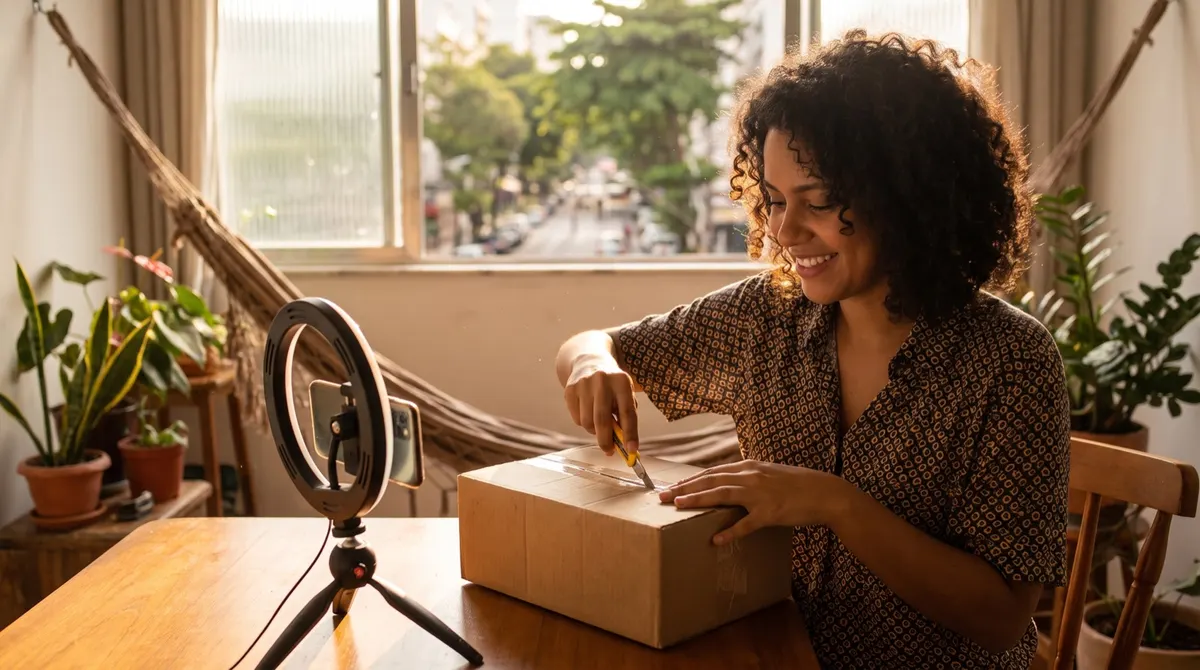
The real opening, in one take, with the sound.
The scale of the product, shown in the hand or next to a known object.
The first opinion, short, with no superlative, given before having used the product.
One sentence on what is not perfect, which lends credibility to all the rest.
And an open ending, announcing what comes next: trial, assembly, use.
Shooting tips to raise the quality
Six settings that make the difference without equipment.
Filming near a window, late morning or late afternoon, never in vertical full sun.
Setting the parcel on a plain matt surface that does not bounce light.
Switching off the fan and the air conditioning for the take: their noise covers the sound of the cardboard.
Holding the phone with two hands or resting it, because a shaky close-up is unusable.
Filming one complete vertical take, then a few separate close shots.
And checking the frame before opening, because you only open once.
What Brazilian brands really expect
Five expectations, often implicit in the brief.
Natural Brazilian Portuguese, with the regional accent embraced when the campaign targets a region.
A setting resembling the home of the target audience, not a studio.
Files delivered in the right format and correctly named, ready for advertising.
A deadline kept, counted from receipt of the parcel and not from the order.
And two or three opening variants, because the brand will test several versions.
The common mistakes to avoid
Six mistakes that get a delivery refused.
Opening the parcel before filming, which produces an acted reaction.
Adding music that covers the sound of the cardboard and the product.
Filming horizontally when the distribution is vertical.
Showing a competitor's name, an address or a readable order number on screen.
Promising a result the product has not yet given.
And forgetting the identification of commissioned content, an obligation whose arrangements are checked with the competent authority.
What this format sells, product by product
| The product | What the opening proves | What to get right |
|---|---|---|
| A fragile object | Its state on arrival | The padding and the box |
| A cosmetic | The real quantity | The container's size in hand |
| A garment | The folding and the finish | The light on the fabric |
What matters more than the image
The sound. Cardboard, paper, a seal giving way: that is what creates the feeling of being there. Music laid over it erases the format's only argument.
What makes a shipment filmable
A parcel designed to be opened on camera: no impossible tape, no contents falling out, a visible insert. That logistical detail is half the success.
Turning unboxing into regular income
Five ways of turning an entry format into a regular flow.
Offering it in batches: three products from one brand shot in the same session.
Systematically pairing it with a second video, trial or demonstration, sold with it.
Varying it into short versions for advertising and long ones for the product page.
Offering it to marketplace sellers, who buy in volume and decide fast.
And keeping a list of the brands whose products arrive fast: those are the ones where your deadline will be reliable.
One last marker: in Brazil, unboxing is worth something not because it shows a product, but because it answers the question everybody asks before buying online, namely what will really arrive, in what state, and in how many days.